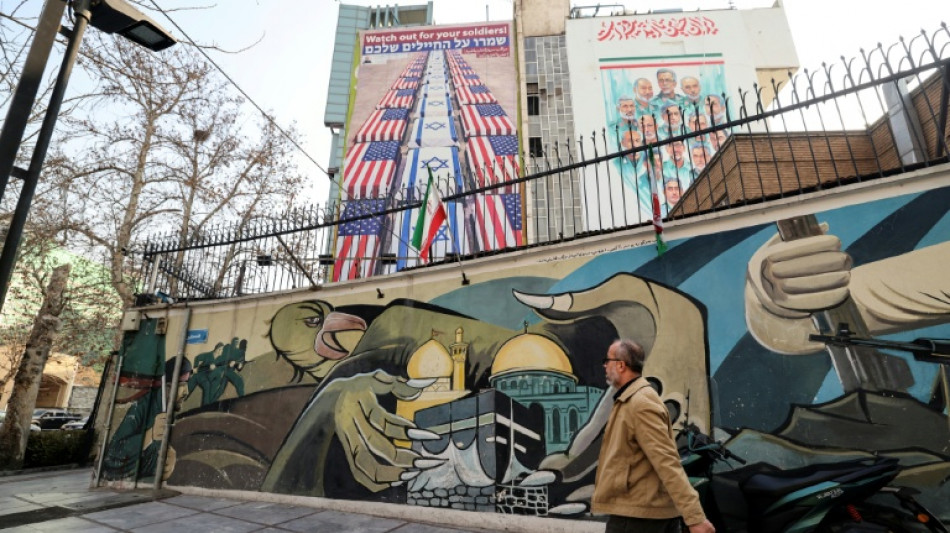
Trump expects Iran to seek deal to avoid US strikes / Photo: ATTA KENARE - AFP

 AI 'warning shots' focus Beijing on national security risks

 Philippine tribe in limbo over US-led tech hub
 Saudi-led coalition says Houthis fired ballistic missile at Riyadh
 Cuba works to restore power after another blackout
 Brigitte Bardot widower slams sale of star's belongings

 Indonesia accepts Malaysia's help to tackle wildfires
 Nvidia, OpenAI CEOs to attend Xi dinner at White House

 Cuba hit with seventh major blackout of the year

 Nigeria miners struggled to breathe in cell before 37 died: survivors

 Warren Buffett steps down as Berkshire Hathaway chairman

 Isolated Syrian-Druze city blames Damascus for shortages

 Kerry James Marshall: American 'blackness' painter celebrated in Europe

 Infantino 'must go', says German FA vice-president

 Japan's busiest rail station tests robot bins

 Backpackers fret over Australian visa crackdown

 Bank of Japan hikes rates to 31-year high to battle inflation

 AI doomsday warnings unlikely to slow IPOs but questions linger

 In Brazil's Amazon, the hunt for oil fuels hopes and fears

 Baby orangutans in India expose 'frightening' scale of trafficking

 Oversight Board blasts 'inadequate' Meta safeguards for AI deepfakes

 Harry makes first public appearance since return to UK

 Princess Diana's brother makes new explosive claims against Charles

 Trump admin overhauls key protection for endangered species

 Mbappe draws political fire over Ceuta t-shirt controversy

 Third malaria death in Germany from outbreak tied to Frankfurt airport

President Donald Trump predicted on Friday that Iran would seek to negotiate a deal rather than face American military action, despite Tehran warning that its arsenal of missiles would never be up for discussion.
"I can say this, they do want to make a deal," Trump told reporters in the Oval Office.
Asked if he had given Iran a deadline to enter talks on its nuclear and missile programs, Trump said "yeah, I have", but refused to say what it was.
"We have a large armada, flotilla, call it whatever you want, heading toward Iran right now," Trump said, referring to a US naval carrier group in waters off Iran.
"Hopefully we'll make a deal. If we do make a deal, that's good. If we don't make a deal, we'll see what happens."
Trump cited what he said was Iran's decision to halt the executions of protesters -- after a crackdown in which rights groups say more than 6,000 people were killed -- as evidence to show Tehran was ready to negotiate.
- 'Doing the right thing' -
Washington's allies in the region are concerned that any US strike on Iran could cause instability and economic chaos.
One senior Gulf official in touch with the Trump administration said that the United States was closely guarded on what it has planned.
"We hope that whatever happens, it is going to lead to stability. That outcome could be reached by the Iranians doing the right thing, and we hope that happens," the official said, speaking on condition of anonymity.
Meanwhile, the head of Iran's top security body -- secretary of the Supreme National Security Council Ali Larijani -- met Tehran's ally Russian President Vladimir Putin in Moscow.
No details of their talks emerged, but Moscow has offered to mediate between Washington and Tehran.
Iran's top diplomat said Friday that his country's missile and defence capabilities would "never" be on the negotiating table.
Foreign Minister Abbas Araghchi said Tehran was "ready to begin negotiations if they take place on an equal footing, based on mutual interests and mutual respect", during a visit to Turkey.
But, he emphasized "Iran's defensive and missile capabilities will never be subject to negotiation", adding that no plans were in place to meet with US officials about resuming talks.
The US news site Axios reported this week that Washington officials say any deal would have to include a cap on Iran's arsenal of long-range missiles, the removal of enriched uranium from the country and a ban on independent enrichment.
Serhan Afacan, director of IRAM, the Ankara-based Centre for Iranian Studies, told AFP that trying to link a nuclear deal with other issues would likely "be impossible".
"For now, the ballistic missile program remains a red line, as it sits at the core of Iran's defense architecture," he said.
- 'Reducing' tensions -
Iran has warned that it would respond instantly with missile strikes against US bases, ships and allies, notably Israel.
"We are not limiting the geography of confrontation to the sea alone and have prepared ourselves for broader and more advanced scenarios," the head of Iran's Defence Council, Ali Shamkhani, said Friday, according to the Tasnim news agency.
Turkish Foreign Minister Hakan Fidan said restarting talks between Tehran and Washington over Iran's nuclear program was "vital for reducing regional tensions."
Speaking at a joint news conference in Istanbul with Araghchi, he said Israel was pushing for the United States to attack Iran, and urged Washington to "not allow this to happen."
Iran has blamed the United States and Israel for the protests that erupted in late December over economic grievances and peaked on January 8 and 9, accusing the two countries of fueling a "terrorist operation" that turned peaceful demonstrations into "riots".
The US-based Human Rights Activists News Agency (HRANA) said it has confirmed 6,479 people killed in the demonstrations, including 6,092 protesters and 118 children, as internet restrictions imposed on January 8 continue to hinder access to information inside the country.
But rights groups warn the toll is likely far higher, with estimates in the tens of thousands.
Iranian authorities acknowledge that thousands were killed during the protests, giving a toll of more than 3,000 deaths, but say the majority were members of the security forces or bystanders killed by "rioters."
burs-sw/dc/bgs
A.Zimmermann--CPN