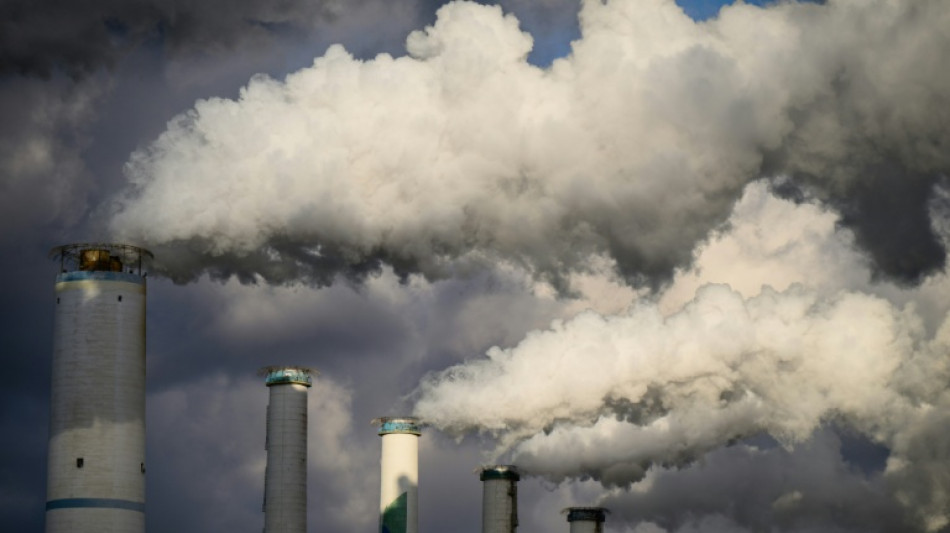
South Korea pledges to phase out coal plants at COP30 / Photo: ANTHONY WALLACE - AFP

 Asia stocks rise on AI, US-China trade talks optimism

 Multi-Asset Trading Venue Monochrome Exchange Announces IEO of Its Native Token, $MCR

 Data centre command hub keeps AI up and running

 Leo XIV, first US pope transcends his restrained style

 France's debt climbs to highest since 1978: ministry

 Thousands protest inaction over climate crisis in Switzerland

 UK actor Naomi Watts honoured at Spain film festival

 Trump signs bill authorizing sweeping Russia sanctions

 Anthropic picks Accenture for in-house AI safety evaluation

 Hushing and hedging: US companies retreat on climate

 Crisis-wracked Volkswagen warns of 10-bn-euro hit to profits

 Shakira to cap off world tour with Madrid 12-gig run

 Isolated Syrian-Druze city shortages

 UNESCO can be 'moderator' in AI debate: chief to AFP

 Russia seizes assets of Nestle, French firms

 Anthropic says AI systems moving towards building themselves

 Asian stocks boosted by falling oil, yen weakens after BoJ rate hike

 Afghan medical students in Pakistan hope court stops college expulsions

 Australia to detain tourists who overstay visa, minister says

 Asian stocks track Wall St rally as oil prices drop

 Prized Mexican relic returns on loan, two centuries on

 'In our lane': Fed's Warsh defies Trump but still fighting for credibility

 Trump admin makes major cut to endangered species protections

 GM delivers first components for US interceptor missiles

 Travis Scott and Keith Richards feature on GTA VI soundtrack

South Korea pledged Monday to phase out coal power plants that lack emission-reducing measures, an ambitious step for a country that generates a third of its electricity from the fossil fuel.
Seoul announced its decision to join the Powering Past Coal Alliance (PPCA) of governments and organisations pushing to eliminate unabated coal as a power source, as Brazil hosts UN climate talks in Belem.
"Our long-term goal is to create a decarbonised green society where renewable energy takes up a large share in our power mix and use nuclear power as a complementary source, phase out coal and use gas as an emergency source," South Korea's Climate Minister Kim Sung-whan told reporters in the Amazonian city.
The pledge does not give a date for an end to all of South Korea's use of unabated coal, but represents the first official government commitment to stop building new unabated coal plants and to phase out existing ones.
"We will kickstart our coal phase-out," Kim said, adding that the pledge will "help the Alliance advance the coal transition worldwide".
Unabated refers to coal burned without any measures to reduce its emissions, such as carbon capture and storage. Most coal-fired power plants do not capture their CO2 emissions.
"Out of 61 existing coal power plants, 40 coal power plants are confirmed to phase out by 2040," the PPCA said in a statement.
The remaining 21 plants will have their closure date "determined based on economic and environmental feasibility", with a detailed roadmap to be finalised in 2026, the group added.
Asia's fourth-largest economy currently operates the world's seventh-largest coal fleet and is the fourth-largest coal importer, according to the PPCA.
The pledge demonstrates South Korea's "commitment to accelerating a just and clean energy transition", Kim said.
The transition will "create thousands of jobs in the industries of the future", the minister added.
- 'Must go even further' -
South Korea has already begun cutting its dependence on coal, with its share of electricity generation falling to 30.5 percent last year from 46.3 percent in 2009, according to energy think tank Ember.
On a global level, renewable energy overtook coal generation for the first time on record in the first half of 2025, according to Ember.
The new commitment builds on Seoul's 2020 pledge to reach carbon neutrality by 2050.
As part of that target, the government aims to reduce greenhouse gas emissions by 53–61 percent from 2018 levels by 2035, in line with global efforts to limit warming to 1.5C.
"A few years ago it would have seemed inconceivable that South Korea would be committing to phase out coal generation," said Richard Black, Ember's director of policy and strategy.
"But what's already happening in Korea, with coal power down by a third since the Paris Agreement was signed ten years ago, makes it now a logical choice," Black said.
Dozens of countries worldwide have pledged to phase out unabated coal.
South Korea is only the second government in Asia to join the PPCA, after Singapore.
"In these critical years of climate action, we must go even further and faster," British climate minister Katie White, who co-chairs the PPCA, said in Belem.
"Emissions from coal have not yet peaked, and we must consider the barriers faced by the developing world and ensure everyone feels the benefits of phasing out coal," White said.
Ch.Lefebvre--CPN