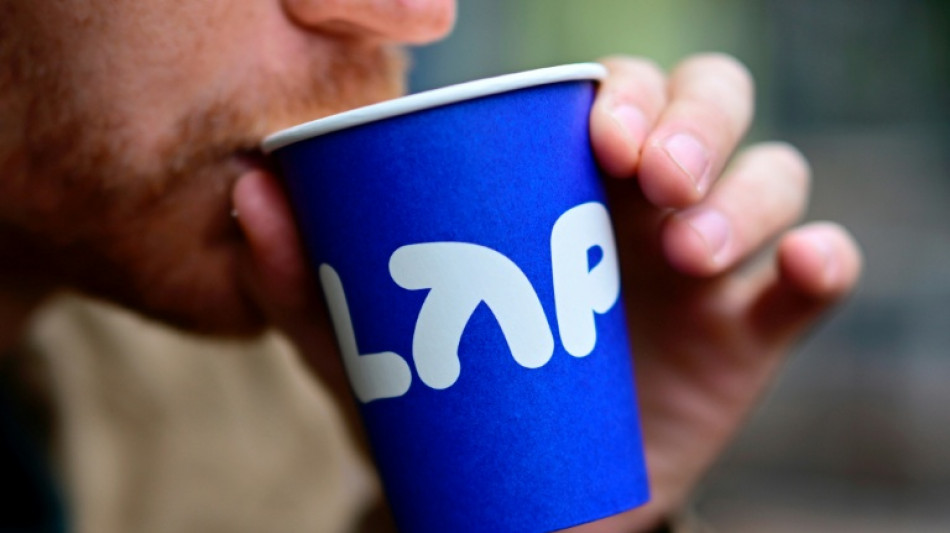
Budget coffee start-up leaves bitter taste in Berlin / Photo: Tobias SCHWARZ - AFP

 Asia stocks rise on AI, US-China trade talks optimism

 Multi-Asset Trading Venue Monochrome Exchange Announces IEO of Its Native Token, $MCR
 Data centre command hub keeps AI up and running

 Leo XIV, first US pope transcends his restrained style

 France's debt climbs to highest since 1978: ministry
 Thousands protest inaction over climate crisis in Switzerland
 UK actor Naomi Watts honoured at Spain film festival

 Trump signs bill authorizing sweeping Russia sanctions
 Anthropic picks Accenture for in-house AI safety evaluation
 Hushing and hedging: US companies retreat on climate

 Crisis-wracked Volkswagen warns of 10-bn-euro hit to profits

 Shakira to cap off world tour with Madrid 12-gig run

 Isolated Syrian-Druze city shortages

 UNESCO can be 'moderator' in AI debate: chief to AFP

 Russia seizes assets of Nestle, French firms

 Anthropic says AI systems moving towards building themselves

 Asian stocks boosted by falling oil, yen weakens after BoJ rate hike

 Afghan medical students in Pakistan hope court stops college expulsions

 Australia to detain tourists who overstay visa, minister says

 Asian stocks track Wall St rally as oil prices drop

 Prized Mexican relic returns on loan, two centuries on

 'In our lane': Fed's Warsh defies Trump but still fighting for credibility

 Trump admin makes major cut to endangered species protections

 GM delivers first components for US interceptor missiles

 Travis Scott and Keith Richards feature on GTA VI soundtrack

Instantly recognisable by their electric blue shop fronts, branches of LAP Coffee have become a common sight in Berlin's hippest neighbourhoods over the past two years.
With their no-frills interiors, minimalist service model and cappuccinos for just 2.50 euros ($2.90), the outlets have become popular haunts for Berliners on a budget.
But LAP, which stands for Life Among People, has also caused a backlash in the German capital from critics who say it is squeezing out local cafes, prompting protests and even vandalism.
Founded in Berlin in 2023 and backed by several heavyweight investors, LAP now has 16 outlets in the capital and eight more in Hamburg and Munich.
Inside its branches, seating is sparse -- the idea being to snap an Instagrammable selfie in front of the chic decor before taking your coffee away in one of LAP's signature electric blue cups.
Behind the counter, a staff member presses the logo of your chosen drink on a touch screen, the machine starts up and the coffee comes out -- no grinding or filtering required.
"It's very fast!" said Artur Kluge, a 22-year-old student, at one of LAP's branches in the trendy Berlin neighbourhood of Prenzlauer Berg.
He considers the quality of the caffeinated beverages to be "pretty good".
But in a country where the price of coffee has risen by 21.3 percent over the past year, he really comes to LAP because "two or three euros is definitely a good price".
- 'Fair, honest coffee' -
However, not all Berliners are so enamoured with the new chain. In October, several LAP shop fronts were sprayed with red paint.
Posters in the streets proclaim that the "aggressive" expansion of the chain is the "rotten cherry on top of a gentrification process that has already driven too many people and small businesses out of our neighbourhoods".
A few minutes' walk away, Umut Ekinci, owner of Auntie's Cafe, believes LAP is "changing the market".
In Prenzlauer Berg, a former East Berlin neighbourhood that has so far resisted the likes of McDonald's and Starbucks, there are already six branches.
"All they have to do is press a button, serve the coffee, say goodbye and that's it," Ekinci said.
"I think most people are happy with the prices. I completely understand that. But it's destroying the other small coffee businesses."
LAP co-founder Ralph Hage, who previously worked for Red Bull and investment bank Standard Chartered, told AFP the company is simply offering "fair prices and honest coffee to customers".
"We've seen very little innovation in coffee in the last 30 years. The lower prices are possible through efficiency and innovation on the preparation method," he said.
LAP is not some evil multinational corporation but a "local business" that is "generally very open to dialogue", he said.
- 'Changing the city' -
Mario, a 43-year-old social worker and anti-LAP activist who did not want to give his full name, does not agree.
He believes LAP is "changing the city" by "setting new standards for what is paid for commercial space" in the most sought-after residential areas.
"It's a chain that offers cheap coffee on the one hand but is also willing to pay extremely high rents on the other," he said.
Investors in LAP include Insight Partners, which specialises in high-growth technology and software, and HV Capital, whose portfolio includes transport company Flixbus and fashion giant Zalando.
"Ultimately, it is becoming increasingly difficult for small, independent businesses that are not geared towards quick profits to find space at all when these large chains are spreading," Mario said.
Flyers posted around the neighbourhood accuse LAP of being supported by "big investors involved in the development of military drones and AI-based weapons systems".
"If this trend continues, all we will have left is chains backed by large funds and luxury restaurants," Mario said.
Y.Ibrahim--CPN