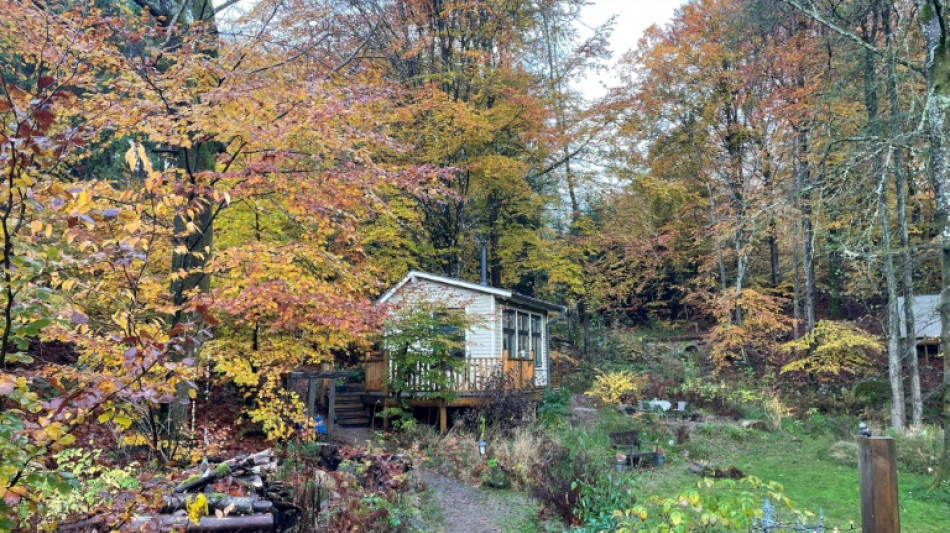
Sweden sees silent forests as sanctuaries from a noisy world / Photo: Camille BAS-WOHLERT - AFP

 Asia stocks rise on AI, US-China trade talks optimism

 Multi-Asset Trading Venue Monochrome Exchange Announces IEO of Its Native Token, $MCR

 Data centre command hub keeps AI up and running

 Leo XIV, first US pope transcends his restrained style

 France's debt climbs to highest since 1978: ministry

 Thousands protest inaction over climate crisis in Switzerland

 UK actor Naomi Watts honoured at Spain film festival

 Trump signs bill authorizing sweeping Russia sanctions

 Anthropic picks Accenture for in-house AI safety evaluation

 Hushing and hedging: US companies retreat on climate

 Crisis-wracked Volkswagen warns of 10-bn-euro hit to profits

 Shakira to cap off world tour with Madrid 12-gig run

 Isolated Syrian-Druze city shortages

 UNESCO can be 'moderator' in AI debate: chief to AFP

 Russia seizes assets of Nestle, French firms

 Anthropic says AI systems moving towards building themselves

 Asian stocks boosted by falling oil, yen weakens after BoJ rate hike

 Afghan medical students in Pakistan hope court stops college expulsions

 Australia to detain tourists who overstay visa, minister says

 Asian stocks track Wall St rally as oil prices drop

 Prized Mexican relic returns on loan, two centuries on

 'In our lane': Fed's Warsh defies Trump but still fighting for credibility

 Trump admin makes major cut to endangered species protections

 GM delivers first components for US interceptor missiles

 Travis Scott and Keith Richards feature on GTA VI soundtrack

In a cottage nestled deep in a Swedish forest, three couples recently spent four days whispering and without phones as part of a campaign about the dangers of noise pollution and promoting quiet Scandinavia.
The project arose from the observation that for many tourists, Sweden's appeal lies in its tranquility.
"What are their reasons for choosing Sweden as a travel destination? Relaxation, calm, and to unwind, as well as experiences in nature," Josefine Nordgren, one of the organisers of the "Silent Cabin" project by Visit Skane, which promotes tourism in southern Sweden, told AFP.
"Even in Germany, noise pollution is 10 times higher than in Sweden," she said.
Noise is the second-most detrimental environmental factor affecting Europeans' health after air pollution, according to the European Environment Agency (EEA).
This autumn, as the sun began its winter retreat in Sweden, Visit Skane invited three couples to spend four days -- on separate occasions -- in a little green cabin with white trim at the end of a winding forest lane, free of charge on the condition that their conversation remained below 45 decibels.
A normal conversation level is around 60 decibels.
To ensure everybody played by the rules, a sound meter was placed on top of a cupboard.
The unit was connected to the organisers' own system, and if the conversation level remained too high for an extended period, the couple faced eviction.
The couples were all city dwellers charmed by the cosy cabin -- kitted out with a large bed, small table and stove -- tucked in between trees with leaves turning yellow and red near a small brook.
The bathroom and kitchen were located in the owner's main house a short walk away.
The sound meter ensured the visitors stuck to the challenge.
"It's so important that we had this measurement, I think, to take it seriously," Lise Holm, a 26-year-old from Tubingen in Germany who stayed in the cabin with her older sister Johanna, told AFP.
- 'A new person now' -
The energetic self-proclaimed chatterboxes spoke in hushed tones when necessary and gesticulated to each other for the four days.
They spent their days taking walks, meditating, painting, making bonfires -- and speaking very little.
"I'm a new person now," Holm said.
"We heard noises (that) you don't hear when everyday life is so loud and everything is fast and rapid," her sister added.
Forcing the guests to stay quiet preserves the tranquility of the site, which in turn improves guests' health, Nordgren from Visit Skane said.
"If you stay quiet and calm, under 45 decibels, it has a positive influence on the body and mind," she said.
Lise Holm said that was her experience.
"My energy level shifted a lot," she said.
"I just felt this deep happiness and deep, energised level to (an) 'I can change the world' feeling," she said.
In the European Union, one in five people are exposed to noise levels harmful to their health, according to the EEA.
Living in an area with transportation noise is linked to a higher risk of developing health problems, including mental health and cardiovascular illnesses.
While brief escapades in the countryside may sound tempting as a remedy, they don't resolve the bigger problems posed by noise pollution.
"This can be an individual solution but it's not a good collective solution," said Eulalia Peris, an EEA expert.
"If everybody moves, let's say, to quiet areas in the countryside but they still need to travel to the city, they may benefit from the quietness of being in the countryside but they are producing noise by taking maybe the car to the city," she said.
"The problem of noise is not going to be solved by only one solution," she said.
She called for measures to reduce noise pollution, including lower speed limits and limits on engine noise, the installation of buffer zones, and promoting walking and cycling as active forms of transport.
M.Anderson--CPN