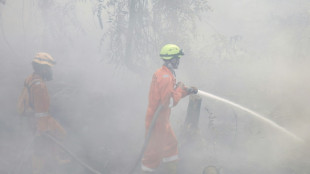
Green goals versus growth needs: India's climate scorecard / Photo: Money SHARMA - AFP/File

 Spanish PM says unregulated AI could be 'devastating'

 From Korean Chipmakers to Leveraged Semiconductor ETFs: STARTRADER Launches 49 New 24/7 Stock and ETF CFDs
 Asia stocks rise on AI, US-China trade talks optimism

 Multi-Asset Trading Venue Monochrome Exchange Announces IEO of Its Native Token, $MCR

 Data centre command hub keeps AI up and running

 Leo XIV, first US pope transcends his restrained style

 France's debt climbs to highest since 1978: ministry

 Thousands protest inaction over climate crisis in Switzerland

 UK actor Naomi Watts honoured at Spain film festival

 Trump signs bill authorizing sweeping Russia sanctions

 Anthropic picks Accenture for in-house AI safety evaluation

 Hushing and hedging: US companies retreat on climate

 Crisis-wracked Volkswagen warns of 10-bn-euro hit to profits

 Shakira to cap off world tour with Madrid 12-gig run

 Isolated Syrian-Druze city shortages

 UNESCO can be 'moderator' in AI debate: chief to AFP

 Russia seizes assets of Nestle, French firms

 Anthropic says AI systems moving towards building themselves

 Asian stocks boosted by falling oil, yen weakens after BoJ rate hike

 Afghan medical students in Pakistan hope court stops college expulsions

 Australia to detain tourists who overstay visa, minister says

 Asian stocks track Wall St rally as oil prices drop

 Prized Mexican relic returns on loan, two centuries on

 'In our lane': Fed's Warsh defies Trump but still fighting for credibility

 Trump admin makes major cut to endangered species protections

India is the world's most populous country, the third-biggest emitter of greenhouse gases, and remains deeply dependent on polluting coal to meet soaring energy demand.
It is also a climate diplomacy heavyweight, representing developing economies.
Ahead of the COP30 climate talks in Brazil this month, here is a look at India's commitments:
- Emissions -
India emitted 4.4 billion tonnes of carbon dioxide equivalent -- a measure of all planet-warming greenhouse gases -- in 2024, according to UN figures, behind only China and the United States.
But with a population of 1.4 billion people, its per capita emissions and historical contributions to global warming are much smaller.
India is committed to reaching net-zero emissions by 2070, and is on track to meet and exceed a pledge to reduce emission intensity 45 percent from 2005 levels by 2030.
- Electricity -
India's emissions are dominated by coal, which generates around 75 percent of the country's electricity.
This year, non-fossil fuels hit half of India's installed energy capacity, a target reached five years earlier than planned.
But that capacity has not translated into generation, and India's remains the world's second largest coal consumer.
Its electricity needs are expected to more than double by 2047, according to the country's Center for Science and Environment.
And so far it remains off-track on an ambitious domestic goal to reach 43 percent renewable energy generation by 2030.
Just 2.5 percent of cars sold in the country last year were electric, according to S&P Global.
- Future goals -
Like all parties to the Paris Agreement, which set a goal of limiting long-term global warming to 1.5 degrees Celsius, India must soon present a roadmap for its climate commitments, with goals to reach by 2035.
Aman Srivastava, climate policy fellow at Sustainable Futures Collaborative, said those targets would likely be cautious, allowing India to meet and possibly exceed them.
One major announcement could be a peak emissions year, perhaps around the 2040-45 range, he told AFP.
That "then allows it to kind of ramp down its emissions over the subsequent 30 years or so" towards its 2070 net-zero target, he added.
India could also increase its emission intensity target, shifting it to the 50 to 55 percent range.
Srivastava said it would also be useful for India to shift from setting renewable energy capacity targets to "speaking about actual generation coming from non-fossil sources".
- Challenges -
India has led the charge among developing countries seeking more financial assistance to both mitigate climate change and deal with its effects.
A recent report suggests India believes it will need up to $21 trillion to meet climate goals while securing the needs of its population.
"India faces multiple priorities," including job creation, infrastructure and energy demand, and growth to lift people out of poverty, said Nakul Sharma and Madhura Joshi of climate think tank E3G.
Its "climate agenda is deeply intertwined with its development and energy-security priorities," added Sharma, senior policy advisor on India, and Joshi, programme lead for Asia.
- Climate diplomacy -
India has positioned itself as a voice for developing countries and was unhappy with the climate funding target set at last year's COP meeting, deeming it insufficient.
It could even offer two sets of climate targets, with more ambitious goals conditioned on receiving more finance, Srivastava said.
It is likely to push for more support from rich nations, and emphasise their historic responsibility for climate change at COP.
"Restoring trust in multilateralism will be really important" at this year's meeting, Srivastava added.
C.Smith--CPN