Saudi chases AI ambitions with homegrown firm pitched to global investors / Photo: Fayez Nureldine - AFP

 COP31 host says AI's climate footprint to be a summit priority
 EU proposes energy rating for data centres

 TradersYard Shifts Focus to Futures Trading

 Indonesia doing 'everything' but struggling to curb fires
 France's Macron, Canada's Carney announce closer ties
 AI 'warning shots' focus Beijing on national security risks
 Philippine tribe in limbo over US-led tech hub

 Saudi-led coalition says Houthis fired ballistic missile at Riyadh
 Cuba works to restore power after another blackout

 Brigitte Bardot widower slams sale of star's belongings

 Indonesia accepts Malaysia's help to tackle wildfires

 Nvidia, OpenAI CEOs to attend Xi dinner at White House

 Cuba hit with seventh major blackout of the year
 Nigeria miners struggled to breathe in cell before 37 died: survivors

 Warren Buffett steps down as Berkshire Hathaway chairman

 Isolated Syrian-Druze city blames Damascus for shortages

 Kerry James Marshall: American 'blackness' painter celebrated in Europe

 Infantino 'must go', says German FA vice-president

 Japan's busiest rail station tests robot bins

 Backpackers fret over Australian visa crackdown

 Bank of Japan hikes rates to 31-year high to battle inflation

 AI doomsday warnings unlikely to slow IPOs but questions linger

 In Brazil's Amazon, the hunt for oil fuels hopes and fears

 Baby orangutans in India expose 'frightening' scale of trafficking

 Oversight Board blasts 'inadequate' Meta safeguards for AI deepfakes

Powered by its sovereign wealth fund of nearly $1 trillion, Saudi Arabia is backing its new AI firm Humain, entering a highly competitive sector some fear is a bubble ready to burst.
The company, launched in May, is bankrolled by Saudi's powerful Public Investment Fund, which has played a key role in financing the kingdom's so-called gigaprojects -- major developments aimed at boosting and diversifying its oil-reliant economy.
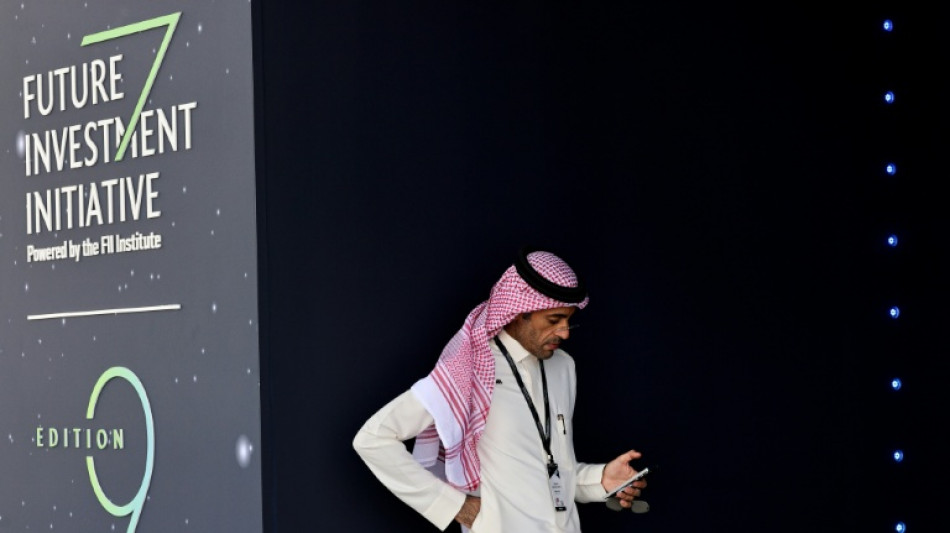
Humain this week signed a number of deals during the Future Investment Initiative conference (FII) in Riyadh, where its CEO doubled down on the stated goal of Saudi Arabia becoming the third-largest provider of AI infrastructure, behind the United States and China.
But Riyadh's ambitions to become a global AI hub face fierce competition from the neighbouring United Arab Emirates, which have invested in AI for years, as well as challenges over acquiring advanced US technology, including powerful chips.
"Our ambition is really, really massive," Humain's CEO Tareq Amin told delegates at the FII conference.
Humain has vowed to offer a wide range of AI services, products and tools, along with a powerful Arabic large language model.
In August, the company unveiled its debut Arabic chatbot that boasted of being able to comprehend the language's myriad dialects while also being mindful of Islamic values.
- Deals -
On Tuesday, state-backed oil giant Saudi Aramco announced plans to acquire a "significant minority stake" in Humain to scale up operations and "accelerate its growth in the AI sector", according to a joint press release.
Aramco's President and CEO Amin Nasser gushed over the potential of AI, saying the technology and digitalisation had the ability to double an oil well's productivity.
Humain also signed a $3 billion deal with private equity giant BlackStone's AirTrunk to build data centres in Saudi Arabia and struck an agreement with US chipmaker Qualcomm.
For Robert C. Mogielnicki, a senior resident scholar at the Arab Gulf States Institute in Washington, Humain, like other "nascent" Saudi tech entities, seeks "to assure audiences that the kingdom's tech ambitions are very real, feasible, and exciting".
"The fast pace of the tech agenda in the neighboring UAE, which is a key regional investment hub, heightens the need to do this," he added.
- 'Our goal' -
AI-related spending is skyrocketing across the globe, with total investments in 2025 alone expected to reach nearly $1.5 trillion, according to US research firm Gartner.
The Gulf's two largest economies, Saudi Arabia and the UAE, are vying to secure access to US technology.
The oil-producing countries have an advantage in the race to build sprawling data centres -- offering ample land, abundant energy supplies and ready access to finance along with backing from authorities.
But many challenges remain.
"The kingdom's capital means little if it doesn't have permission from Washington buy the advanced chips needed for its data center ambitions -- either for training or operating AI," Vivek Chilukuri, a senior fellow at the Center for a New American Security, told AFP.
Chilukuri added that Saudi is also facing an acute shortage of AI talent and is competing not only with "more established and well-capitalized US firms" but also with the UAE.
There are also concerns over the impact of AI, with companies across the globe shedding tens of thousands of jobs, while economic returns remain uncertain.
The spending spree has also prompted painful memories of the dotcom bubble of the late 1990s, when vast investments were wiped out.
Yet optimism was in no short supply this week in Riyadh.
"It's exciting to be in this region now because there is so much motivation from the very top levels of government to want to be leaders in AI," said Adam Jackson, the head of Middle East operations with the tech firm CIQ.
"We are not in the AI race to compete," added a female employee from Humain, who spoke to AFP on condition of anonymity because she did not have permission to speak to the press.
"We are there to be at the top with the US and China. That's our goal and vision."
M.García--CPN