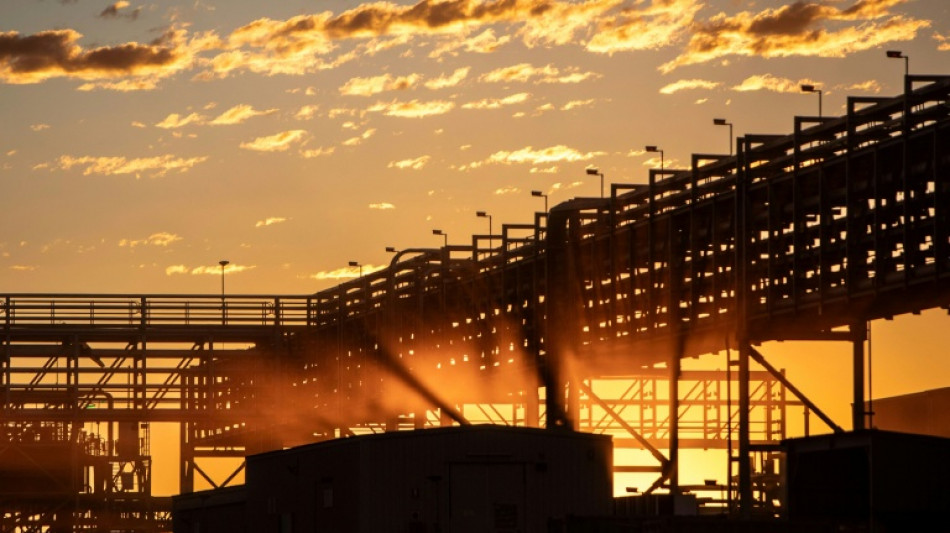
G7 meets on countering China's critical mineral dominance / Photo: Handout - Lynas Rare Earths Limited/AFP

 COP31 host says AI's climate footprint to be a summit priority
 EU proposes energy rating for data centres

 TradersYard Shifts Focus to Futures Trading

 Indonesia doing 'everything' but struggling to curb fires
 France's Macron, Canada's Carney announce closer ties

 AI 'warning shots' focus Beijing on national security risks

 Philippine tribe in limbo over US-led tech hub

 Saudi-led coalition says Houthis fired ballistic missile at Riyadh

 Cuba works to restore power after another blackout

 Brigitte Bardot widower slams sale of star's belongings

 Indonesia accepts Malaysia's help to tackle wildfires

 Nvidia, OpenAI CEOs to attend Xi dinner at White House

 Cuba hit with seventh major blackout of the year

 Nigeria miners struggled to breathe in cell before 37 died: survivors

 Warren Buffett steps down as Berkshire Hathaway chairman

 Isolated Syrian-Druze city blames Damascus for shortages

 Kerry James Marshall: American 'blackness' painter celebrated in Europe

 Infantino 'must go', says German FA vice-president

 Japan's busiest rail station tests robot bins

 Backpackers fret over Australian visa crackdown

 Bank of Japan hikes rates to 31-year high to battle inflation

 AI doomsday warnings unlikely to slow IPOs but questions linger

 In Brazil's Amazon, the hunt for oil fuels hopes and fears

 Baby orangutans in India expose 'frightening' scale of trafficking

 Oversight Board blasts 'inadequate' Meta safeguards for AI deepfakes
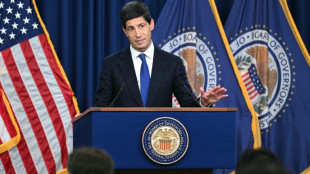
Curbing China's critical mineral dominance will top the agenda at a G7 energy ministers meeting in Canada on Thursday, as industrialized democracies seek more reliable access to the resources that power future technologies.
The Group of Seven, including US President Donald Trump's administration, has sounded the alarm over China's stranglehold on the supply of minerals used in everything from solar panels to precision missiles.
Trump announced a rare earths deal with China after meeting the country's leader Xi Jinping in South Korea on Thursday, clarifying that the agreement stood for a year and would be re-negotiated annually.
At a summit in western Canada in June, G7 leaders launched a "Critical Minerals Action Plan," which calls for diversified supply chains to advance "shared national and economic security interests."
The upcoming two-day meeting in Toronto offers "a major opportunity" to advance that effort, Tae-Yoon Kim, head of the critical minerals division at the International Energy Agency, told AFP.
"The high concentration of critical minerals refining in a single country creates economic and national security risks," Kim said in an email, urging the G7 "to start shifting market power."
"We need to work to avoid a similar kind of supply shock as we saw with oil in the 1970s."
– 'Hinge moment' –
A central complaint about China's conduct is that it does not adhere to market principles.
Multiple countries have substantial mineral reserves, but China's true dominance lies in its processing and refining capacity -- especially for rare earths, which are needed to make the specialized magnets used in a range of high-tech products.
Since a high proportion of material moves through Chinese-controlled businesses, Beijing can build stockpiles and control global supply.
Canada's energy ministry said the Toronto meeting should include announcements aimed at countering manipulation of the global critical minerals market.
"For decades, we've been facing a competitor who has very consistently distorted free markets, used industrial subsidies, created overcapacity, and undermined fair trade," said Abigail Hunter, executive director of the Washington-based Center for Critical Minerals Strategy.
For Canada's Energy Minister Tim Hodgson, the G7 meeting comes at a "hinge moment," his spokesman Gregory Frame told AFP.
At the meeting, Canada "will announce the first deliverables reached under (a new alliance) that will help ensure the minerals that underpin the industries of the future can be mined, refined, and produced by countries that share our values."
– Traceability –
Hunter noted that within the G7 -- Britain, Canada, France, Germany, Italy, Japan, and the United States -- there are contrasting energy policy priorities.
The Trump administration, in particular, is seen as less concerned about the transition to clean energy.
G7 unity on critical minerals may also be undermined by Trump's protectionist trade policies, which have caused global economic upheaval.
But G7 energy ministers are united in concern about the "security of supply," Hunter said, with China imposing more serious rare earth export controls.
For Hunter, progress at the Toronto meeting would include concrete action on the issue of traceability -- tracking raw materials from mining to refinement and ensuring suppliers follow global market rules.
Hunter said that "opaque" Chinese-controlled companies exist across the supply chain, which the G7 should strive to "box out of the market" with new policies on traceability and transparency.
"I'm really interested to see what they do on that," she said, adding that processing still includes a "spider web of entities" where Chinese officials maintain outsized control.
"We have a short window of opportunity to fix this. The window is still open -- it's just very, very small," Hunter said.
"I'm an optimist. I have to be, because this sector is very painful at times."
H.Cho--CPN