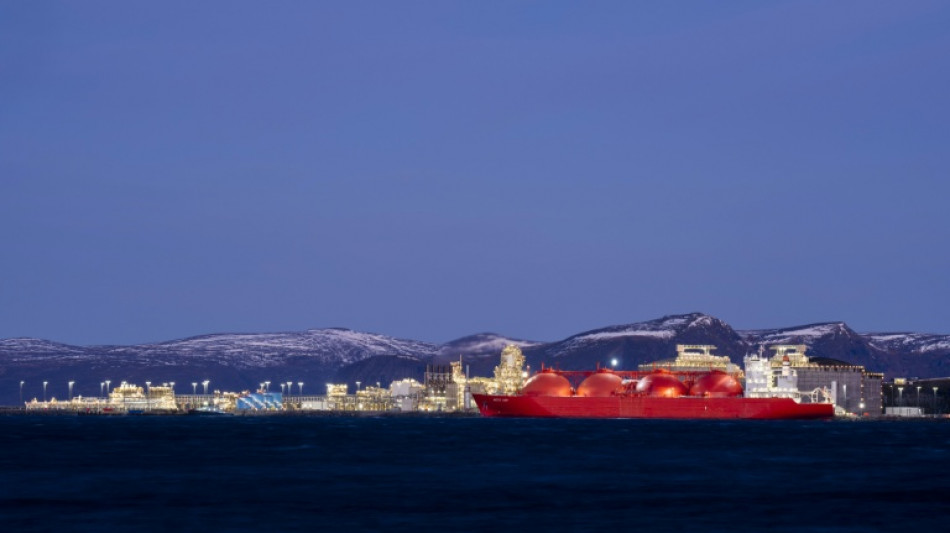
European court clears Norway of climate misconduct over oil licences / Photo: Fredrik Varfjell - NTB/AFP

 US networks halt Trump coverage in revolt over White House ban

 NOWPayments Releases Cross-Chain Payout Data Revealing Key Performance Benchmarks Across TRON, BNB Chain, and Solana

 COP31 host says AI climate footprint to be a summit priority
 Global stocks rally on lower oil prices, US-China hopes

 Spanish PM says unregulated AI could be 'devastating'

 From Korean Chipmakers to Leveraged Semiconductor ETFs: STARTRADER Launches 49 New 24/7 Stock and ETF CFDs

 Asia stocks rise on AI, US-China trade talks optimism

 France's Macron, Canada's Carney announce closer ties

 AI 'warning shots' focus Beijing on national security risks

 Philippine tribe in limbo over US-led tech hub

 Saudi-led coalition says Houthis fired ballistic missile at Riyadh

 Cuba works to restore power after another blackout

 Brigitte Bardot widower slams sale of star's belongings

 Indonesia accepts Malaysia's help to tackle wildfires

 Nvidia, OpenAI CEOs to attend Xi dinner at White House

 Cuba hit with seventh major blackout of the year

 Nigeria miners struggled to breathe in cell before 37 died: survivors

 Warren Buffett steps down as Berkshire Hathaway chairman

 Isolated Syrian-Druze city blames Damascus for shortages

 Kerry James Marshall: American 'blackness' painter celebrated in Europe

 Infantino 'must go', says German FA vice-president

 Japan's busiest rail station tests robot bins

 Backpackers fret over Australian visa crackdown

 Bank of Japan hikes rates to 31-year high to battle inflation

 AI doomsday warnings unlikely to slow IPOs but questions linger

The European Court of Human Rights said Tuesday that Norway did not breach its climate obligations when it awarded Arctic oil and gas exploration licenses in 2016.
It was a blow to climate activists after the Strasbourg court last year issued a historic first ruling condemning a state for its lack of action on climate change in another case involving Switzerland.
In the most recent case, six Norwegian activists and local branches of environmental NGOs Greenpeace and Young Friends of the Earth approached the court in France's Strasbourg after repeatedly losing in national courts.
The groups say that before awarding the licences, Norwegian "authorities did not conduct an environmental impact assessment of the potential impacts of petroleum extraction on Norway's obligations to mitigate climate change".
As Western Europe's largest oil and gas producer, Norway is a frequent legal target of climate activists.
But the ECHR found that there had been no violation of Article 8 of the European Convention on Human Rights, which guarantees "the right to respect for private and family life".
In its ruling, it noted initial "shortcomings" in the environmental impact assessment decision-making process, but said they were remedied within enough time not to affect that right.
Norway's Energy Minister Terje Aasland said the ruling was "positive".
"The court clearly finds that we are not breaching human rights," he told AFP in an email.
- 'Significant consequences' -
In 2016, the Norwegian energy ministry granted 10 exploration licences in the Barents Sea to 13 companies, including national champion Statoil, now known as Equinor, as well as US companies Chevron and ConocoPhillips, and Russia's Lukoil.
Relying at the time on the Paris Agreement, which aims to limit global warming to less than 2C above pre-industrial (1850-1900) levels, NGOs appealed to national courts, arguing the attribution of the licenses was contrary to articles in the constitution guaranteeing the right to a healthy environment.
Norway's supreme court ruled in 2021 that the award of the permits did not represent a "real and immediate danger" to life.
The licences were eventually all returned after no exploitable reserves were found.
In its Tuesday ruling, the ECHR "found that the impact assessment during the processes leading to the 2016 decision had not been fully comprehensive" and "the assessment of the activity's climate impacts had been deferred".
But, it said, "there was no indication that deferring such an assessment" had breached the rights convention.
Sigrid Hoddevik Losnegard, vice-president of the Young Friends of the Earth Norway, one of the plaintiffs, welcomed the ruling as a step in the right direction.
She said she was happy the court had indicated that "a state has to evaluate global emissions related to the combustion of hydrocarbons before approving a new oil field".
"This will have significant consequences on how oil activities are managed in Norway," she added.
- Ruling against Switzerland -
Last year, the ECHR issued a ruling condemning Switzerland for its lack of action on climate change, the first ruling against a state.
The court found that the Swiss state had violated Article 8.
The Swiss association of Elders for Climate Protection -- 2,500 women aged 73 on average -- had complained about the "failings of the Swiss authorities" in terms of climate protection that could "seriously harm" their health.
The court found "there were some critical lacunae" in relevant Swiss regulations, including a failure to quantify limits on national greenhouse gas emissions.
In a milestone but non-binding ruling, the International Court of Justice (ICJ) ruled in July that climate change was an "urgent and existential threat" and that countries had a legal duty to prevent harm from their planet-warming pollution.
C.Peyronnet--CPN