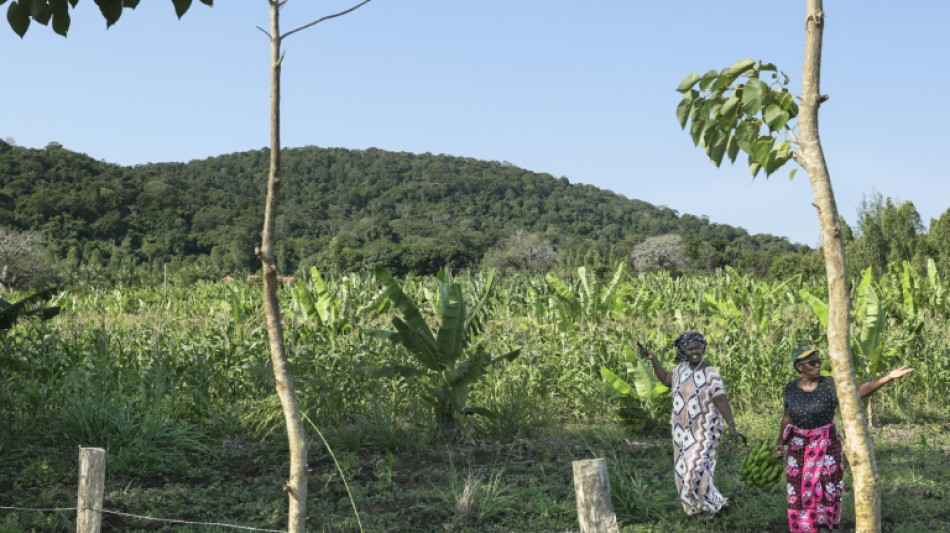
Global race for rare earths comes to Kenya's Mrima Hill / Photo: Tony KARUMBA - AFP

 US networks halt Trump coverage in revolt over White House ban

 NOWPayments Releases Cross-Chain Payout Data Revealing Key Performance Benchmarks Across TRON, BNB Chain, and Solana

 COP31 host says AI climate footprint to be a summit priority
 Global stocks rally on lower oil prices, US-China hopes

 Spanish PM says unregulated AI could be 'devastating'

 From Korean Chipmakers to Leveraged Semiconductor ETFs: STARTRADER Launches 49 New 24/7 Stock and ETF CFDs
 Asia stocks rise on AI, US-China trade talks optimism

 France's Macron, Canada's Carney announce closer ties
 AI 'warning shots' focus Beijing on national security risks

 Philippine tribe in limbo over US-led tech hub

 Saudi-led coalition says Houthis fired ballistic missile at Riyadh

 Cuba works to restore power after another blackout
 Brigitte Bardot widower slams sale of star's belongings

 Indonesia accepts Malaysia's help to tackle wildfires
 Nvidia, OpenAI CEOs to attend Xi dinner at White House

 Cuba hit with seventh major blackout of the year

 Nigeria miners struggled to breathe in cell before 37 died: survivors

 Warren Buffett steps down as Berkshire Hathaway chairman

 Isolated Syrian-Druze city blames Damascus for shortages

 Kerry James Marshall: American 'blackness' painter celebrated in Europe

 Infantino 'must go', says German FA vice-president

 Japan's busiest rail station tests robot bins

 Backpackers fret over Australian visa crackdown

 Bank of Japan hikes rates to 31-year high to battle inflation

 AI doomsday warnings unlikely to slow IPOs but questions linger

Division and suspicion have gripped five villages near Kenya's coast as global powers from the United States to China eye a forest that is rich in rare earths -- minerals vital to high-tech and low-carbon industries.
The US government under President Donald Trump has made securing critical minerals central to its diplomacy in Africa, including through a peace deal in the resource-rich Democratic Republic of Congo this year.
Mrima Hill -- a forest of around 390 acres near Kenya's Indian Ocean coastline -- could be another target.
It sits quietly on huge rare-earth deposits that Cortec Mining Kenya, a subsidiary of UK and Canada-based Pacific Wildcat Resources, estimated in 2013 were worth $62.4 billion, including large stores of niobium, used to strengthen steel.
US official Marc Dillard visited the hill in June when he was serving as the interim ambassador to Kenya.
Other foreigners also attempted to visit in recent months, including Chinese nationals who were turned away, according to Juma Koja, a guard for the Mrima Hill community.
An Australian consortium of mining firms RareX and Iluka Resources announced a bid this year to mine rare earths on the site, and locals say land speculators are flocking to the area.
- Buried riches -
The interest is worrying the community, mostly of the Digo ethnic group, who fear they will be evicted or denied a share in future mining windfalls.
The lush forest is home to their sacred shrines and has long supported farming and livelihoods, though today more than half the population lives in extreme poverty, according to government data.
AFP was initially barred access to the forest.
"People come here with big cars... but we turn them away," said Koja.
His stance stems from past encounters with prospective investors -- a process he says was not transparent.
"I do not want my people to be exploited," he said.
Kenya revoked a mining licence in 2013 that had been granted to Cortec Mining Kenya, citing environmental and licensing irregularities.
Cortec claimed in court that the licence was revoked after it refused to pay a bribe to then–mining minister Najib Balala, an allegation he denied. The company lost multiple legal efforts over the revocation.
In 2019, Kenya imposed a temporary ban on new mining licences over concerns about corruption and environmental degradation.
But it now sees a major opportunity, particularly as China -- the biggest source of rare earths -- increasingly limits its exports.
Kenya's mining ministry announced "bold reforms" this year, including tax breaks and improved licensing transparency, aimed at attracting investors and boosting the sector from 0.8 percent of GDP to 10 percent by 2030.
Daniel Weru Ichang'i, a retired economic geology professor at the University of Nairobi, said Kenya had a long way to go, especially in gathering reliable data on its resources.
"There's a romantic view that mining is an easy area, and one can get rich quickly... We need to sober up," he told AFP.
"Corruption makes this area, which is very high-risk, less attractive to invest in."
Competition between the West and China is driving up prices, but if the country wants to profit, it "must stick to the law, and individual interests must be subjugated to that of the nation," he said.
- 'Mrima is our life' -
On Mrima Hill, locals worry for their livelihoods, sacred shrines, medicinal plants, and the forest they have known all their lives.
"This Mrima is our life... Where will we be taken?" said Mohammed Riko, 64, vice chairman of the Mrima Hill Community Forest Association.
Koja is concerned about the loss of unique indigenous trees like the giant orchid, already a problem before mining has even started.
"In my heart I am crying. This Mrima has endangered species that we are losing," he said.
But others, like Domitilla Mueni, treasurer of the Mrima Hill association, see an opportunity.
She has been developing her land -- planting trees, farming -- in order to push up the value when mining companies come to buy.
"Why should we die poor while we have minerals?" she said.
D.Goldberg--CPN