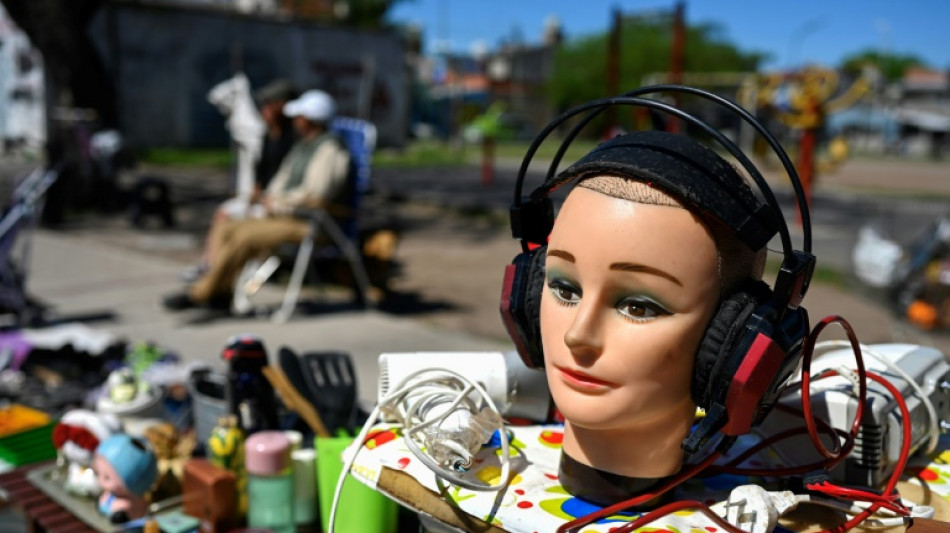
To make ends meet, Argentines sell their possessions / Photo: Luis Robayo - AFP

 South Africa arrests three more suspects, after nine women murdered
 Paramount settles with US states to clear Warner Bros. mega-merger
 Climate crisis a job for world leaders, not just activists: UK FM
 COP31 host says AI's climate footprint to be a summit priority

 EU proposes energy rating for data centres

 TradersYard Shifts Focus to Futures Trading

 Indonesia doing 'everything' but struggling to curb fires

 FQ-42 Vengeance Finds New Home at Creech Air Force Base

 Multi-Asset Trading Venue Monochrome Exchange Announces IEO of Its Native Token, $MCR

 Data centre command hub keeps AI up and running
 Leo XIV, first US pope transcends his restrained style
 France's debt climbs to highest since 1978: ministry
 Thousands protest inaction over climate crisis in Switzerland

 UK actor Naomi Watts honoured at Spain film festival
 Trump signs bill authorizing sweeping Russia sanctions

 Anthropic picks Accenture for in-house AI safety evaluation
 Hushing and hedging: US companies retreat on climate

 Crisis-wracked Volkswagen warns of 10-bn-euro hit to profits

 Shakira to cap off world tour with Madrid 12-gig run

 Isolated Syrian-Druze city shortages

 UNESCO can be 'moderator' in AI debate: chief to AFP

 Russia seizes assets of Nestle, French firms

 Anthropic says AI systems moving towards building themselves

 Asian stocks boosted by falling oil, yen weakens after BoJ rate hike

 Afghan medical students in Pakistan hope court stops college expulsions

A street market in a Buenos Aires working-class neighborhood bustles with desperate Argentines who have taken to hawking their belongings to make ends meet as the economy sputters.
The market in Villa Fiorito -- the birthplace of football great Diego Maradona -- has gotten ever busier with an explosion in the number of so-called "blanket sellers" peddling household objects, items collected from the trash or goods bought with loans and displayed on blankets spread out on the pavement.
As Maradona looks on from several murals in the city that hails him as a rags-to-riches hero, locals spread out used toys and frayed backpacks, ice cube trays, thermos flasks without lids, well-paged magazines, worn clothes, even blister packs of pills.
As the smell of barbecue fires and grilling meat mix with that of accumulated trash, and the sounds of children at play vie with the microphone of a street pastor, some residents also sell home-made bread.
"Whenever I manage to get clothes, or if I see something that's cheap, I buy it and resell it, which is what the majority of neighbors around here do," vendor Gladys Gutierrez, 46, told AFP.
"They buy, resell, and that's how they manage to make a bit of extra money."
Gutierrez normally sells cleaning products from her home, but with fewer and fewer neighbors able to afford them, she took out a loan to buy snacks, drinks and perfumes to sell at the market.
Her husband, a construction worker, has been out of work for a while.
"People are tired, they're angry," she said.
In a country accustomed to economic crisis, Argentines are once again tightening their belts after a brief hopeful period as President Javier Milei made good on his promise of slashing inflation.
Prices have been creeping up again, consumption and production numbers are down, and the central bank has been battling a run on the peso amid fears of devaluation after mid-term elections Sunday.
Some 40 percent of Argentina's income earners work in the informal sector with no social benefits -- and many hold several jobs at once.
"It reminds me a lot of 2001," said Juana Sena, a 71-year-old market vendor, referring to the economic crash that saw Argentina default on its debt obligations -- the biggest such failure in history -- followed by deadly protests and the collapse of a government.
- 'Deepened and exacerbated' -
Economist Guillermo Oliveto told AFP about 70 percent of working class Argentines cannot make their incomes stretch beyond half a month. Some 200,000 people lost their jobs under Milei's austerity measures.
According to the IETSE economic data center, nine out of ten Argentine families are in debt -- most of it spent on food since Milei took office and slashed social spending.
"The government underestimated the impact that the real economy has on daily life, social sentiment, and consequently on electoral sentiment," said Oliveto.
"Reducing inflation was a necessary condition, but it is not sufficient."
On Sunday, the people of Villa Fiorito will vote with the rest of Argentina in elections to determine whether budget-slashing Milei, whose party is in a minority, will wield more power in parliament in the second half of his term.
In Argentina's presidential election of 2023, Milei got 27 percent of the neighborhood's vote -- which dropped to 16 percent in a provincial ballot in September.
Political scientist Matias Mora, a native of Villa Fiorito, told AFP the country's economic woes did not start under Milei, though he "deepened and exacerbated it."
And while Argentines are known for their resilience, it comes "at the cost of mental health, physical health, and being extremely worn out," he said.
A.Levy--CPN