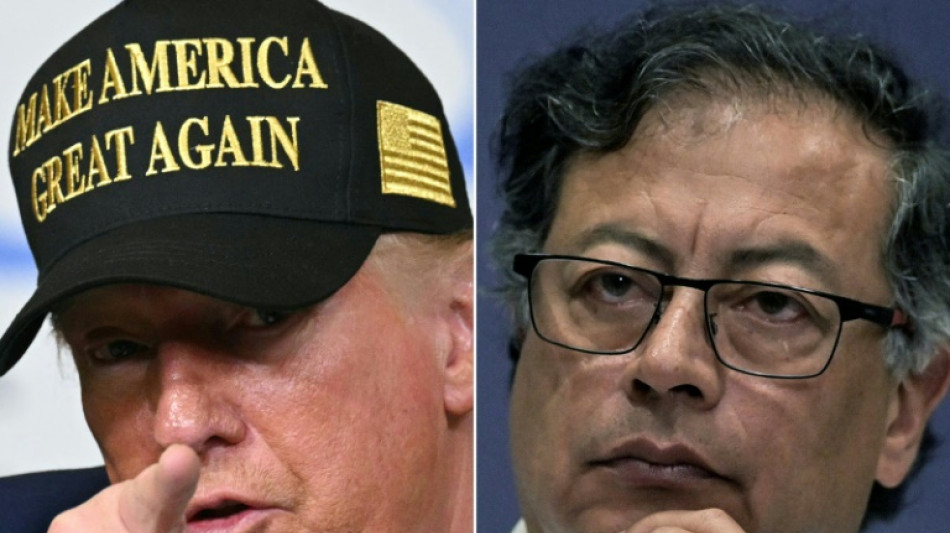
Colombia's president embraces war of words with Trump / Photo: Mandel NGAN, Joaquín SARMIENTO - AFP/File

 South Africa arrests three more suspects, after nine women murdered
 Paramount settles with US states to clear Warner Bros. mega-merger
 Climate crisis a job for world leaders, not just activists: UK FM
 COP31 host says AI's climate footprint to be a summit priority
 EU proposes energy rating for data centres

 TradersYard Shifts Focus to Futures Trading

 Indonesia doing 'everything' but struggling to curb fires
 FQ-42 Vengeance Finds New Home at Creech Air Force Base
 Multi-Asset Trading Venue Monochrome Exchange Announces IEO of Its Native Token, $MCR

 Data centre command hub keeps AI up and running
 Leo XIV, first US pope transcends his restrained style

 France's debt climbs to highest since 1978: ministry

 Thousands protest inaction over climate crisis in Switzerland

 UK actor Naomi Watts honoured at Spain film festival

 Trump signs bill authorizing sweeping Russia sanctions

 Anthropic picks Accenture for in-house AI safety evaluation

 Hushing and hedging: US companies retreat on climate

 Crisis-wracked Volkswagen warns of 10-bn-euro hit to profits

 Shakira to cap off world tour with Madrid 12-gig run

 Isolated Syrian-Druze city shortages

 UNESCO can be 'moderator' in AI debate: chief to AFP

 Russia seizes assets of Nestle, French firms

 Anthropic says AI systems moving towards building themselves

 Asian stocks boosted by falling oil, yen weakens after BoJ rate hike

 Afghan medical students in Pakistan hope court stops college expulsions

Donald Trump's decision to freeze millions in aid to Colombia and brand its president a drug trafficker has smashed long-standing ties and could yet shake up the country's 2026 presidential race.
With the US president's threat of "significant" punitive tariffs looming, Colombian businesses are panicking and investors are spooked.
But one person seems unfazed by the row between Colombia and its largest trading partner: Colombian President Gustavo Petro.
The ex-guerrilla-turned-politico has embraced the battle with Trump, using it as a tool to stir his base and, he hopes, Colombian voters ahead of the May presidential elections.
He has recalled Colombia's ambassador from Washington, attacked Trump in lengthy social media posts -- and at the United Nations -- and embraced ever-more nationalist rhetoric.
"President Trump doesn't like us being out of his control," he wrote on X Tuesday, while claiming the threat of a US invasion and stating "they want a coup against me".
Visiting New York last month, he urged the US military to refuse Trump's orders, earning him a US visa ban.
Over the weekend, Petro backed US demonstrations, posting 'No to kings' and sharing protest videos.
- 'Looking for confrontation'? -
The shift in US-Colombian relations since Trump and Petro took power could hardly be starker.
For decades, the two countries jointly fought drug cartels, traded broadly, and enjoyed close political ties. Colombia was arguably the United States' closest ally in South America.
Today, "Petro is looking for a confrontation with Washington," said Theodore Kahn, of global risk consultancy Control Risks in Bogota.
According to Kahn, Petro wants to use the spat to influence a presidential primary in his Historic Pact party this Sunday and push the electorate to the left.
Petro is constitutionally barred from running for president again, but he is keen to have a say over who Colombia's next leader will be.
So, it seems, is Trump and his Secretary of State, Marco Rubio.
Trump has branded Petro "a rated and very unpopular leader, with a fresh mouth toward America." Rubio has repeatedly backed Petro's foes, including right-wing ex-president Alvaro Uribe.
Petro may also be betting that the attacks help revive his popularity and influence at home, as they have done for Brazil's leftist President Luiz Inacio Lula da Silva.
"There is a calculation by Petro to use foreign policy, as we saw with his stance on the Gaza war, to recover lost popularity," said Yan Basset, political science professor at Bogota's Rosario University.
Petro's approval rating hovers below 40 percent.
- Lose-lose? -
In reality, "the crisis benefits no one," and cuts in cooperation would hurt both Washington and Bogota, according to Gimena Sanchez of the Washington Office on Latin America, a rights organization.
The crisis could be felt in Colombia's military and security services, who are wary of Petro and largely inclined to support close cooperation with the United States.
But given Colombia's free trade deal with Washington, a spat with the United States could hit the economy hard.
Nearly a third of Colombian exports go to the United States, official data shows.
Maria Claudia Lacouture, president of the Colombo-American Chamber of Commerce, said the implications of Washington's message cannot be "taken lightly."
Oil, coffee, flowers, and minerals such as iron and ferronickel are most exposed.
Javier Diaz, head of the National Association of Foreign Trade (Analdex), warned of uncertainty among businesses: "We hope diplomatic channels are activated," he said.
And Washington's threats have stoked polarization in a country still recovering from decades of internecine violence.
On the right, former presidents Alvaro Uribe and Andres Pastrana this week demanded that Petro clarify his ties to drug cartels.
H.Meyer--CPN