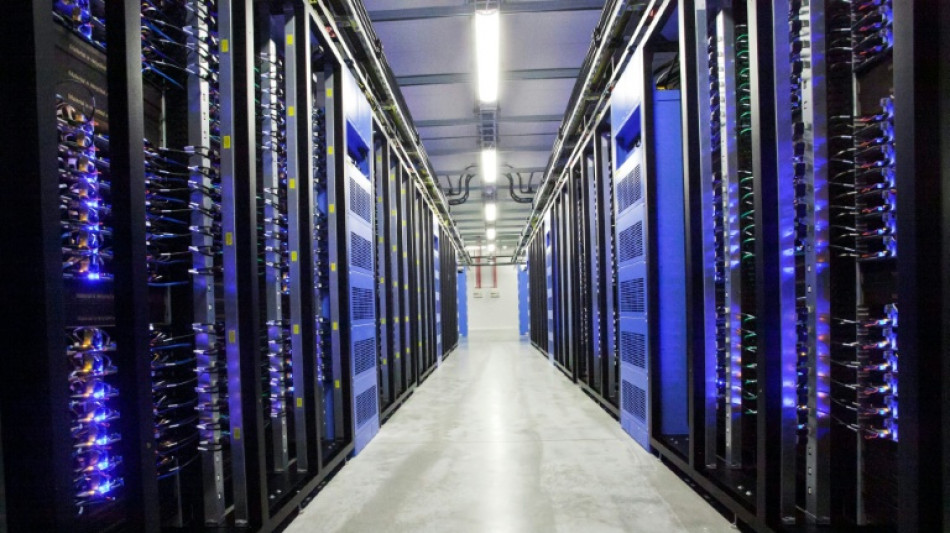
Servers, software and data: how the cloud powers the web / Photo: - - SCANPIX SWEDEN/AFP/File

 South Africa arrests three more suspects, after nine women murdered

 Paramount settles with US states to clear Warner Bros. mega-merger
 Climate crisis a job for world leaders, not just activists: UK FM

 COP31 host says AI's climate footprint to be a summit priority

 EU proposes energy rating for data centres

 TradersYard Shifts Focus to Futures Trading

 Indonesia doing 'everything' but struggling to curb fires

 FQ-42 Vengeance Finds New Home at Creech Air Force Base

 Multi-Asset Trading Venue Monochrome Exchange Announces IEO of Its Native Token, $MCR

 Data centre command hub keeps AI up and running

 Leo XIV, first US pope transcends his restrained style

 France's debt climbs to highest since 1978: ministry

 Thousands protest inaction over climate crisis in Switzerland

 UK actor Naomi Watts honoured at Spain film festival

 Trump signs bill authorizing sweeping Russia sanctions

 Anthropic picks Accenture for in-house AI safety evaluation

 Hushing and hedging: US companies retreat on climate

 Crisis-wracked Volkswagen warns of 10-bn-euro hit to profits

 Shakira to cap off world tour with Madrid 12-gig run

 Isolated Syrian-Druze city shortages

 UNESCO can be 'moderator' in AI debate: chief to AFP

 Russia seizes assets of Nestle, French firms

 Anthropic says AI systems moving towards building themselves

 Asian stocks boosted by falling oil, yen weakens after BoJ rate hike

 Afghan medical students in Pakistan hope court stops college expulsions

The outage that hit the world's leading cloud provider Amazon Web Services on Monday has highlighted global reliance on the technology, which offers businesses on-demand IT resources without heavy investment in expensive server farms.
In its most widespread form, the so-called "public" cloud relies on shared data centres, where clients hire IT capacity. The "private" cloud", on the other hand, consists of dedicated machines reserved for a single company.
The United States dominates the global market for cloud computing.
AWS held 30 percent of the market share in the second quarter of this year, followed by Microsoft Azure (20 percent) and Google Cloud (13 percent), according to the Synergy Research Group.
These three firms have been dubbed "The Big Three".
The AWS outage made part of the global internet and applications inaccessible for several hours on Monday, preventing millions of people from logging on to sites such as Snapchat, Fortnite, Airbnb and Reddit.
Other players, such as the US firms Oracle, IBM, Salesforce or Akamai, as well as Chinese giants Alibaba, Tencent and Huawei, share parts of a rapidly growing market, with significant barriers to entry.
In Europe, France's OVHcloud is one of the main providers.
In 2023, 43 percent of businesses in the European Union used cloud services, mainly for email, file storage and office or cybersecurity software.
Adoption varies by size: 78 percent of large companies with more than 250 employees use the cloud compared to 42 percent of small businesses (10-49 staff), according to a study of 161,000 companies published by Eurostat.
- Foreign giants -
There are three distinct major models of cloud services. In all cases, providers handle the installation of services, storage drive and network connections in data centres across the world, which consume huge amounts of energy daily.
The most popular model -- Software as a Service or SaaS -- allows the direct use of online apps such as Gmail, Zoom, Teams or Slack.
In 2023, 96 percent of EU cloud client companies bought at least one SaaS service
In the case of Infrastructure as a Service or IaaS, businesses hire resources with only minimal pre-configured settings to install their own software.
The third -- Platform as a Service of PaaS -- is an intermediate model, where the client can outsource not only the management of the infrastructure but also part of the software that runs their apps.
PaaS is the least adopted model in the EU, with 26 percent of cloud client companies using it.
Despite the growth in the European market, local providers have seen their share of the market shrink in recent years and captured by foreign giants known as "hyperscalers".
Hyperscalers are able to finance the construction of ever more data centres, even if the return on investment takes time.
Significant amounts are at stake as the construction of large data centres can exceed a billion dollars.
S.F.Lacroix--CPN