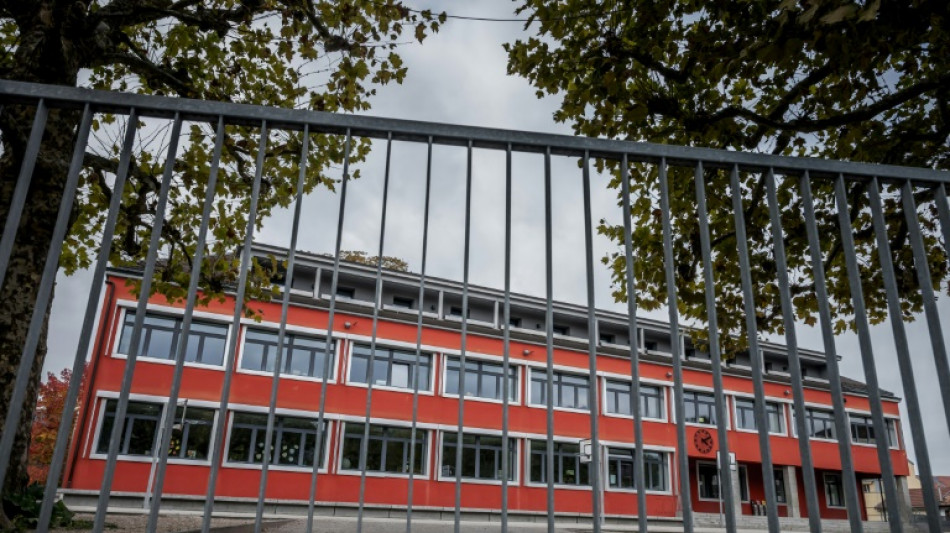
Border order: Geneva schools kick out Swiss kids living in France / Photo: Fabrice COFFRINI - AFP

 South Africa arrests three more suspects, after nine women murdered

 Paramount settles with US states to clear Warner Bros. mega-merger

 Climate crisis a job for world leaders, not just activists: UK FM
 COP31 host says AI's climate footprint to be a summit priority
 EU proposes energy rating for data centres

 TradersYard Shifts Focus to Futures Trading

 Indonesia doing 'everything' but struggling to curb fires
 FQ-42 Vengeance Finds New Home at Creech Air Force Base

 Multi-Asset Trading Venue Monochrome Exchange Announces IEO of Its Native Token, $MCR
 Data centre command hub keeps AI up and running
 Leo XIV, first US pope transcends his restrained style

 France's debt climbs to highest since 1978: ministry
 Thousands protest inaction over climate crisis in Switzerland
 UK actor Naomi Watts honoured at Spain film festival
 Trump signs bill authorizing sweeping Russia sanctions

 Anthropic picks Accenture for in-house AI safety evaluation
 Hushing and hedging: US companies retreat on climate

 Crisis-wracked Volkswagen warns of 10-bn-euro hit to profits

 Shakira to cap off world tour with Madrid 12-gig run

 Isolated Syrian-Druze city shortages

 UNESCO can be 'moderator' in AI debate: chief to AFP

 Russia seizes assets of Nestle, French firms

 Anthropic says AI systems moving towards building themselves

 Asian stocks boosted by falling oil, yen weakens after BoJ rate hike

 Afghan medical students in Pakistan hope court stops college expulsions

Swiss families priced out of Geneva and forced to live just across the border in France are reeling from another blow: their children are now being elbowed out of Genevan schools.
The Geneva authorities' decision to bar pupils who live in the Swiss city's surrounding French suburbs and villages has left parents angry, children worried, and French municipalities fuming at having to absorb more than 2,000 extra kids into their classrooms.
"We've become second-class Swiss citizens," lamented Joana, a 35-year-old mother of two, declining to give her surname for professional reasons.
Like many cross-border commuters, Joana, who works in healthcare, left Geneva due to the lack of affordable housing.
"We agreed to leave our sub-standard home in the city centre to move to the countryside -- but crossing the border was conditional on access to Swiss schools," she told AFP.
Home to numerous international institutions, Geneva is one of the most expensive cities in the world to live in.
Its position is geographically curious: the Swiss city is almost entirely surrounded by France. Nowhere in the Geneva canton is more than 5.5 kilometres (3.4 miles) from the French border.
Around 115,000 people work in Geneva but live across the border, where the cost of living is cheaper.
- 'We're not happy' -
The French village of Bossey is home to cross-border workers, many of them Swiss nationals who cannot afford to live in Geneva.
Its mayor, Jean-Luc Pecorini, can see the border from his office, less than 100 metres away on the other side of the highway.
"We're not happy," he told AFP, evoking a sentiment shared by other French mayors.
He called Geneva's decision -- taken in June and coming into force at the start of the next school year in September 2026 -- "abrupt".
Opening a new classroom would cost around 80,000 euros ($93,000), he explained.
A source with knowledge of the figures, who did not want to be identified, told AFP around 2,500 pupils would initially be affected, followed by "a steady stream of students" who would otherwise have gone to Swiss schools later on.
While some are French, 80 percent of those affected are Swiss.
The financial consequences for France are estimated at around 60 million euros in schooling and infrastructure costs, plus another 15 million euros a year thereafter, the source said.
- Geneva's demographic growth -
Geneva is refusing to budge, citing demographic pressure and a shortage of school places.
The change represents "a saving of just over 27 million Swiss francs ($34 million) over four years," the Genevan authorities told AFP.
Roberto Balsa, a 47-year-old cross-border IT worker, said the news was "very brutal" for his seven-year-old daughter.
Some parents have filed legal appeals in Geneva, while others have signed an online petition.
Emmanuel, a father of four affected by the decision, who did not want to give his surname, called Geneva's attitude "discriminatory", noting that so-called "frontalier" workers like himself pay their taxes in Switzerland, with only a third remitted to France.
France's Auvergne-Rhone-Alpes regional prefecture told AFP that French authorities "can no longer accept" Geneva shifting the impact of its problems onto neighbouring France "without any real consideration of the financial impact".
By kicking out pupils, most of whom are Swiss and intend to work in Switzerland, "Geneva is exporting the burden of schooling to France, while our schools are already under severe pressure in terms of capacity", it said.
J.Bondarev--CPN