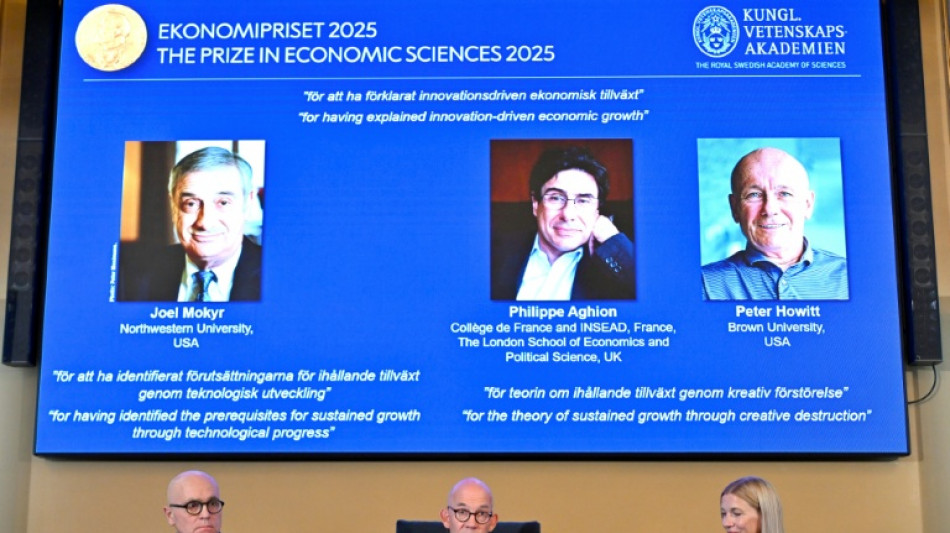
Nobel economist warns of AI dangers / Photo: Anders WIKLUND - TT NEWS AGENCY/AFP

 Infantino proposes consulting federations to reform FIFA

 South Africa arrests three more suspects, after nine women murdered
 Paramount settles with US states to clear Warner Bros. mega-merger

 Climate crisis a job for world leaders, not just activists: UK FM
 COP31 host says AI's climate footprint to be a summit priority
 EU proposes energy rating for data centres

 TradersYard Shifts Focus to Futures Trading

 Indonesia doing 'everything' but struggling to curb fires
 FQ-42 Vengeance Finds New Home at Creech Air Force Base
 Multi-Asset Trading Venue Monochrome Exchange Announces IEO of Its Native Token, $MCR
 Data centre command hub keeps AI up and running

 Leo XIV, first US pope transcends his restrained style

 France's debt climbs to highest since 1978: ministry

 Thousands protest inaction over climate crisis in Switzerland

 UK actor Naomi Watts honoured at Spain film festival

 Trump signs bill authorizing sweeping Russia sanctions
 Anthropic picks Accenture for in-house AI safety evaluation

 Hushing and hedging: US companies retreat on climate

 Crisis-wracked Volkswagen warns of 10-bn-euro hit to profits

 Shakira to cap off world tour with Madrid 12-gig run

 Isolated Syrian-Druze city shortages

 UNESCO can be 'moderator' in AI debate: chief to AFP

 Russia seizes assets of Nestle, French firms

 Anthropic says AI systems moving towards building themselves

 Asian stocks boosted by falling oil, yen weakens after BoJ rate hike

A winner of this year’s Nobel prize in economics warned Monday that artificial intelligence offers "amazing possibilities" but should be regulated because of its job-destroying potential.
The remarks from Canadian Peter Howitt, professor emeritus at Brown University in the United States, came amid growing concerns about how AI will impact society and the labor market.
California Governor Gavin Newsom on Monday signed a first-of-its-kind law regulating interactions with AI chatbots, defying a push from the White House to leave the technology unchecked.
Howitt was one of three economists honored Monday by the Royal Swedish Academy of Sciences for work on how technology drives and affects growth.
His research with fellow winner Philippe Aghion of France focused on the theory of "creative destruction" in which a new and better product enters the market, and the companies selling the older products lose out.
Howitt told a news conference that it remains to be seen who will be the leader in AI, and "we don't know what the creative destruction effects are going to be."
"It's obviously a fantastic technology that has amazing possibilities. And it also obviously has an amazing potential for destroying other jobs or replacing highly skilled labor. And all I can say is that this is a conflict. It's going to have to be regulated," he said.
"Private incentives in an unregulated market are not really going to resolve this conflict in a way that's best for society, and we don't know what's going to come from it."
Howitt, 79, said it was a "big moment in human history" and likened it to past periods of technological innovation, including the telecoms boom of the 1990s, and the dawns of electricity and steam power.
He said those innovations all demonstrated how technology can enhance and not just replace labor. "How we're going to do it this time? I wish I had specific answers, but I don't," he added.
Howitt said that when he and Aghion first wrote their seminal 1992 paper on creative destruction it took five years to get it published, but his collaborator knew they were on to something special.
"Right from the beginning, from our very first research, I remember back in 1987, Philippe saying we're going to get a Nobel Prize for this. I said, 'Sure, sure, sure,'" Howitt recalled.
"He said, 'Our time will come. Our time will come,' okay, and now it’s come. Amazing."
M.Mendoza--CPN