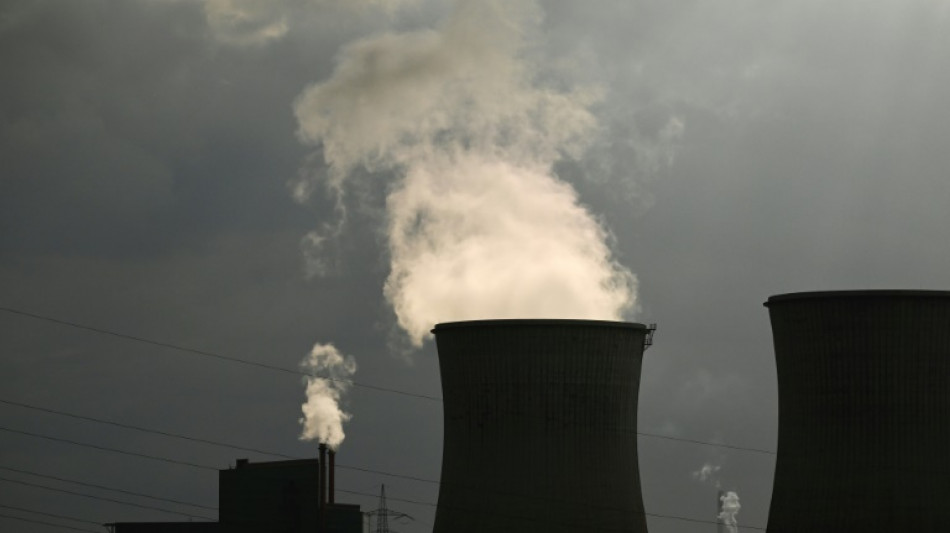
Germany raises growth forecasts, but warns reforms needed / Photo: Ina FASSBENDER - AFP

 Green policies just good politics, says UK minister
 El Nino weather pattern enters record territory: scientist

 US networks halt Trump coverage in revolt over White House ban

 NOWPayments Releases Cross-Chain Payout Data Revealing Key Performance Benchmarks Across TRON, BNB Chain, and Solana

 COP31 host says AI climate footprint to be a summit priority
 Global stocks rally on lower oil prices, US-China hopes

 Spanish PM says unregulated AI could be 'devastating'

 From Korean Chipmakers to Leveraged Semiconductor ETFs: STARTRADER Launches 49 New 24/7 Stock and ETF CFDs

 Asia stocks rise on AI, US-China trade talks optimism

 France's Macron, Canada's Carney announce closer ties

 AI 'warning shots' focus Beijing on national security risks

 Philippine tribe in limbo over US-led tech hub

 Saudi-led coalition says Houthis fired ballistic missile at Riyadh

 Cuba works to restore power after another blackout

 Brigitte Bardot widower slams sale of star's belongings

 Indonesia accepts Malaysia's help to tackle wildfires

 Nvidia, OpenAI CEOs to attend Xi dinner at White House

 Cuba hit with seventh major blackout of the year

 Nigeria miners struggled to breathe in cell before 37 died: survivors

 Warren Buffett steps down as Berkshire Hathaway chairman

 Isolated Syrian-Druze city blames Damascus for shortages

 Kerry James Marshall: American 'blackness' painter celebrated in Europe

 Infantino 'must go', says German FA vice-president

 Japan's busiest rail station tests robot bins

 Backpackers fret over Australian visa crackdown

Germany's economy will eke out meagre growth in 2025 before picking up speed next year, the government Wednesday said as it raised forecasts, but called for "decisive reforms" for a sustained recovery.
Europe's top economy shrank in both 2024 and 2023 as it was hit by a manufacturing slump, surging energy costs and weak demand for its exports, particularly from key market China.
In its latest forecasts, the economy ministry said it did not expect a third year of recession in 2025, although the economy would only grow 0.2 percent. This was up from a forecast of stagnation in April.
Next year it expects growth of 1.3 percent, up from a previous forecast of one percent, with a spending blitz on defence and infrastructure championed by Chancellor Friedrich Merz set to provide a boost.
In 2027 the economy is expected to expand 1.4 percent.
But Economy Minister Katherina Reiche warned the government would have to "fight" to revive the economy in the long term as it battles strengthening headwinds, from volatile US trade policy to China's emergence as a rival in numerous industries.
"The economy is far from running smoothly," she told a press conference in Berlin.
"We must fight to return to growth. And we must fight to keep Europe strong. So we need the courage to implement decisive reforms."
Much of the growth momentum in 2026 and 2027 would come from a special fund set up to overhaul infrastructure and extra spending on defence, said Reiche.
Merz has moved to loosen Germany's tough debt rules to allow greater borrowing to overhaul creaking trains and crumbling bridges, and more spending on the military in the face of a growing Russian threat.
However, Reiche noted that deeper reforms were needed to "overcome structural weakness".
Her comments echoed criticism from economists that reforms are needed to deal with deep-rooted problems, such as onerous bureaucracy, to help the economy in the long term.
- China, from market to rival -
Data released earlier Wednesday highlighted the problems -- industrial production dropped sharply in August, particularly in the crisis-hit automotive sector.
Following a contraction in GDP of 0.3 percent in the second quarter, these figures show "that the risk of yet another quarter of contraction and thus an outright technical recession is very real", said economist Carsten Brzeski of ING bank.
US President Donald Trump's tariff blitz has hit Germany hard, as the United States is a major destination for the country's exporters.
A rush to stock up on imports before the tariffs kicked in gave the German economy a boost at the start of the year -- but that trend has since reversed, with the levies acting as a drag.
Foreign trade, which has been a key support for the economy in recent years, was unlikely to provide the same sort of momentum going forward, said Reiche.
This was due not only to volatile US trade policy, but also because China had become a rival to Germany in many industries, rather than simply a destination for its exports.
"China has become a serious competitor to Germany in such important transformation industries as photovoltaics, batteries, and even wind energy," said Reiche.
J.Bondarev--CPN