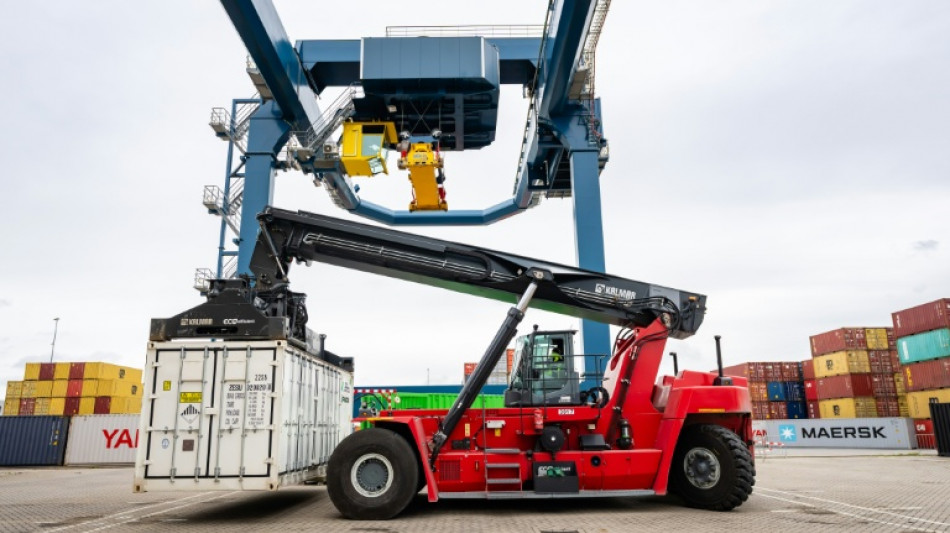
Dutch lead charge on electric inland vessels / Photo: Etienne Hessels - AFP

 In Bangladesh, Pakistan's Jinnah photo stirs anger

 China's robot dancers limber up for America's Got Talent final
 Green policies just good politics, says UK minister
 El Nino weather pattern enters record territory: scientist

 US networks halt Trump coverage in revolt over White House ban

 NOWPayments Releases Cross-Chain Payout Data Revealing Key Performance Benchmarks Across TRON, BNB Chain, and Solana

 COP31 host says AI climate footprint to be a summit priority
 Global stocks rally on lower oil prices, US-China hopes
 Spanish PM says unregulated AI could be 'devastating'

 From Korean Chipmakers to Leveraged Semiconductor ETFs: STARTRADER Launches 49 New 24/7 Stock and ETF CFDs

 Asia stocks rise on AI, US-China trade talks optimism

 France's Macron, Canada's Carney announce closer ties
 AI 'warning shots' focus Beijing on national security risks
 Philippine tribe in limbo over US-led tech hub

 Saudi-led coalition says Houthis fired ballistic missile at Riyadh
 Cuba works to restore power after another blackout

 Brigitte Bardot widower slams sale of star's belongings

 Indonesia accepts Malaysia's help to tackle wildfires

 Nvidia, OpenAI CEOs to attend Xi dinner at White House
 Cuba hit with seventh major blackout of the year
 Nigeria miners struggled to breathe in cell before 37 died: survivors

 Warren Buffett steps down as Berkshire Hathaway chairman

 Isolated Syrian-Druze city blames Damascus for shortages

 Kerry James Marshall: American 'blackness' painter celebrated in Europe

 Infantino 'must go', says German FA vice-president

At a windswept container park near the sprawling port of Rotterdam, a crane slots a 30-tonne white battery into a transporter vessel, enough to provide eight hours of zero-emissions freight.
The ship, the MS Den Bosch Max Groen, will ply the waterways between the ports of Rotterdam and Den Bosch using a pioneering system of swappable batteries, hailed as the world's first commercial deployment of the technology.
Organisers believe it could be game-changing for the inland waterway transport sector, while admitting there is work to be done to make it cost competitive.
The system is simple and time-efficient. While the ship unloads its cargo at one of three strategic locations near Rotterdam, a crane swaps out a depleted battery for a fully-charged one.
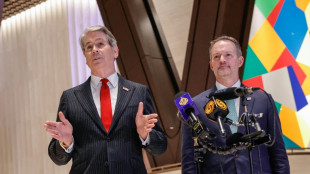
"The ship owner, or the shipper, doesn't lose any time for charging," said Michael Beemer, chief executive of Zero Emission Services (ZES), which provides the batteries.
The battery, known as a Zespack (or "six pack"), takes around three hours to charge and only 15 minutes to haul by crane into the ship, Beemer told AFP.
With this system, no CO2, nitrogen, or particulates are emitted. Some 800 tonnes of CO2 per year is saved with just this ship, said Eduard Backer, chief executive of Inland Terminals Group (ITG).
ITG has 17 terminals connecting key locations in the Netherlands and Belgium with the sea ports of Antwerp and Rotterdam, handling one million containers per year.
There are currently battery swapping facilities at three ITG terminals, but Backer said there were already plans for three more, with the network expanding rapidly.
"I have a strong, strong belief in waterway transport. We should aim to get much more cargo from the road onto the water," said Backer, 54.
This is particularly important in the Netherlands, which has one of the world's highest population densities and heavily congested roads, especially around Rotterdam.
- 'Cleaner air, cleaner water' -
As befits a country known globally for its canals, the Netherlands is a European leader when it comes to shipping goods inland.
According to European Union data, the Dutch transported 18.5 tonnes of goods per habitant via inland shipping routes in 2024, nearly 17 times the EU average.
Statistics Netherlands registered a 1.5-percent increase in the volume of goods shipped over inland waterways in 2024 compared to the previous year.
Of the roughly 10,000 inland waterway vessels in Europe, around half sail under a Dutch flag, said Beemer.
Transitioning from diesel-powered vessels to zero-emissions electric freighters is a game-changer for the local environment, he told AFP.
"We have cleaner air, cleaner water, so a cleaner living environment," he said, adding that conditions on board the ship were noticeably healthier too.
Beemer sees huge potential in the system, already being supported by corporate giants like Heineken.
"The aim is to have around eight to 10 locations live by the end of 2026," he said, with plans to expand to a minimum of 50 vessels using the swappable battery system.
The former investment banker is talking to potential clients, hoping to persuade them to become a "forerunner" in the sector and stay ahead of tighter environmental regulations that will further limit emissions.
"You'd be ready to hit the ground running when there's rules and regulations," said the 39-year-old.
The batteries are charged using 100-percent green electricity, and shippers pay using an innovative system based on the time the battery is on board and energy used.
Beemer acknowledged that the technology still has some way to go before competing with traditional diesel-fuelled vessels on cost.
"We need the market to adapt this system so we can have more scale. Scale is the key for lowering the cost and getting it more reliable for the ship owners," he said.
"It's not much more expensive. It's not competitive yet, but it will be," he promised.
A similar pilot project has run on the Yangtze River in China and in Vietnam, but the Dutch aim to be the world leader in the technology, building on its rich seafaring heritage and centuries of living and working on water.
Beemer said it's not about global competition but rather learning from other countries.
"Are we competing in meeting climate goals? Or are we wanting to meet climate goals all together?"
S.F.Lacroix--CPN