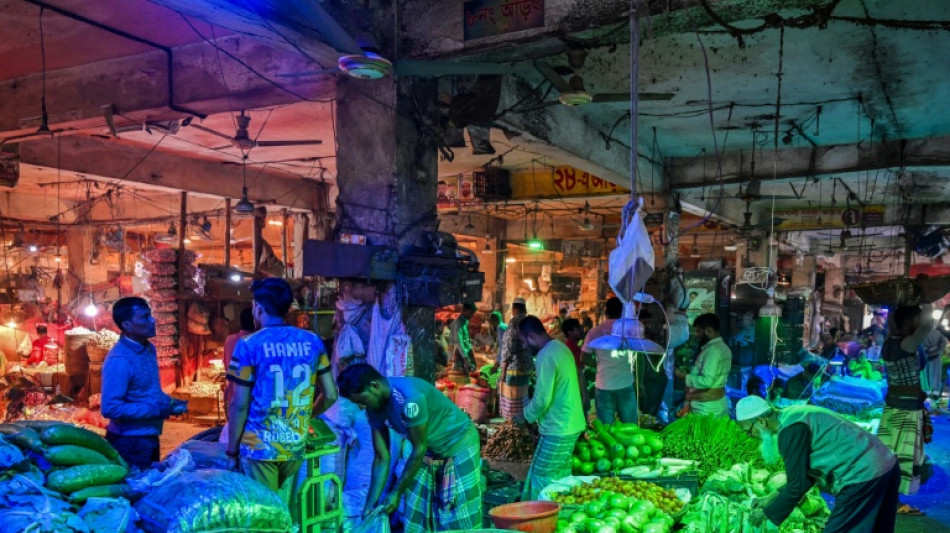
Mired in economic trouble, Bangladesh pins hopes on election boost / Photo: Munir UZ ZAMAN - AFP

 AI 'warning shots' focus Beijing on national security risks
 Philippine tribe in limbo over US-led tech hub

 Saudi-led coalition says Houthis fired ballistic missile at Riyadh

 Cuba works to restore power after another blackout
 Brigitte Bardot widower slams sale of star's belongings

 Indonesia accepts Malaysia's help to tackle wildfires
 Nvidia, OpenAI CEOs to attend Xi dinner at White House

 Cuba hit with seventh major blackout of the year

 Nigeria miners struggled to breathe in cell before 37 died: survivors

 Warren Buffett steps down as Berkshire Hathaway chairman

 Isolated Syrian-Druze city blames Damascus for shortages

 Kerry James Marshall: American 'blackness' painter celebrated in Europe

 Infantino 'must go', says German FA vice-president

 Japan's busiest rail station tests robot bins

 Backpackers fret over Australian visa crackdown

 Bank of Japan hikes rates to 31-year high to battle inflation

 AI doomsday warnings unlikely to slow IPOs but questions linger

 In Brazil's Amazon, the hunt for oil fuels hopes and fears

 Baby orangutans in India expose 'frightening' scale of trafficking

 Oversight Board blasts 'inadequate' Meta safeguards for AI deepfakes

 Harry makes first public appearance since return to UK

 Princess Diana's brother makes new explosive claims against Charles

 Trump admin overhauls key protection for endangered species

 Mbappe draws political fire over Ceuta t-shirt controversy

 Third malaria death in Germany from outbreak tied to Frankfurt airport

Textile worker Sabina Khatun is in limbo after losing her job during sweeping factory closures, caught up like millions in Bangladesh in the fallout from a 2024 uprising that toppled years of autocratic rule.
In the 18 months since the collapse of Sheikh Hasina's government, Bangladesh has endured political turmoil but also biting economic pain -- with many hoping for a rebound under new leadership after elections on February 12.
"I've gone to a dozen factories looking for work," said Khatun, 30, who lost her job last year in garment hub Narayanganj.
"There are no openings."
Bangladesh, the world's second-largest producer of garments, has seen 240 factories shut since the August 2024 uprising, many of them textile industries, according to government data.
That has dealt a blow to a major sector that forms 80 percent of Bangladesh's export economy.
Some of the factories were owned by Hasina's cronies, who have since fled.
Many workers like Khatunhave been laid off, with the closures rippling through the wider labour market.
"Small markets, stores and low-cost cosmetics shops catering to female garment workers have all disappeared," said Iqbal Hossain, a trade union leader.
- 'Law and order' -
The economy has improved since the chaotic aftermath of Hasina's ouster, but there are wider issues in the country of 170 million people.
Salehuddin Ahmed, who holds the finance portfolio in the interim government, said the economy had shifted from the "intensive care unit to the high dependency unit".
Bangladesh's economy is expected to grow 4.7 percent this year, up from 3.7 percent in 2025, according to the International Monetary Fund.
Fahmida Khatun, head of the Dhaka-based Centre for Policy Dialogue, said foreign reserves have risen and the banking sector is showing signs of repair.
"But unemployment is rising, merchandise exports have declined, imports of heavy machinery and raw materials remain weak, and private-sector credit has hit a historic low," she told AFP.
"The gradual deterioration of law and order has emerged as the biggest threat."
In August, Bangladesh struck a trade deal with the United States -- a key market for ready-made garment exports -- scaling back President Donald Trump's threatened tariffs to 20 percent.
But US orders "remained static", said Mohiuddin Rubel, former head of the Bangladesh Garment Manufacturers and Exporters Association, noting that some new factories had opened.
They, however, have had little impact on the labour market, as the unemployment rate remains high.
Merchandise exports still fell for a fifth consecutive month in December 2025, and while inflation slightly eased, it continues to erode what people can afford.
"We don't buy fish or meat anymore," said unemployed textile worker Khatun, who continues her search for a job. "Everyone tells me to come back after the election".
Syed Sultan Uddin Ahmed, head of the Bangladesh Institute of Labour Studies, said the interim government had done little to help the bruised textile sector.
"Some of these were big factories employing thousands of workers," he said.
"In some cases, the government sold factory land and assets to clear workers' dues -- but there was no initiative to restart viable factories."
Unemployment is at 4.63 percent, according to the latest government figures released in May, up from 3.95 percent recorded during the same period the previous year.
- 'No quick fix' -
Once juggling multiple odd jobs, Helal Uddin now ekes out a living running a food cart.
"It's hard to pay the house rent with the meagre amount I earn now," the 33-year-old told AFP, gloomy about the "sharp rise" in the price of rice he serves.
"The economy is not moving," Uddin said. "It's stuck. We are all waiting for the election."
Hasina, 78, was once praised for overseeing Bangladesh's rapid economic rise, with growth topping seven percent annually and per capita GDP more than quadrupling since 2000.
But she also presided over an autocratic government that crushed dissent, and now faces court cases alleging the looting of national wealth.
She is a convicted fugitive in hiding in India, sentenced to death in absentia for crimes against humanity.
Economist Fahmida Khatun warned that the new administration will face many challenges.
"People hope things will improve after the election, but many of the problems are structural," she said. "There is no quick fix."
Y.Ponomarenko--CPN