
OECD raises world growth outlook as tariffs contained, for now / Photo: JOEL SAGET - AFP

 Typhoon Dujuan leaves four dead in Japan, 45,000 houses without power

 Stocks rise on AI buzz, drop in oil prices

 UK king braces as memoir by Diana's brother goes on sale

 Infantino proposes consulting federations to reform FIFA
 South Africa arrests three more suspects, after nine women murdered
 Paramount settles with US states to clear Warner Bros. mega-merger
 Climate crisis a job for world leaders, not just activists: UK FM
 COP31 host says AI's climate footprint to be a summit priority

 EU proposes energy rating for data centres

 TradersYard Shifts Focus to Futures Trading

 Indonesia doing 'everything' but struggling to curb fires

 FQ-42 Vengeance Finds New Home at Creech Air Force Base
 Multi-Asset Trading Venue Monochrome Exchange Announces IEO of Its Native Token, $MCR
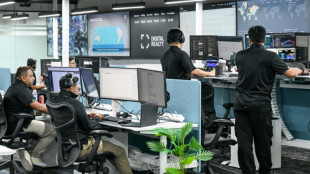 Data centre command hub keeps AI up and running

 Leo XIV, first US pope transcends his restrained style

 France's debt climbs to highest since 1978: ministry

 Thousands protest inaction over climate crisis in Switzerland

 UK actor Naomi Watts honoured at Spain film festival

 Trump signs bill authorizing sweeping Russia sanctions

 Anthropic picks Accenture for in-house AI safety evaluation

 Hushing and hedging: US companies retreat on climate

 Crisis-wracked Volkswagen warns of 10-bn-euro hit to profits

 Shakira to cap off world tour with Madrid 12-gig run

 Isolated Syrian-Druze city shortages

 UNESCO can be 'moderator' in AI debate: chief to AFP

The world economy will grow more than previously forecast this year after absorbing the shock of US President Donald Trump's tariffs, but their full impact remains uncertain, the OECD said Tuesday.
In June, the Paris-based organisation had cut its forecast from 3.1 percent to 2.9 percent, warning at the time that Trump's tariffs would stifle the world economy.
But in an updated outlook on Tuesday, it raised the projection to 3.2 percent, saying the economy "proved more resilient than anticipated" in the first half of 2025.
"The impact of tariffs is taking longer to reach the economy," OECD chief economist Alvaro Pereira told AFP in an interview.
The OECD report said "front-loading" -- companies rushing to import goods ahead of Trump's tariffs -- "was an important source of support".
The economy also got a boost from strong AI-related investments in the United States and government spending in China.
The updated figure is still a slight slowdown from 3.3 percent in 2024.
"The full effects of tariff increases have yet to be felt -- with many changes being phased in over time and companies initially absorbing some tariff increases through (profit) margins," the Organisation for Economic Co-operation and Development said.
"But (they) are becoming increasingly visible in spending choices, labour markets and consumer prices," the report said.
- 'Significant risks remain' -
World growth is due to slow to 2.9 percent in 2026 "as front-loading ceases and higher tariff rates and still-high policy uncertainty dampen investment and trade", the OECD said.
Trump imposed a baseline 10 percent tariff on imports from around the world in April.
He later hit dozens of countries with even higher duties, but the US leader also left the door open for negotiations, striking deals with Britain, Japan and the European Union, among others.
The United States has yet to find a compromise with China, though the world's two biggest economies have temporarily de-escalated their tit-for-tat tariffs while they negotiate.
The overall effective US tariff rate rose to an estimated 19.5 percent in August, the highest level since 1933, the OECD said.
"Significant risks to the economic outlook remain," the OECD said.
"Amid ongoing policy uncertainty, a key concern is that bilateral tariff rates could be raised further on merchandise imports," it said.
The OECD also warned that inflation could rise as food and energy prices climb, and companies begin to pass the cost of higher tariffs to consumers.
"On the upside, reductions in trade restrictions or faster development and adoption of artificial intelligence technologies could strengthen growth prospects," it said.
- Growth due to slow -
The OECD also upgraded the growth outlook of the United States for 2025 from 1.6 percent to 1.8 percent but that is much slower than 2.8 percent last year.
US growth is expected to slow even further to 1.5 percent next year due to higher tariffs and elevated "policy uncertainty".
The OECD also pointed to the impact of Trump's immigration crackdown and cuts in the federal workforce.
The report was written before the White House raised the H-1B visa fee for high-skilled workers to $100,000, which has rattled the tech industry.
"We do think that continuing to attract high-skilled individuals from the United States or from around the world is a key strength of the US economy," said Pereira, noting that there is a labour shortage in the tech sector.
The OECD raised the growth outlook of other major economies: to 4.9 percent in China, 1.2 percent in the eurozone and 1.1 percent in Japan.
But it flagged a drop in industrial production in recent months in several countries, including Brazil, Germany and South Korea, and moderating consumption in the United States, China and the eurozone.
P.Kolisnyk--CPN