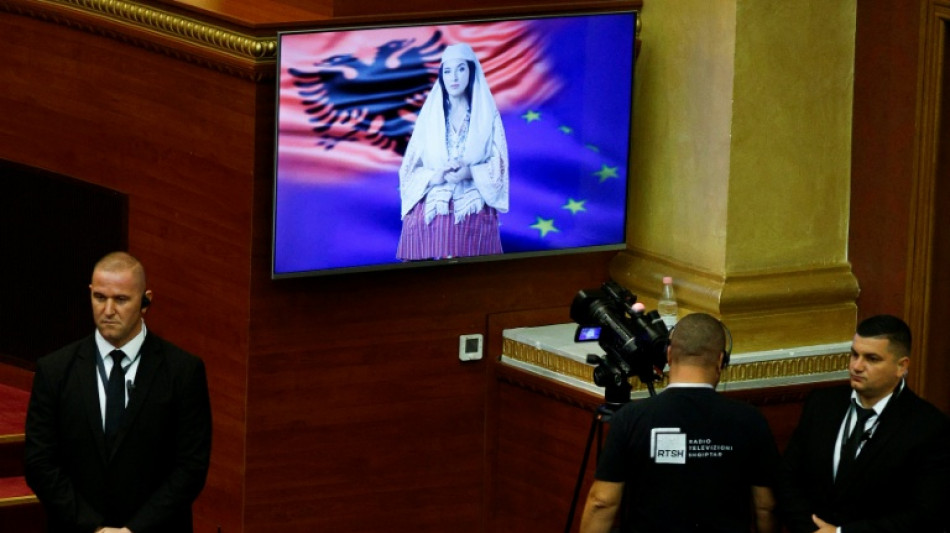
Experts question Albania's AI-generated minister / Photo: Adnan Beci - AFP

 Typhoon Dujuan leaves four dead in Japan, 45,000 houses without power
 Stocks rise on AI buzz, drop in oil prices

 UK king braces as memoir by Diana's brother goes on sale
 Infantino proposes consulting federations to reform FIFA
 South Africa arrests three more suspects, after nine women murdered
 Paramount settles with US states to clear Warner Bros. mega-merger
 Climate crisis a job for world leaders, not just activists: UK FM
 COP31 host says AI's climate footprint to be a summit priority
 EU proposes energy rating for data centres

 TradersYard Shifts Focus to Futures Trading

 Indonesia doing 'everything' but struggling to curb fires
 FQ-42 Vengeance Finds New Home at Creech Air Force Base
 Multi-Asset Trading Venue Monochrome Exchange Announces IEO of Its Native Token, $MCR
 Data centre command hub keeps AI up and running
 Leo XIV, first US pope transcends his restrained style
 France's debt climbs to highest since 1978: ministry
 Thousands protest inaction over climate crisis in Switzerland
 UK actor Naomi Watts honoured at Spain film festival
 Trump signs bill authorizing sweeping Russia sanctions
 Anthropic picks Accenture for in-house AI safety evaluation
 Hushing and hedging: US companies retreat on climate
 Crisis-wracked Volkswagen warns of 10-bn-euro hit to profits

 Shakira to cap off world tour with Madrid 12-gig run

 Isolated Syrian-Druze city shortages

 UNESCO can be 'moderator' in AI debate: chief to AFP

Last week, Albania announced that an AI-generated minister would take charge of a new public tenders portfolio.
"Diella" is touted as the world's first virtual minister, and Albanian Prime Minister Edi Rama promised the appointment would end rampant corruption in government contracts -- a major obstacle to the Balkan nation's accession to the European Union.
But serious technical, political and ethical questions have been raised about the virtual lawmaker.
- Truly incorruptible? -
In announcing Diella's appointment, Rama claimed that public tenders would now be "100 percent free of corruption".
"Diella never sleeps, she doesn't need to be paid, she has no personal interests, she has no cousins, because cousins are a big issue in Albania," according to the prime minister, whose country ranks 80th out of 180 in Transparency International's corruption index.
Albanian politicians are frequently implicated in corruption scandals linked to public funds.
The former mayor of the capital Tirana was detained while in office and remains in custody, suspected of corruption in connection with the awarding of government contracts.
The opposition leader and former prime minister Sali Berisha is also suspected of awarding public contracts to his associates.
- Is Diella the solution? -
Not really, according to experts.
"Like any AI system, she depends entirely on the quality and consistency of the data and the reliability of the models behind her," said Erjon Curraj, an expert in digital transformation and cybersecurity.
The exact workings of Diella remain unknown, but it likely relies on Large Language Models (LLM) to respond to queries -- similar to the vast amounts of text that power generative chatbots such as ChatGPT or Gemini.
But if input data is incomplete, biased, or outdated, the AI's decisions will reflect those flaws, and it "might misinterpret documents, wrongly flag a supplier, or miss signs of collusion", Curraj said.
"LLMs reflect society; they have biases. There's no reason to believe it solves the problem of corruption," computer scientist and artificial intelligence specialist Jean-Gabriel Ganascia said.
"Assuming a machine has no biases implies we must submit to the machine," Ganascia said.
- Who has control? -
The Albanian opposition has appealed to the Constitutional Court over concerns about who would be accountable for the AI's decisions.
"Who will control Diella?" Berisha asked the parliament.
Ganascia agrees that questions of accountability and control are key when it comes to AI.
"If public decision-making is entrusted to a machine, it means there is no longer accountability; we are reduced to the state of slaves."
"What worries me is the idea of a machine governing, offering the 'right' answer, and preventing any deliberation," the researcher, who is also a philosopher, said.
"A politician takes responsibility, but here, the idea is that the machine is perfect, and we cannot go against its decisions anyway."
Appearing to address these concerns, a decree published Thursday states that Rama "also holds responsibility for the creation and operation of the virtual Ministry of Artificial Intelligence Diella."
- Old corruption, new software -
The appointment grabbed headlines around the world, something the prime minister excels at whether by attending international meetings in sneakers, announcing a TikTok ban, creating a Bektashi State modelled on the Vatican, or opening migrant camps to house people intercepted at sea by the Italian government.
But achieving his goals is a different issue.
TikTok remains easily accessible in Albania, only a few dozen men have been transferred to the migrant camps and the initiative's legality is still being contested by Italian courts.
Little public progress has been made either on the Bektashi State since its announcement a year ago.
As for Diella, whose face is that of the well-known Albanian actress Anila Bisha, who signed a contract expiring in December for the use of her image, it is unclear whether her appointment will survive the Constitutional Court's scrutiny.
It is also uncertain whether it will comply with the standards of the European Union, which Albania hopes to join within the next five years.
"So far, there is no information about how Diella actually works," Albanian political scientist Lutfi Dervishi said.
"If a corrupt system provides manipulated data, or filters are set up on what it must not see, Diella will merely legitimise old corruption with new software."
L.Peeters--CPN