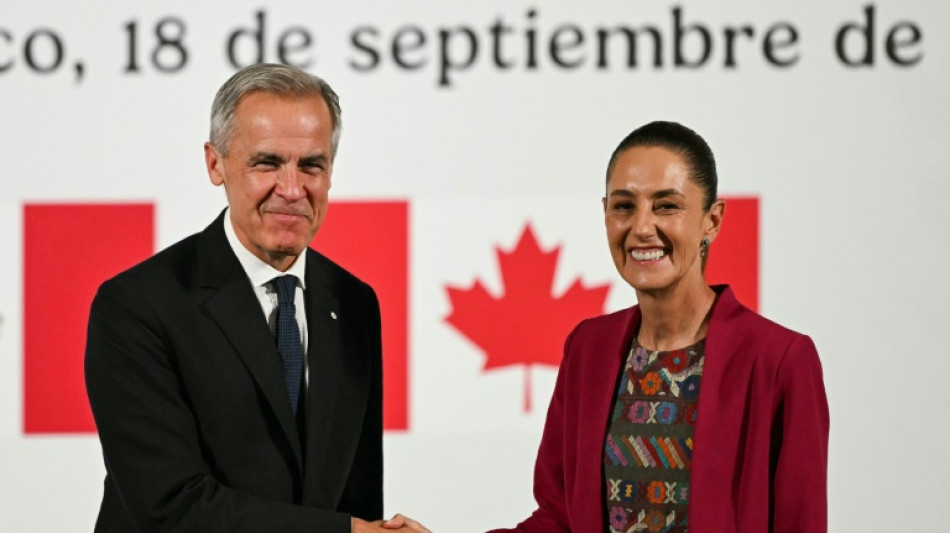
Canada, Mexico leaders agree to seek 'fairer' trade deal with US / Photo: Yuri CORTEZ - AFP

 Stocks rise on AI buzz, oil prices cool

 In Bangladesh, Pakistan's Jinnah photo stirs anger

 China's robot dancers limber up for America's Got Talent final
 Green policies just good politics, says UK minister
 El Nino weather pattern enters record territory: scientist

 US networks halt Trump coverage in revolt over White House ban

 NOWPayments Releases Cross-Chain Payout Data Revealing Key Performance Benchmarks Across TRON, BNB Chain, and Solana

 COP31 host says AI climate footprint to be a summit priority
 Global stocks rally on lower oil prices, US-China hopes

 Spanish PM says unregulated AI could be 'devastating'

 From Korean Chipmakers to Leveraged Semiconductor ETFs: STARTRADER Launches 49 New 24/7 Stock and ETF CFDs

 Asia stocks rise on AI, US-China trade talks optimism

 France's Macron, Canada's Carney announce closer ties

 AI 'warning shots' focus Beijing on national security risks

 Philippine tribe in limbo over US-led tech hub

 Saudi-led coalition says Houthis fired ballistic missile at Riyadh

 Cuba works to restore power after another blackout

 Brigitte Bardot widower slams sale of star's belongings

 Indonesia accepts Malaysia's help to tackle wildfires

 Nvidia, OpenAI CEOs to attend Xi dinner at White House

 Cuba hit with seventh major blackout of the year
 Nigeria miners struggled to breathe in cell before 37 died: survivors

 Warren Buffett steps down as Berkshire Hathaway chairman

 Isolated Syrian-Druze city blames Damascus for shortages

 Kerry James Marshall: American 'blackness' painter celebrated in Europe

The leaders of Canada and Mexico on Thursday defended their three-way free-trade deal with the United States, while agreeing to try and make it "fairer" in the face of tariff pressure from President Donald Trump.
After talks in Mexico with President Claudia Sheinbaum, Canadian Prime Minister Mark Carney said the pair were "committed" to the United States-Mexico-Canada Agreement (USMCA), saying it had "helped make North America the economic envy of the world."
Sheinbaum said she was "optimistic" about the future of the accord, which Trump wants to renegotiate on terms more favorable to US manufacturers.
"I believe that the USMCA will prevail," she told a joint press conference with Carney.
The agreement, in place since 2020, is up for review next year.
It is critical to the economies of both Mexico and Canada, which send around 80 percent and 75 percent of their exports to the United States, respectively.
Trump has already imposed tariffs on some exports from Canada and Mexico that don't fall under the agreement and threatened further punishment if they fail to curb cross-border migration and drug trafficking.
The USMCA replaced the North American Free Trade Agreement signed in the 1990s.
The successive deals fundamentally reshaped North America's economy over three decades, creating a high degree of interdependence between the three partners.
However, Trump's trade war has already significantly disrupted cross-border supply chains.
He has hit Canadian goods that fall outside the agreement with 35-percent duties and similar Mexican goods with 25-percent levies.
The tariffs are hurting Canada's crucial auto, steel and aluminum sectors, leading to job losses, and also causing pain for Mexico's auto and steel industries.
"We complement the United States, we make them stronger, we are all stronger together," Carney said.
The fact that Washington was already reviewing UMSCA was "a good thing," he added, arguing that it meant decisions on tariffs and local content could be "taken in a calm, deliberate manner."
- 'Move forward together' -
Both Sheinbaum and Carney have been attempting to reach side deals with Trump. But on Thursday they insisted they were not in competition with each other.
"We will move forward together," said Carney, holding up next year's FIFA World Cup, to be jointly hosted by the United States, Canada and Mexico as an expression of the countries' synergies.
Anxious to diversify their exports, Carney and Sheinbaum also announced plans to boost bilateral trade and investment, using Canadian and Mexican ports rather than shipping goods across the United States.
Trade between the two countries last year totaled under $32 billion -- more than 20 times less than the amount each has with the United States.
Mexico is Canada's third-largest partner and Canada is Mexico's fifth-largest.
The two leaders also announced plans to cooperate more closely on foreign affairs, agriculture, the environment and security, among other areas.
Some Canadian politicians have complained that Trump unfairly lumped their country, a small player in the global drug trade, with Mexico in terms of fentanyl trafficking.
"The unfortunate fact is that there are gangs from one country in another country but also vice-versa," Carney said.
St.Ch.Baker--CPN