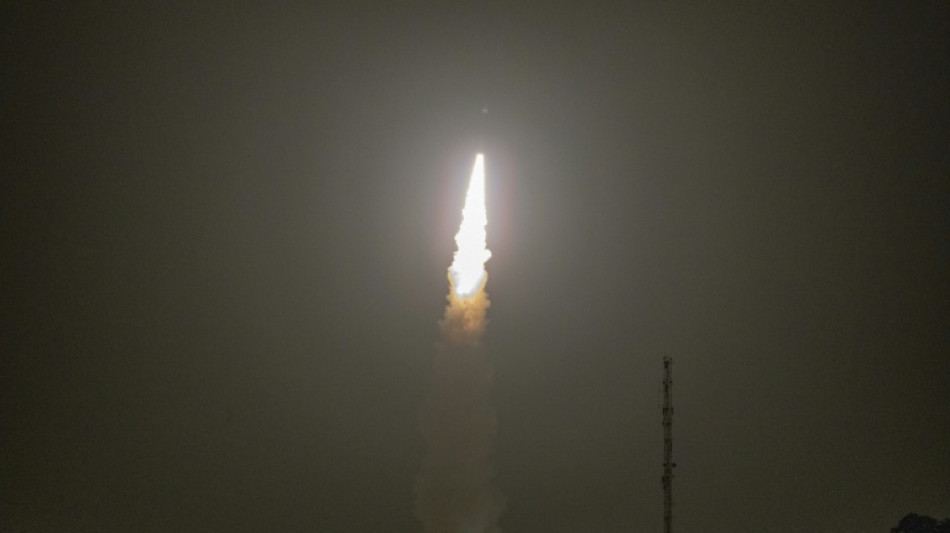
Taiwan running out of time for satellite communications, space chief tells AFP / Photo: Ronan LIETAR - AFP

 Stocks rise on AI buzz, oil prices cool
 In Bangladesh, Pakistan's Jinnah photo stirs anger

 China's robot dancers limber up for America's Got Talent final

 Green policies just good politics, says UK minister

 El Nino weather pattern enters record territory: scientist

 US networks halt Trump coverage in revolt over White House ban

 NOWPayments Releases Cross-Chain Payout Data Revealing Key Performance Benchmarks Across TRON, BNB Chain, and Solana

 COP31 host says AI climate footprint to be a summit priority
 Global stocks rally on lower oil prices, US-China hopes
 Spanish PM says unregulated AI could be 'devastating'

 From Korean Chipmakers to Leveraged Semiconductor ETFs: STARTRADER Launches 49 New 24/7 Stock and ETF CFDs
 Asia stocks rise on AI, US-China trade talks optimism

 France's Macron, Canada's Carney announce closer ties
 AI 'warning shots' focus Beijing on national security risks
 Philippine tribe in limbo over US-led tech hub

 Saudi-led coalition says Houthis fired ballistic missile at Riyadh

 Cuba works to restore power after another blackout

 Brigitte Bardot widower slams sale of star's belongings

 Indonesia accepts Malaysia's help to tackle wildfires

 Nvidia, OpenAI CEOs to attend Xi dinner at White House

 Cuba hit with seventh major blackout of the year
 Nigeria miners struggled to breathe in cell before 37 died: survivors

 Warren Buffett steps down as Berkshire Hathaway chairman

 Isolated Syrian-Druze city blames Damascus for shortages

 Kerry James Marshall: American 'blackness' painter celebrated in Europe

Taiwan's space chief Wu Jong-shinn says the "clock is ticking" for the democratic island to launch its own satellites to secure internet and phone services during a potential conflict with China.
The island faces the constant threat of an invasion by Beijing, which claims the island is part of its territory and in recent years has intensified military pressure.
Taiwan needs 150 of its own low Earth orbit (LEO) satellites for "basic communication resilience" in case the subsea telecoms cables connecting the island with the rest of the world are damaged or cut, Wu told AFP in an interview.
It currently has none.
"We need to build up our own technology. But as you know... the clock is ticking," said Wu, director general of Taiwan Space Agency.
"We need to speed up."
Taiwanese authorities have already seen what happens when subsea cables are disconnected.
In February 2023, two telecoms lines serving Taiwan's outlying Matsu archipelago were severed, disrupting communications for weeks.
Taiwan plans to launch the first of six LEO satellites 600 kilometres (373 miles) above the planet in 2027 as part of its Beyond 5G LEO Satellite programme.
US officials have previously cited 2027 as a possible timeline for a Chinese invasion of Taiwan.
In the meantime, Taiwan's Chunghwa Telecom is striking deals with satellite companies around the world to provide back-up telecommunications for the island in case of a war or natural disaster.
Starlink dominates the satellite communications sector, with 8,000 satellites lofted into orbit by Elon Musk's comparatively cheap, reusable SpaceX rockets.
But Musk's business ties with China and his previous comments that Taiwan should become part of China have angered the island.
Taiwan instead has signed a multi-million dollar deal with European company Eutelsat, the world's second-largest operator of LEO satellites.
Eutelsat has more than 600 satellites, following its 2023 merger with British firm OneWeb.
"We're developing our own technology, but it takes a while, but we can leverage the commercial resources to get us to have this communication resilience," Wu said.
But Wu said Eutelsat's satellites were not enough and other providers were needed.
Taiwan has also partnered with US company Astranis and SES of Luxembourg, and is in talks with Amazon's Kuiper and Canada's Telesat.
Eutelsat's satellite system was reportedly used in a Taiwan disaster for the first time in 2024 when a deadly 7.4-magnitude earthquake struck the east coast and knocked out communications.
- 'We can't rely on one side' -
Taiwan is light years behind the the US and Chinese space programmes.
The rival superpowers have ploughed billions of dollars sending people into orbit and launching thousands of satellites.
Taiwan currently has seven meteorological satellites and one optical remote sensing satellite in orbit, and hopes to have "more than 20" by around 2031, Wu said.
It plans to launch a second optical remote sensing satellite in November from the Vandenberg Space Force Base in California on a SpaceX rocket.
Wu said Taiwan would have its own rockets and launch site in the next decade.
When it comes to communication satellites, however, some question the economic sense of countries developing their own networks when commercial options are available.
"If you want this to work, you need a large number of them in low Earth orbit for that continuous coverage," Brad Tucker, an astrophysicist and cosmologist at the Australian National University, told AFP.
"You have to be committed to this long-term operation but also then you need to maintain it. Starlink works because they are de-orbiting their satellites every three years, putting up a new one."
But Taiwanese expert Cathy Fang said it would be "dangerous" for Taiwan to rely only on foreign satellite operators for phone and internet signal during a war.
Taiwan has learned lessons from Ukraine where Starlink has been a vital communications tool for Ukrainian forces fighting Moscow's troops.
Musk has admitted blocking a Ukraine attack on Russian warships by turning off internet access to the system.
"We can't just rely on one side," Fang, a policy analyst at the government-backed Research Institute for Democracy, Society and Emerging Technology, told AFP.
"We need to cultivate our industry."
Ch.Lefebvre--CPN