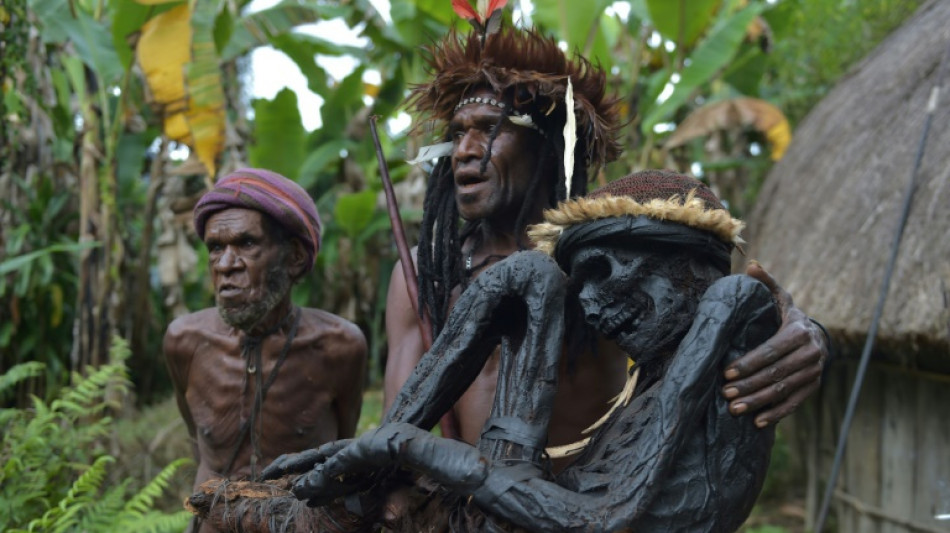
Smoke-dried bodies could be world's 'oldest mummies': study / Photo: ADEK BERRY - AFP/File

 Blueberry Strengthens MENA Presence with CMA Category 5 License and Dubai Office Launch

 In first, French presidential candidate gives birth during campaign

 A Full Moon for Every Child: STARTRADER's STARCARES Brings Support to SOS Children's Village Ho Chi Minh City

 Mongolian herders enlist new tech against harsher, drier climate

 Tata turmoil shines light on India succession woes

 OMP and PwC Alliance Moves Process Manufacturers from Siloed Supply Chain Planning to Unified Decisions

 Chile's Atacama Desert blossoms with life after El Nino rains

 Drug cocktail killed former child star Hayden Panettiere: coroner

 Trump rejects international regulation of AI

 Oil prices slide, AI stock buzz fades
 Quoin Pharmaceuticals Announces FDA Fast Track Designation for QRX003 for the Treatment of Peeling Skin Syndrome
 Tunisia says 2026 summer hottest on record

 Houthis accuse Saudi Arabia of deadly strikes as thousands flee

 STARTRADER Expands Its Chinese Equity CFD Range with CXMT and Unitree Robotics

 MEXC Expands Opportunity Compass with Stock Trading Handbook to Help Crypto Users Build Investment Knowledge

 Typhoon Dujuan leaves four dead in Japan, 45,000 houses without power
 Stocks rise on AI buzz, drop in oil prices

 UK king braces as memoir by Diana's brother goes on sale

 Infantino proposes consulting federations to reform FIFA
 South Africa arrests three more suspects, after nine women murdered

 Paramount settles with US states to clear Warner Bros. mega-merger

 Climate crisis a job for world leaders, not just activists: UK FM

 COP31 host says AI's climate footprint to be a summit priority

 EU proposes energy rating for data centres

 TradersYard Shifts Focus to Futures Trading

Some ancient societies in China and southeast Asia appear to have smoke-dried their dead, effectively mummifying them thousands of years earlier than their Egyptian counterparts, new research has found.
While the bandage-bound bodies of ancient Egypt date back perhaps as far as 4,500 years ago, the oldest previously known examples of mummification are from ancient Chilean societies.
There, the dry air of the Atacama coastline allowed for natural mummification by drying.
But the bodies retrieved by researchers from China and southeast Asia came largely from humid regions.
The scientists were initially intrigued by the contorted positions of skeletons found in burial sites in China, Vietnam, the Philippines, Laos, Thailand, Malaysia and Indonesia.
The remains appeared to have scorch marks in some places, but in patterns inconsistent with attempts at cremation.
They theorised that the contorted burials might have been possible because no soft tissue remained on the bodies -- the result of mummification by drying, a practice known in parts of Indonesia's Papua.
They tested this by analysing the composition of bone samples from the sites against control samples taken from ancient burial sites in Japan and found evidence of exposure to mostly low-temperature heat.
The intact nature of the skeletons suggested there was no attempt to cremate the bodies, and preservation was the goal.
The samples include some dating back more than 10,000 years, suggesting societies were practicing forms of mummification thousands of years earlier than previously known.
The results were "a great surprise," said Hsiao-chun Hung, senior research fellow at Australian National University.
"The bones are so ancient, and it is remarkable to discover that this tradition is so old, connecting the practices of ancient peoples with those still found in some communities today."
While the scientists said smoking was probably the "most effective option for preserving corpses in tropical climates," the process also likely held cultural significance.
Several societies in Indonesia and Australia are known to have smoke-dried bodies by binding them tightly and placing them above a continuously burning fire, often for several months.
The process allowed relatives to maintain contact with the deceased, and in some cases was believed to allow the spirit to roam freely during the day and return to a body at night.
"I believe this reflects something deeply human -- the timeless wish that our loved ones might never leave us, but remain by our side forever," Hung told AFP.
The researchers theorise that the practice may have been common in ancient Asian civilisations.
"This tradition may have been known among hunter-gatherer societies across a vast region, for many millennia," they wrote in the study, published Monday in the Proceedings of the National Academy of Sciences journal.
M.Mendoza--CPN