Malaysia's largest island state aims to be region's 'green battery' / Photo: Mohd RASFAN - AFP

 Blueberry Strengthens MENA Presence with CMA Category 5 License and Dubai Office Launch

 In first, French presidential candidate gives birth during campaign

 A Full Moon for Every Child: STARTRADER's STARCARES Brings Support to SOS Children's Village Ho Chi Minh City

 Mongolian herders enlist new tech against harsher, drier climate

 Tata turmoil shines light on India succession woes

 OMP and PwC Alliance Moves Process Manufacturers from Siloed Supply Chain Planning to Unified Decisions

 Chile's Atacama Desert blossoms with life after El Nino rains

 Drug cocktail killed former child star Hayden Panettiere: coroner

 Trump rejects international regulation of AI
 Oil prices slide, AI stock buzz fades
 Quoin Pharmaceuticals Announces FDA Fast Track Designation for QRX003 for the Treatment of Peeling Skin Syndrome
 Tunisia says 2026 summer hottest on record

 Houthis accuse Saudi Arabia of deadly strikes as thousands flee

 STARTRADER Expands Its Chinese Equity CFD Range with CXMT and Unitree Robotics

 MEXC Expands Opportunity Compass with Stock Trading Handbook to Help Crypto Users Build Investment Knowledge

 Typhoon Dujuan leaves four dead in Japan, 45,000 houses without power

 Stocks rise on AI buzz, drop in oil prices

 UK king braces as memoir by Diana's brother goes on sale

 Infantino proposes consulting federations to reform FIFA
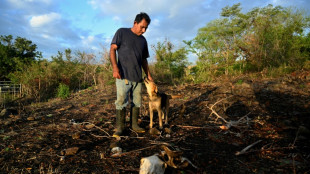
 South Africa arrests three more suspects, after nine women murdered

 Paramount settles with US states to clear Warner Bros. mega-merger
 Climate crisis a job for world leaders, not just activists: UK FM
 COP31 host says AI's climate footprint to be a summit priority

 EU proposes energy rating for data centres

 TradersYard Shifts Focus to Futures Trading

Malaysia's verdant, river-crossed state of Sarawak is charging ahead with plans to become a regional "green battery," but its renewable energy dreams could come at serious environmental cost, experts warn.
Wedged between peninsular Malaysia, Indonesia, Singapore and the Philippines, Sarawak's leadership believes it could become a keystone in a regional energy transition.
Its many rivers and streams offer potentially abundant hydro-electricity and could one day power production of green hydrogen.
It is also installing solar and touting biomass to grow its renewable capacity, with Premier Abang Johari Tun Openg telling investors in Europe last week the state is "committed to a low-carbon and sustainable energy future".
But environmental groups warn much of this green energy infrastructure contributes to deforestation and the displacement of Indigenous groups.
And for now, Sarawak's main export is a fossil fuel: liquefied natural gas.
- Harnessing hydro power -
Sarawak began generating hydroelectricity several decades ago, and is currently building a fourth hydro-power plant.
They currently account for around 3,500 megawatts -- enough to light about two to three million Southeast Asian households daily.
Its first floating solar field is already producing around 50 megawatts, and more than a dozen others are planned, Chen Shiun, senior vice president of Sarawak Energy Corporation, told AFP.
With a population of fewer than three million, the huge potential energy surplus is obvious, he said.
By 2030, Sarawak aims to generate around 10,000 megawatts, mostly from hydropower, with solar and natural gas contributing.
It wants to supply neighbouring Sabah state and Brunei, and potentially mainland Malaysia, Singapore and the Philippines.
The state's ambitions are "bold and promising," and send "a strong signal for accelerating the region's energy transition," Shabrina Nadhila, an Asia analyst at energy think-tank Ember, told AFP.
- 'Good example' -
Southeast Asia's power demands have more than doubled in the last decade, and will only grow further as the expanding middle class installs air conditioning and energy-hungry data centres emerge.
Kuala Lumpur is hoping the growing demand will re-energise a long-mooted electricity grid connecting members of the 10-country Association of Southeast Asian Nations (ASEAN).
"Sarawak is a good example that we can learn from, especially when we talk about the APG (ASEAN Power Grid)," top Malaysian energy official Zaidi Mohd Karli told AFP.
Already, a 128-kilometre (80-mile) cross-border electricity connection is bringing hydropower from Sarawak to neighbouring Indonesia.
The state is also learning from other ASEAN countries such as Laos, which launched a similar hydro-powered plan in February, aiming to exchange around 1,500 megawatts of electricity with China by next year.
- Environmental fears -
But the state's grand aspirations remain dogged by environmental concerns over the destruction of ancient tropical rainforests for hydropower construction and timber logging.
"Although Sarawak has the lowest emissions grade factor by far of any state in Malaysia, it also has the largest rate of deforestation," Adam Farhan, of environmental watchdog RimbaWatch, told AFP.
"A large part of that can be attributed to hydropower."
More than 9,000 Indigenous people were relocated from Bakun to make space for one of Southeast Asia's largest dams, commissioned in 2011.
Almost 70,000 hectares -- an area about the size of Singapore -- of forest ecosystem was flooded, according to several environmental organisations and academic studies.
Relocation and compensation issues continue even today and there are fears of repeat scenarios and exclusion of local communities as new hydropower projects launch elsewhere, environmental groups said.
"The expansion of large hydropower infrastructure in Sarawak raises important environmental and social concerns," Ember's Nadhila said.
"To address these challenges, it is crucial to enforce strict and comprehensive environmental and social safeguards," she warned.
Farhan from RimbaWatch added: "Sarawak needs to do a lot more to sort out its Indigenous rights issues and its deforestation issues before I think it could call itself a 'green battery' for Southeast Asia."
H.Cho--CPN