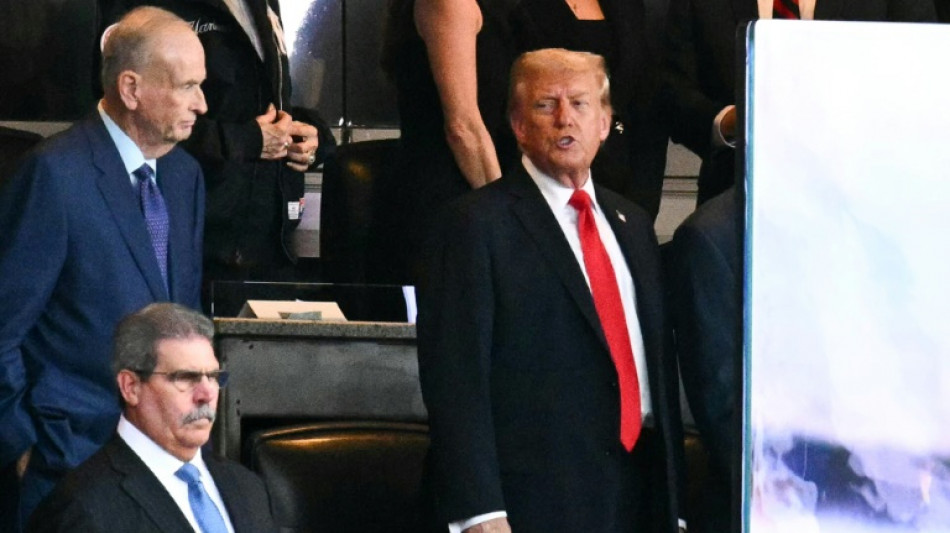
Airstrikes, drones, tariffs: being US friend not what it used to be / Photo: Mandel NGAN - AFP/File

 Blueberry Strengthens MENA Presence with CMA Category 5 License and Dubai Office Launch
 In first, French presidential candidate gives birth during campaign

 A Full Moon for Every Child: STARTRADER's STARCARES Brings Support to SOS Children's Village Ho Chi Minh City

 Mongolian herders enlist new tech against harsher, drier climate
 Tata turmoil shines light on India succession woes
 OMP and PwC Alliance Moves Process Manufacturers from Siloed Supply Chain Planning to Unified Decisions
 Chile's Atacama Desert blossoms with life after El Nino rains

 Drug cocktail killed former child star Hayden Panettiere: coroner
 Trump rejects international regulation of AI
 Oil prices slide, AI stock buzz fades

 Quoin Pharmaceuticals Announces FDA Fast Track Designation for QRX003 for the Treatment of Peeling Skin Syndrome

 Tunisia says 2026 summer hottest on record

 Houthis accuse Saudi Arabia of deadly strikes as thousands flee

 STARTRADER Expands Its Chinese Equity CFD Range with CXMT and Unitree Robotics

 MEXC Expands Opportunity Compass with Stock Trading Handbook to Help Crypto Users Build Investment Knowledge

 Typhoon Dujuan leaves four dead in Japan, 45,000 houses without power

 Stocks rise on AI buzz, drop in oil prices

 UK king braces as memoir by Diana's brother goes on sale

 Infantino proposes consulting federations to reform FIFA
 South Africa arrests three more suspects, after nine women murdered
 Paramount settles with US states to clear Warner Bros. mega-merger
 Climate crisis a job for world leaders, not just activists: UK FM
 COP31 host says AI's climate footprint to be a summit priority
 EU proposes energy rating for data centres

 TradersYard Shifts Focus to Futures Trading

Donald Trump returned to the White House vowing always to put America first. In recent days, even longtime US allies have found out the hard way that friendship has limits.
Russia, which has rebuffed Trump's pleas for a ceasefire in Ukraine, apparently fired 17 drones that landed Wednesday in Poland -- whose security is guaranteed by the US-backed NATO alliance and whose president visited the White House the previous week.
A day earlier, Qatar -- home to the largest US air base in the Middle East and classified by Washington as a major non-NATO ally -- saw Israel carry out airstrikes targeting Palestinian militants Hamas.
Israeli Prime Minister Benjamin Netanyahu, who is close to Trump's political base, attacked even though Qatar has assiduously courted the US president including with a controversial gift of a luxury jet.
Also in recent weeks, zealous US immigration agents, fulfilling Trump's promise of mass deportations, rounded up hundreds of South Korean workers at a Hyundai-LG battery plant in the state of Georgia, stunning the treaty-bound US ally that had been promising greater investment.
Trump has also ramped up sanctions on India, courted for decades by leaders of both parties, drawing outrage in a democracy long seen by the United States as a counterweight to fellow billion-plus power China.
Trump said he was taking action over India's purchases of oil from Russia but in the case of Russian President Vladimir Putin he has favored diplomacy.
Trump appeared peeved that Indian Prime Minister Narendra Modi, defying a chorus of leaders who go out of the way to congratulate Trump, played down US efforts in an India-Pakistan ceasefire.
"The bigger context here, it's weakness, chaos and vanity," said Damian Murphy, a former congressional aide who is senior vice president of national security and international policy at the left-leaning Center for American Progress.
"Netanyahu and Putin are pushing for advantage, sensing weakness, and getting away with things that they shouldn't be able to get away with," he said.
Murphy said the events went against Trump's frequent boasts that Putin would not have invaded Ukraine in 2022 if Trump were president at the time instead of Joe Biden.
"Increasingly, we're seeing governments around the world sensing weakness and testing the administration," he said.
- No longer 'world's police force' -
Trump and his advisors insist they are putting core US interests first and scaling back decades of wasteful and unnecessary commitments -- a sharp contrast with Biden's promises to emphasize alliances first.
On South Korea and India, Trump aides say he is holding up US partners to the same or higher standards expected of all.
The US president has mused that Russia's drones could have been an error, an idea rebutted by Poland.
Trump's Ukraine envoy, former general Keith Kellogg, traveled to Kyiv and posted that he was carrying out "America First diplomacy in action" by continuing to seek ways of "securing peace abroad and stopping endless wars."
Trump acknowledged concerns with Israel's attack in Qatar -- where Hamas leaders were discussing a new US ceasefire proposal in Gaza -- but said Washington found out too late to stop it.
The episode had striking parallels to June, when Israel attacked Iranian nuclear sites just as the United States was pursuing diplomacy with Tehran.
For both Russia and Israel, "there's a perception that Trump is going to allow certain actions to go unpunished," said Paul Poast, a University of Chicago political scientist who has studied alliances.
Netanyahu has calculated that Trump will ultimately support Israel even when upset, while Putin believes he can be "pushing the envelope" as Trump, at least for now, still hopes to broker a deal.
But Poast also said the world is seeing more conflict that at any time since World War II, a chaos Trump himself noted when running for president, and that the United States is no longer the overwhelming unipolar power as China rises and Russia grows assertive.
"I think these are smaller instances of a much larger trend, which is this emboldening of states and actors to be able to take military action and engage in conflict because there's not the same level of US engagement to be able to be the world's police force," he said.
A.Zimmermann--CPN