Italy approves plans for world's longest suspension bridge / Photo: Andreas SOLARO - AFP/File

 As Moscow steps up attacks, Kyiv residents brace for harsh winter

 Markets mixed as China's Xi arrives for US talks

 Archaeological 'breakthrough' could confirm origins of Paris

 Australian PM says OpenAI hacked government health website

 Rio breaks record for rainiest September amid powerful El Nino
 Mandela Digital Extends Early Access Programme to 11 February 2027 Following Strong Response

 McDonald's to boost franchisees as inflation weighs on consumers
 Archaelogical 'breakthrough' could confirm origins of Paris

 Fendi brings disco bling, Italian style, to Milan Fashion Week

 アレックス・ボディ氏とシュテファン・ハウプト教授、ルーマニアの伝説的な美術コレクションをめぐり提携に合意

 Stocks dip, oil rises as traders eye chances of Iran deal

 Oil falls, stocks steady as Trump hails 'good' Iran talks

 Canada judge to decide prison term for suicide poison seller

 Meta leans into AI, smart glasses amid privacy pushback

 Oil prices fall after Trump hails 'good' talks with Iran

 AI political ads warp reality ahead of US midterms

 Oil prices retreat as markets welcome US-Iran talks

 French prosecutors probe secret filming of women with smart glasses

 Trump renames AI "super intelligence," rejects international oversight
 How is the EU approaching record fuel prices?

 11 hurt as teen opens fire outside school in western Turkey

 UN chief says 'Big Oil' treats atmosphere as open sewer
 Memoir by Diana's brother goes on sale after rocking UK monarchy
 Stocks climb as oil slides, AI buzz returns

 MEXC Launches “Real Stocks, Real Friends” with Rewards for Bringing Friends to Wall Street

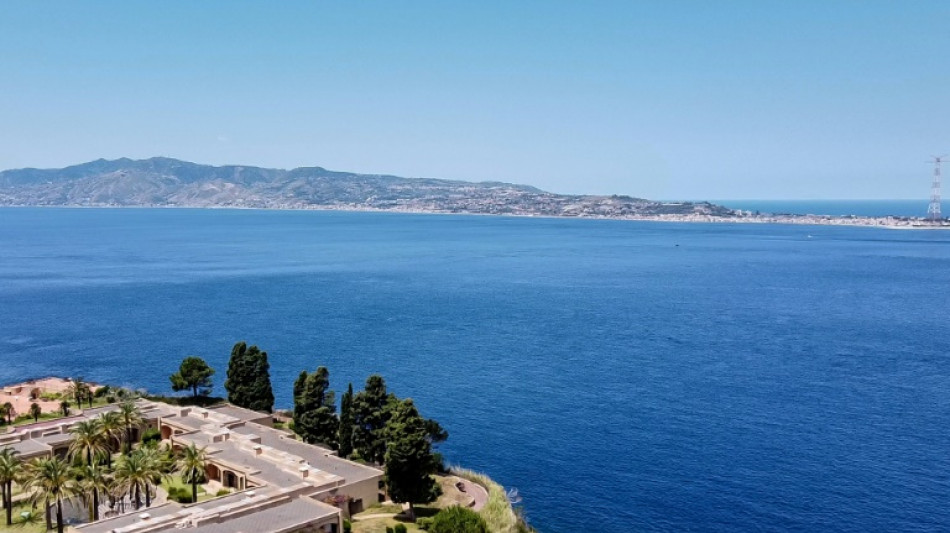
Italy's government on Wednesday approved a controversial 13.5-billion-euro ($15.6-billion) project to build what would be the world's longest suspension bridge connecting the island of Sicily to the mainland.
Prime Minister Giorgia Meloni's coalition hailed the state-funded project as an economic boost for the impoverished south of Italy -- only for critics to warn that it risks turning into a financial black hole.
Italian politicians have for decades debated a bridge over the Strait of Messina, a narrow strip of water between the island of Sicily and the region of Calabria, at the toe of Italy's boot.
But ministers say Wednesday's approval by a government committee, CIPESS, is the furthest the project has ever got.
Advocates say the bridge, due for completion by 2032, is at the cutting edge of engineering, able to withstand high winds and earthquakes in a region that lies across two tectonic plates.
It has been designed with two railway lines in the middle and three lanes of traffic on either side, with a suspended span of 3.3 kilometres (2.05 miles) -- a world record -- stretching between two 400-metre (1,300 feet) high towers.
Deputy Prime Minister Matteo Salvini, who is also responsible for transport and infrastructure, told reporters work could begin as soon as September or October.
He said the bridge and the associated new roads, railways and stations would act as a "development accelerator" for impoverished Sicily and Calabria, boosting economic growth and creating tens of thousands of jobs, many of them skilled.
Yet the project has sparked local protests over the environmental impact and the cost, with critics saying the money could be better spent elsewhere.
Nicola Fratoianni, an MP of the Greens and Left Alliance, slammed a "mega-project that will divert a huge amount of public resources" and "risks turning into a gigantic black hole".
The Italian Court of Auditors has criticised the extent of debt-laden state's investment in this one project in its assessment of the 2024 budget.
The centre-left Democratic Party warned that the project "tramples environmental, safety and European norms -- and common sense".
The public prosecutor of Messina also recently warned of the risk that organised crime would benefit from the project. Salvini on Wednesday insisted the government would do everything to prevent mafia infiltration.
- NATO spending -
The longest suspended bridge in the world is currently the 1915 Canakkale Bridge in Turkey, which has a main span of 2,023 kilometres (1,257 miles) between its towers and opened in 2022.
Many believe that Italy's ambitious project will never actually materialise, pointing to a long history of public works announced, financed, yet never completed in Italy.
The project has had several false starts, with the first plans drawn up more than 50 years ago.
Eurolink, a consortium led by Italian group Webuild, won the tender in 2006 only for the government to cancel it after the eurozone debt crisis.
The consortium remains the contractor on the revived project.
This time, Rome may have an added incentive to press ahead -- by classifying the cost of the bridge as defence spending.
Italy has agreed along with other NATO allies to massively increase its defence expenditure to five percent of GDP, at the demand of US President Donald Trump.
Of this, 1.5 percent can be spent on "defence-related" areas such as cybersecurity and infrastructure -- and Rome is hoping the Messina bridge will qualify, particularly as Sicily hosts a NATO base.
Currently the only way to cross the Messina Strait is by ferry, taking at least an hour by car and two on the train -- where individual carriages are loaded onto the ferry -- but the bridge aims to cut journey times to 10 and 15 minutes, respectively.
Meloni insisted Wednesday it was a "demonstration of Italy's willpower and technical expertise" that would "form the backbone of a faster and more modern nation".
A.Leibowitz--CPN