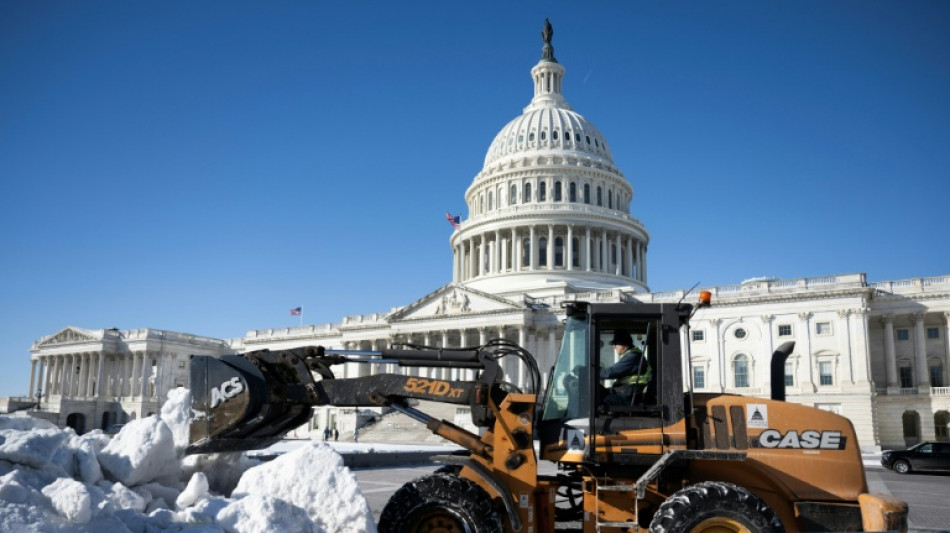
Late-January US snowstorm wasn't historically exceptional: NOAA / Photo: ANDREW CABALLERO-REYNOLDS - AFP

 AI 'warning shots' focus Beijing on national security risks

 Philippine tribe in limbo over US-led tech hub

 Saudi-led coalition says Houthis fired ballistic missile at Riyadh

 Cuba works to restore power after another blackout

 Brigitte Bardot widower slams sale of star's belongings

 Indonesia accepts Malaysia's help to tackle wildfires
 Nvidia, OpenAI CEOs to attend Xi dinner at White House

 Cuba hit with seventh major blackout of the year

 Nigeria miners struggled to breathe in cell before 37 died: survivors

 Warren Buffett steps down as Berkshire Hathaway chairman

 Isolated Syrian-Druze city blames Damascus for shortages

 Kerry James Marshall: American 'blackness' painter celebrated in Europe

 Infantino 'must go', says German FA vice-president

 Japan's busiest rail station tests robot bins

 Backpackers fret over Australian visa crackdown

 Bank of Japan hikes rates to 31-year high to battle inflation

 AI doomsday warnings unlikely to slow IPOs but questions linger

 In Brazil's Amazon, the hunt for oil fuels hopes and fears

 Baby orangutans in India expose 'frightening' scale of trafficking

 Oversight Board blasts 'inadequate' Meta safeguards for AI deepfakes

 Harry makes first public appearance since return to UK

 Princess Diana's brother makes new explosive claims against Charles

 Trump admin overhauls key protection for endangered species

 Mbappe draws political fire over Ceuta t-shirt controversy

 Third malaria death in Germany from outbreak tied to Frankfurt airport

Despite its deadly impacts, the recent winter storm that battered much of the United States was not historically exceptional, official data showed Monday.
The January 23–26 system dumped snow and crippling ice from New Mexico to Maine, with some of the worst effects felt in the South, and it was linked to more than 100 deaths.
But according to the National Oceanic and Atmospheric Administration (NOAA), the storm ranked only as a Category 3, or "major," on the Regional Snowfall Index (RSI) -- a scale that measures the societal impact of snowstorms from 0 to 5 and has been calculated back to 1900.
Category 5 storms are extremely rare, accounting for about one percent of events classified as "extreme," while Categories 0 and 1 are common, together making up 79 percent of storms.
Last week's system reached Category 3 levels in the Ohio Valley and the South, Category 2 in the Northeast, Category 1 in the Southeast, and Category 0 in the Upper Midwest and Northern Rockies and Plains.
"Snowstorms are complex and impacts can be determined by a number of varying factors, which makes communicating the severity of a snowstorm challenging," John Bateman, a NOAA meteorologist, told AFP.
"For the Regional Snowfall Index (RSI), the area of snowfall, the amount of snowfall, and the number of people living within the snowfall boundaries are used to determine a range of impacts."
By comparison, the "Blizzard of 1996" was a Category 5 storm that struck the Northeast in January of that year, affecting more than 58 million people. The "Groundhog Day Blizzard of 2011" impacted four regions and reached Category 5 intensity in the Ohio Valley and Category 3 in the South.
More notable than the snowfall itself was the prolonged blast of extreme cold that followed, hardening snow into what has been informally dubbed "snowcrete" and making cleanup efforts especially difficult.
Another storm hit the South over the weekend, with cold-stunned iguanas falling from trees in normally mild Florida, while the city of Lexington in North Carolina recorded 16 inches (40 centimeters) of snow.
Y.Ibrahim--CPN
