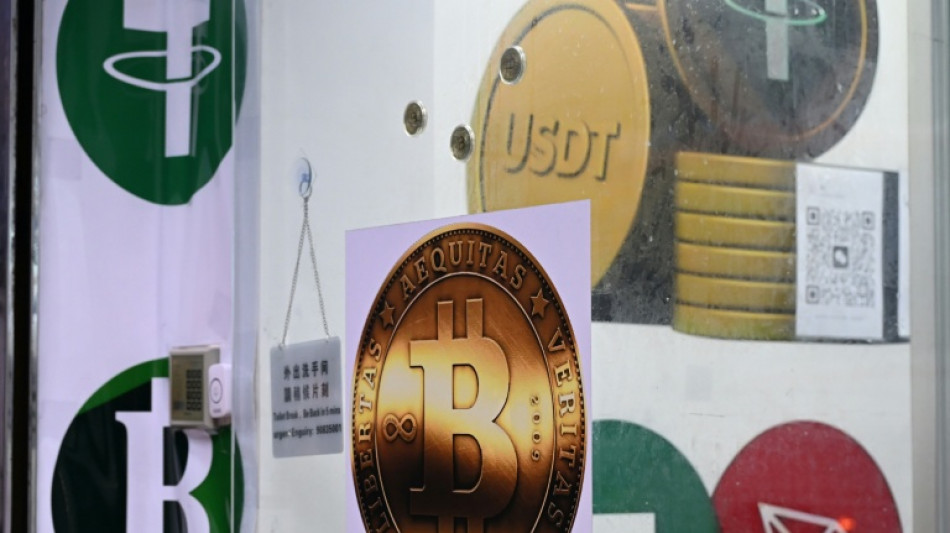
Stablecoins inspire hope, and hype, in Hong Kong / Photo: Peter PARKS - AFP

 Hungary detects invasive spotted lanternfly for first time in EU
 Forex Expo Dubai 2026 Breaks Guinness World Record Again With 23,816 Attendees

 Asian markets fall on US-China jitters as leaders meet

 As Moscow steps up attacks, Kyiv residents brace for harsh winter

 Markets mixed as China's Xi arrives for US talks

 Archaeological 'breakthrough' could confirm origins of Paris

 Australian PM says OpenAI hacked government health website

 Rio breaks record for rainiest September amid powerful El Nino

 Mandela Digital Extends Early Access Programme to 11 February 2027 Following Strong Response

 McDonald's to boost franchisees as inflation weighs on consumers
 Archaelogical 'breakthrough' could confirm origins of Paris
 Fendi brings disco bling, Italian style, to Milan Fashion Week

 アレックス・ボディ氏とシュテファン・ハウプト教授、ルーマニアの伝説的な美術コレクションをめぐり提携に合意

 Stocks dip, oil rises as traders eye chances of Iran deal

 Oil falls, stocks steady as Trump hails 'good' Iran talks

 Canada judge to decide prison term for suicide poison seller

 Meta leans into AI, smart glasses amid privacy pushback

 Oil prices fall after Trump hails 'good' talks with Iran

 AI political ads warp reality ahead of US midterms

 Oil prices retreat as markets welcome US-Iran talks

 French prosecutors probe secret filming of women with smart glasses

 Trump renames AI "super intelligence," rejects international oversight
 How is the EU approaching record fuel prices?

 11 hurt as teen opens fire outside school in western Turkey

 UN chief says 'Big Oil' treats atmosphere as open sewer

Stablecoin excitement has gripped Hong Kong as the city prepares to launch a licensing system for the less volatile type of cryptocurrency, but authorities warn against overplaying its future role in financial systems.
The digital units have been touted as a cheaper, easier way to carry out monetary transactions -- and their popularity is soaring, with more than US$270 billion in circulation worldwide.
Unlike the heady highs and lows of bitcoin, the value of most stablecoins is kept steady by being linked to an existing national currency -- mainly the dollar -- or a commodity like gold.
Stablecoins are useful internationally because they enable fast, low-cost cross-border payments, handy in markets where hard currency is limited, such as Argentina and Nigeria.
The tokens, bought and sold on digital exchanges, are also used as a safe way for crypto investors to station their profits, instead of converting to cash.
"The size of the stablecoin market has reached a level where the cash flows have geopolitical implications," said Paul Brody, global blockchain leader at consulting firm EY.
More than 99 percent of stablecoin assets are in US dollars, so for other countries "if you're not a player, you could find yourself frozen out", Brody told AFP.
The US House of Representatives this month passed an act codifying stablecoin use, which Senator Bill Hagerty said will "ensure the dominance of the US dollar".
Hong Kong's own stablecoin regulations come in on Friday, part of a push to position itself as an Asian crypto hub as US President Donald Trump's support for the sector fuels a global resurgence.
- 'Overly idealistic' -
"The opportunities are massive," said Rita Liu, whose payment company is developing a Hong Kong dollar-denominated stablecoin in a government-run trial.
"There's a wave of legitimising the digital asset industry... Hong Kong is trying to be at the forefront of that wave," said Liu, chief executive of RD Technologies.
Crypto trading has been banned since 2021 in mainland China, which sees it as a "bit too close to gambling", Brody said.
He and others think stablecoins could prove more acceptable to Beijing, which has experimented with its own "e-yuan" central bank digital currency.
Officials may first want to see how things go in the semi-autonomous territory of Hong Kong.
So far, "a few dozen institutions" have expressed interest in issuing stablecoins or requested more information, Hong Kong Monetary Authority head Eddie Yue said last week.
But he called for the public to "rein in the euphoria" over the new bill, as "in the initial stage, we will at most grant a handful of stablecoin issuer licences".
"Some discussion on stablecoins may be overly idealistic," Yue warned, especially around their "potential to disrupt the mainstream financial system".
The hype can inflate companies' stock prices, he added, a point echoed by Lily King of crypto company Cobo.
"Some applications may be influenced by public relations strategies, as stablecoin-related news often drives market sentiment," she said.
- Bigger problems -
RD's Liu, a former senior manager at Chinese payment platform Alipay, feels that "some of it is fake hype, and some is real", fuelled by "people's hope in this industry".
Stablecoins account for about seven percent of the global cryptocurrency market capitalisation, according to CoinGecko.
If they eventually become "a mainstay of the plumbing" in finance, Hong Kong could enjoy something of a "first-mover advantage", said Jonas Goltermann at Capital Economics.
Japan and Singapore already regulate stablecoins, while South Korea is exploring the possibility.
While stablecoin issuers usually assure buyers their currency is backed up by real-world reserves, they are not risk-free, and sometimes deviate from their pegged value due to market fluctuations, tech issues or problems with the underlying assets.
There is also the risk that stablecoins will become "more of a niche product" if banks work out how to make their own programmable money, Goltermann said.
"It makes sense for Hong Kong to try anything -- it's kind of on a declining path, for reasons that are not to do with technology. It's mostly about the politics, and its relationship with China," he told AFP.
"It's not like stablecoins are a silver bullet that can fix that. But that doesn't mean it can't help."
D.Avraham--CPN