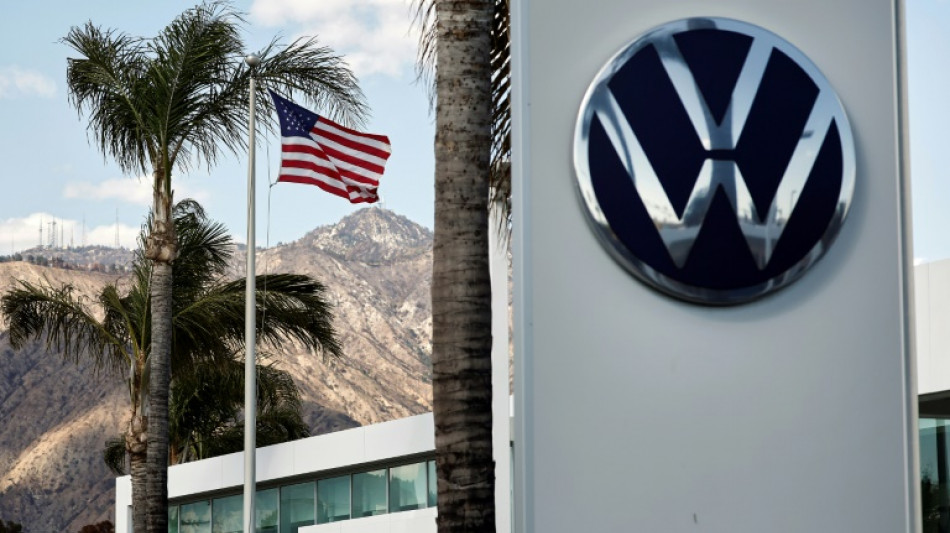
EU car industry sees relief - and pain - in US trade deal / Photo: MARIO TAMA - GETTY IMAGES NORTH AMERICA/AFP/File

 South Lebanon children return to school destroyed by Israel strike

 European stock markets climb as oil prices drop

 Asian markets mixed after recent oil surge

 Cash for nature protection: hotelier's offer to Principe islanders
 India rape cases turn focus back onto women's safety

 Rich nations should foot climate bill, says Nepal minister
 Italy bans burqas in schools, caps numbers of foreign students per class

 Napoli hoping to build new stadium, says owner
 What happens if the US bans diesel exports

 Oscar-winner Cotillard fears being moved by AI actor

 Stocks fall, oil prices rise as global bonds back under pressure
 Streamex Converts Interest Into Capital as GLDY Investment Strategy Secures $1M+ Institutional Allocation

 STARTRADER Named Best Fintech Forex Broker at Forex Expo Dubai 2026
 German think tanks urge Merz to stick with reforms after election defeats

 France's top-selling newspaper to slash jobs

 BaazEX Enters the Asian Trading Market With a New Approach to Online Forex Trading.
 Sao Tome voters want to stop exodus of 'neglected' youth
 Mexican cartels target Australia with their African meth
 Rapper-turned-PM faces first big test after Nepal disaster

 Meta launches camera-free AI glasses amid privacy pushback

 Anthropic touts AI-led biology discovery

 Stocks fall on soaring bond yields, higher oil prices

 ArcPoint Expands Globally with Institutional Intelligence Platform for Modern Investors
 Outgoing UN chief makes final climate push at New York summit

 Stocks dip, oil soars despite Trump hailing "productive" Iran talks

The car industry in the EU on Monday viewed the trade deal struck with the United States as a de-escalation -- but one that still puts sand in its gearbox.
German auto companies in particular were in for a great deal of export pain, as their share prices indicated.
Shares in Porsche, Volkswagen, BMW and Mercedes-Benz all lost more than three percent in trading Monday.
The agreement eases "the intense uncertainty surrounding transatlantic trade relations in recent months", Europe's main auto group, the European Automobile Manufacturers' Association (ACEA), said in a statement welcoming the deal "in principle".
But it noted that the 15 percent US tariffs imposed on EU goods including cars "will continue to have a negative impact not just for industry in the EU but also in the US".
German Chancellor Friedrich Merz said his country's economy -- the biggest in Europe -- would face "substantial damage" from the US tariffs agreed in the deal.
But, he said, "we couldn't expect to achieve any more".
The United States is a key market for European automakers, which last year sent nearly 750,000 of its cars to it, representing nearly a quarter of the sector's overall exports.
While the 15 percent rate is less than the 27.5 percent tariff US President Donald Trump imposed in April, it is far higher than the 2.5 percent levy European car manufacturers faced before Trump's return to the White House.
A German analyst, Stefan Bratzel, said it could be expected that US consumers would pay two-thirds of the price hike caused by the tariff, while car exporters would probably swallow the other third.
For those companies, "we might have to see whether it is possible for cost-cutting somewhere else," he said.
The 15 percent rate was similar to one reached in the deal the United States struck with Japan, another major car-exporting country.
- Will cost industry 'billions' -
For German carmakers, the United States represents around 13 percent of their exports.
In the short term, a 15 percent tariff will cost them "billions each year", said Hildegard Mueller, head of the national automobile manufacturers' association VDA.
The situation has forced all the automakers to lower their 2025 profit forecasts and to look for ways to alleviate the pressure.
BMW boss Oliver Zipse suggested in June that Europe could get rid of its own tariffs on imported vehicles made in the United States.
That could benefit his company, which last year exported 153,000 vehicles from the Americas, and imported into Europe 92,000 cars that were assembled in the United States.
Similarly, Mercedes is looking for help from the national or EU level.
"The deal reached between the EU and the US is a first, important step that needs to be followed by other measures," a company spokeswoman told AFP.
"Politicians need to keep working to get rid of obstacles getting in the way of free trade. We are counting on the EU and US to continue their constructive dialogue in the future," she said.
Volkswagen is also facing tariff hardship for vehicles it makes in Mexico for the US market, announcing that its first-quarter results had been shaved by around 1.3 billion euros ($1.5 billion) from a year earlier.
Its Porsche and Audi cars are also exposed as they have no production factories in the United States.
On Monday, Audi cut its revenue and profit targets for this year, though it said it expects them to rise next year.
Volkswagen CEO Oliver Blume has suggested reaching a side deal with the United States that would take into account investments his company could make in that country.
Volvo Cars, the Swedish carmaker owned by China's Geely Holding, has announced steep second-quarter losses because of tariffs.
The European auto sector is now lobbying the European Commission to delay the timetable for making the European car market go all-electric, and to provide some sort of industry stimulus.
With no help, European car factories, already facing uphill challenges, "will have to reduce production," said Ferdinand Dudenhoeffer, director of the Center for Automotive Research.
That, he said, could affect up to 70,000 jobs in Germany alone.
D.Goldberg--CPN