Dutch coastal village turns to tech to find lost fishermen / Photo: Nicolas TUCAT - AFP

 Trump's photo of Xi greeting carries signs of AI

 First US trial against TikTok to open Monday
 French literary prize removes novel from longlist after AI claims

 Trump accuser E. Jean Carroll finally has her damages

 Heavy fighting, internet disruption as Ethiopia conflict rages

 Asian markets mixed after oil gains

 UN approves resolution on dealing with rising sea levels
 Global stocks mostly fall as oil prices and bond yields rise
 Starbucks to close 250 more cafes in North America

 Stocks fall as oil prices rise and bonds back under pressure
 Top ECB official to resign to take up IMF role
 Eviction of pensioner puts Spain housing crisis in spotlight

 Average EU diesel price hits record 2.23 euros a litre: AFP analysis

 Whitetip Investments Marks 10 Years of Regulation, Transparency & Responsible Trading

 Stocks fall, oil prices rise as global bonds under pressure
 Hungary detects invasive spotted lanternfly for first time in EU

 Forex Expo Dubai 2026 Breaks Guinness World Record Again With 23,816 Attendees

 Asian markets fall on US-China jitters as leaders meet

 As Moscow steps up attacks, Kyiv residents brace for harsh winter
 Markets mixed as China's Xi arrives for US talks
 Archaeological 'breakthrough' could confirm origins of Paris

 Australian PM says OpenAI hacked government health website

 Rio breaks record for rainiest September amid powerful El Nino
 Mandela Digital Extends Early Access Programme to 11 February 2027 Following Strong Response

 McDonald's to boost franchisees as inflation weighs on consumers
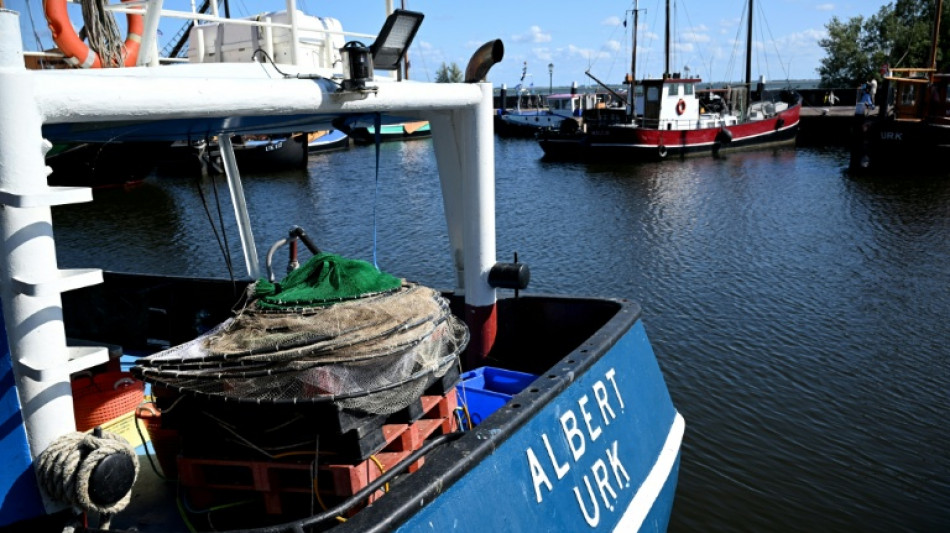
Jan van den Berg stares out at the sea where his father vanished seven decades ago -- lost in a storm just days before his birth. Now aged 70, he clings to the hope of finding even the smallest fragment of his father's remains.
In Urk, a fishing village in the northern Netherlands, the sea has long been the lifeblood for families -- but has often taken loved ones in return.
Some bodies never surfaced. Others washed ashore on German or Danish coasts and were buried in unnamed graves.
Despite the tragedy, Van den Berg -- the last of six children -- became a fisherman like his brothers, defying their mother's terror that the North Sea would claim her sons too.
"We never found his body," he told AFP in a low voice, mumbling under the brim of his hat.
But after decades of uncertainty, advances in DNA technology and artificial intelligence have given Van den Berg renewed hope.
Researchers are now able to match remains with living relatives more accurately than ever before, offering families long-awaited answers and the chance to finally mourn properly.
"Many families still gaze at the front door, hoping their loved-one will walk through it," said Teun Hakvoort, an Urk resident who serves as spokesperson for a new foundation dedicated to locating and identifying fishermen lost at sea.
"All sunken boats have been mapped. Using modern tech, we look at the weather and currents at the time of the shipwreck to estimate where the fishermen might have washed ashore," the 60-year-old said.
- Found after 47 years -
The foundation, Identiteit Gezocht (Identity Sought), aims to list all unknown graves on the coasts of the North Sea, hoping to identify remains.
The new searches have already borne fruit. A body was recently exhumed on Schiermonnikoog, a small island north of the Netherlands, and returned to the family.
"This man had been missing for 47 years. After all this time, DNA and this new method of work made it possible to discover he came from Urk," said Hakvoort.
Another Hakvoort, Frans Hakvoort, leads the foundation with the support of his two brothers in Urk, a tight-knit Protestant community where certain family names frequently reoccur.
The three men, who have all lost a relative at sea, dedicate their free time to searching for the missing.
"With AI, we search for press articles published after a body washed ashore, possibly in specific circumstances," said Frans Hakvoort, 44.
"We enter all this information into a database to see if we can establish a link. If so, we contact local authorities to see if they can exhume the body."
The Netherlands leads other North Sea countries in identifying the missing, he said, with about 90 percent of unknown bodies exhumed and all DNA profiles stored in a European database.
Given the usual fishing areas and prevailing currents, Urk fishermen are more likely to be buried on German or Danish coasts, he said.
The foundation has called on the public to help identify unknown graves in Germany and Denmark.
- Human remains -
Jan van den Berg runs his fingers over his father's name, engraved on a monument overlooking Urk beach to honour lost fishermen.
The list is long. More than 300 names -- fathers, brothers, and sons, with dates stretching back to the 18th century.
Among the names are about 30 fishermen never found. Kees Korf, missing since 1997 aged 19. Americo Martins, 47, in 2015.
A statue of a woman, her back turned to the sea, represents all these mothers and wives hoping their loved-one returns.
"My father disappeared during a storm on a freezing October night in 1954," says Van den Berg.
"One morning he left the port heading for the North Sea. He was not supposed to be gone long because I was about to be born."
His uncle, who was also aboard, later said his father was on deck when wild waves flipped the boat over.
The tragedy still haunts the family to this day.
"When they pulled the nets on deck with fish, my older brothers always feared there might be something that looked like a human," van den Berg said.
In 1976, his uncle's boat disappeared with two of his cousins, aged 15 and 17, also on board.
He was among those who found the body of Jan Jurie, the eldest, four months later.
The others were never found.
"Not a day goes by without thinking of them, all those men, and that is why I take part in the searches and give my DNA, because it remains an open wound," he said.
"I would like to have at least a small bone of my father to place in my mother's grave." And finally be able to mourn.
P.Petrenko--CPN