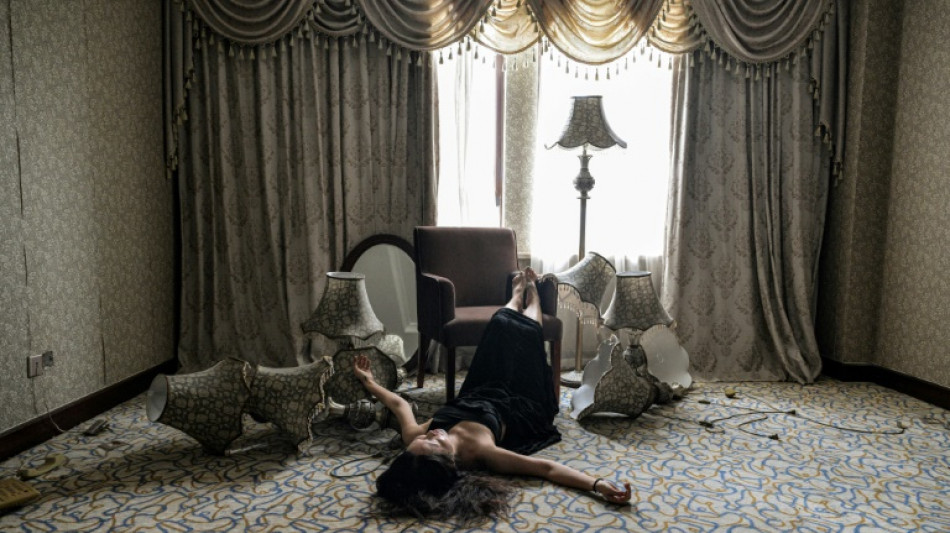
China's abandoned buildings draw urban explorers despite risks / Photo: Hector RETAMAL - AFP

 Trump's photo of Xi greeting carries signs of AI

 First US trial against TikTok to open Monday

 French literary prize removes novel from longlist after AI claims

 Trump accuser E. Jean Carroll finally has her damages

 Heavy fighting, internet disruption as Ethiopia conflict rages

 Asian markets mixed after oil gains

 UN approves resolution on dealing with rising sea levels

 Global stocks mostly fall as oil prices and bond yields rise

 Starbucks to close 250 more cafes in North America

 Stocks fall as oil prices rise and bonds back under pressure
 Top ECB official to resign to take up IMF role

 Eviction of pensioner puts Spain housing crisis in spotlight

 Average EU diesel price hits record 2.23 euros a litre: AFP analysis

 Whitetip Investments Marks 10 Years of Regulation, Transparency & Responsible Trading

 Stocks fall, oil prices rise as global bonds under pressure

 Hungary detects invasive spotted lanternfly for first time in EU

 Forex Expo Dubai 2026 Breaks Guinness World Record Again With 23,816 Attendees

 Asian markets fall on US-China jitters as leaders meet

 As Moscow steps up attacks, Kyiv residents brace for harsh winter

 Markets mixed as China's Xi arrives for US talks

 Archaeological 'breakthrough' could confirm origins of Paris

 Australian PM says OpenAI hacked government health website

 Rio breaks record for rainiest September amid powerful El Nino

 Mandela Digital Extends Early Access Programme to 11 February 2027 Following Strong Response

 McDonald's to boost franchisees as inflation weighs on consumers

Xu Pengcheng looks over his shoulder and, after confirming the coast is clear, helps his crew of urban adventurers climb through the broken window of an abandoned building.
Long popular in the West, urban exploration, or "urbex" for short, sees city-dwelling thrill-seekers explore dilapidated, closed-off buildings and areas -- often skirting the law in the process.
And it is growing in popularity in China, where a years-long property sector crisis has left many cities dotted with empty buildings.
Xu, a 29-year-old tech worker from the eastern city of Qingdao, has amassed hundreds of thousands of followers for his photos of rundown schools and vacant cinemas.
"When people see these images, they find them incredibly fresh and fascinating," he told AFP.
"The realisation that so many abandoned buildings exist -- and that they can photograph so beautifully -- naturally captures attention."
AFP joined Xu and his comrades at a deserted hotel in the outskirts of Shanghai for a unique photoshoot.
From the outside, the hotel looked like a prefabricated medieval castle.
Once inside, it was clear the property had been abandoned for years.
Searching through the rooms for good spots for striking photos, Xu and his friends came across remnants of the hotel's past -- a mahjong table, laundry sheets and piles of dinner plates.
Props from past photoshoots were scattered on the floor and on one ballroom wall, "Long Live Chairman Mao" was written in spray paint.
China's recent property market downturn has left many abandoned large-scale projects ready ground for urban explorers.
"I don't think you would find sites like this in Europe," long-time explorer Brin Connal told AFP as he walked around an empty, abandoned building.
"In China, there's a lot of these places which are unfinished."
- 'Really special' -
One such unfinished megaproject in Shanghai, the Pentagon Mall, has become such a hotspot that explorers leave messages for each other on the walls of its top floor.
"I think this is something really special about Chinese urban exploration," said Sean, a Shanghai resident who did not want to give his real name.
"There's a very strong sense of community and it's very, very welcoming."
Situated in Shanghai's Pudong district, the project came close to completion in 2009 but investment fell through.
The giant concrete building now sits mostly in disrepair -- broken tiles litter the ground and a large faded map of the uncompleted mall is barely visible under a thick layer of dust.
Some rooms still have signs of life, with mattresses from squatters, discarded takeout and cigarette boxes and even laundry hanging outside.
"In places like Shanghai, people always find a way to make use of these buildings, even if they're not completely built and completely usable," said Sean's exploration partner Nov, who also asked to go by a pseudonym.
- 'Way too dangerous' -
Chinese social media companies are less enthusiastic.
Looking up abandoned buildings on Instagram-like Xiaohongshu, users are met with a message warning "there are risks in this area, please pay attention to safety and comply with local policies and regulations".
Connal, originally from Britain, told AFP he understood the restrictions.
"Some of them are way too dangerous, and some of these abandoned locations were getting overwhelmed with people," he said.
The hobby also takes place in a legal grey area.
Many urban explorers go by a simple mantra -- taking nothing from the places they visit and leaving nothing behind.
But the act of trespassing can come with fines in China, just as it does in the West.
Xu also acknowledged the risks that come with urban exploration -- from angry security guards to errant circuitry.
"Firstly, you might face the risk of trespassing illegally. Secondly, private properties may have security guards or be completely sealed off," he told AFP.
"These locations often involve hazards like no electricity or lighting, structural damage, and injuries from construction materials like exposed nails."
But model Mao Yi said the hobby offered a respite from the drudgery of big city living.
"Living in these sprawling metropolises of steel and concrete, we've grown familiar with the routines of daily life," she told AFP.
D.Philippon--CPN