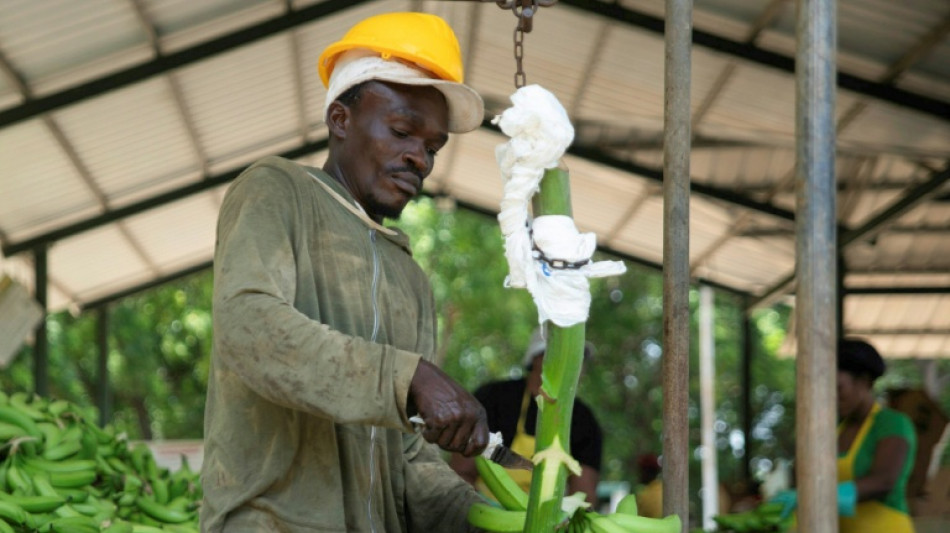
'Always hiding': Haitian laborers fear Dominican deportation push / Photo: Eddy Vittini - AFP

 Trump's photo of Xi greeting carries signs of AI

 First US trial against TikTok to open Monday
 French literary prize removes novel from longlist after AI claims
 Trump accuser E. Jean Carroll finally has her damages
 Heavy fighting, internet disruption as Ethiopia conflict rages
 Asian markets mixed after oil gains

 UN approves resolution on dealing with rising sea levels

 Global stocks mostly fall as oil prices and bond yields rise

 Starbucks to close 250 more cafes in North America

 Stocks fall as oil prices rise and bonds back under pressure
 Top ECB official to resign to take up IMF role

 Eviction of pensioner puts Spain housing crisis in spotlight

 Average EU diesel price hits record 2.23 euros a litre: AFP analysis

 Whitetip Investments Marks 10 Years of Regulation, Transparency & Responsible Trading

 Stocks fall, oil prices rise as global bonds under pressure
 Hungary detects invasive spotted lanternfly for first time in EU
 Forex Expo Dubai 2026 Breaks Guinness World Record Again With 23,816 Attendees

 Asian markets fall on US-China jitters as leaders meet
 As Moscow steps up attacks, Kyiv residents brace for harsh winter
 Markets mixed as China's Xi arrives for US talks

 Archaeological 'breakthrough' could confirm origins of Paris

 Australian PM says OpenAI hacked government health website

 Rio breaks record for rainiest September amid powerful El Nino

 Mandela Digital Extends Early Access Programme to 11 February 2027 Following Strong Response

 McDonald's to boost franchisees as inflation weighs on consumers

Agamise Cheranfant hides as soon as he finishes his work at a banana plantation in the Dominican Republic. Like many others, he is Haitian, undocumented, and lives in constant fear of deportation.
Owners of farms, construction companies and tourism businesses are also nervous -- they rely on Haitian laborers to work long days under the scorching sun.
On the banana plantations in Mao, in the country's northwest, most of the workers are from Haiti, which shares an island with the Dominican Republic.
It is an arduous job that few Dominicans want to do.
The daily wage of 800 pesos (less than $14) "is very low," said Cheranfant, 33.
And with immigration authorities breathing down undocumented workers' necks, "we're always scared, we're always hiding," he said.
Relations between the Dominican Republic and Haiti are marked by resentment and mistrust.
Dominican President Luis Abinader has toughened his policy on migration from the neighboring country, which is plagued by poverty and gang violence that has led thousands of Haitians to flee.
Abinader ordered the construction of a wall on the border and increased raids and deportations of undocumented immigrants.
In the first half of 2025 alone, more than 200,000 Haitians were sent home, even as gang violence there soars.
Such "disorderly" repatriations have reduced the availability of labor in tasks that "aren't of interest to Dominicans," according to the construction workers' association, Acoprovi.
In some areas, the labor supply has fallen by between 40 and 80 percent.
In tourism, the labor squeeze has affected areas such as cooking, said Henri Hebrard, an economist and consultant.
"This could affect the quality of service," he said.
- Companies demand change -
Business leaders are calling for a regularization plan for undocumented laborers.
Acoprovi proposes issuing 87,000 temporary work permits.
But the government, so far, has shown no signs of flexibility regarding the requests.
Antony Florestal has a passport, alien identification card and work card that have all expired.
If he is caught in a raid, he faces deportation.
"I'm scared," said the 32-year-old, who has been working in agriculture since 2009.
"I live here (on the farm) so I don't have to go out on the street."
The Dominican Republic exports bananas to the United States, Europe and other countries in the Caribbean, with agriculture representing 5.6 percent of the country's economic output.
- 'Can't live in peace' -
At the plantation where Cheranfant works, bunches of bananas are harvested with machetes, before being placed on a steel hook and moved along a cable to another area where they are sorted and packed for sale.
The best bananas are exported, in this case to Germany. The rest are sold on the local market.
The country's banana industry was already in crisis due to factors including the weather, pests and rising costs.
Production fell 44 percent between 2021 and 2024, according to the Dominican Association of Banana Producers.
The labor shortage is yet another blow.
"Here, the workforce has decreased by more than 50 percent" due to the deportations, said producer Osvaldo Pineo.
Some Haitians now work "nomadically," he said.
"Today, they offer you the service, but tomorrow, you don't know if you'll get it."
For employers, too, there is a risk.
"If you put them in a vehicle and it's checked (by the authorities), you're accused of being a trafficker of undocumented migrants," Pineo said.
Cheranfant has already been deported several times but always returns -- life is a constant game of cat and mouse with immigration authorities.
His wife and three children live in a town near the plantation.
"Almost every day we flee, in the morning, at night, at three in the morning, at one in the morning," Cheranfant said.
"You're scared while you sleep and while you eat. We can't live in peace."
U.Ndiaye--CPN