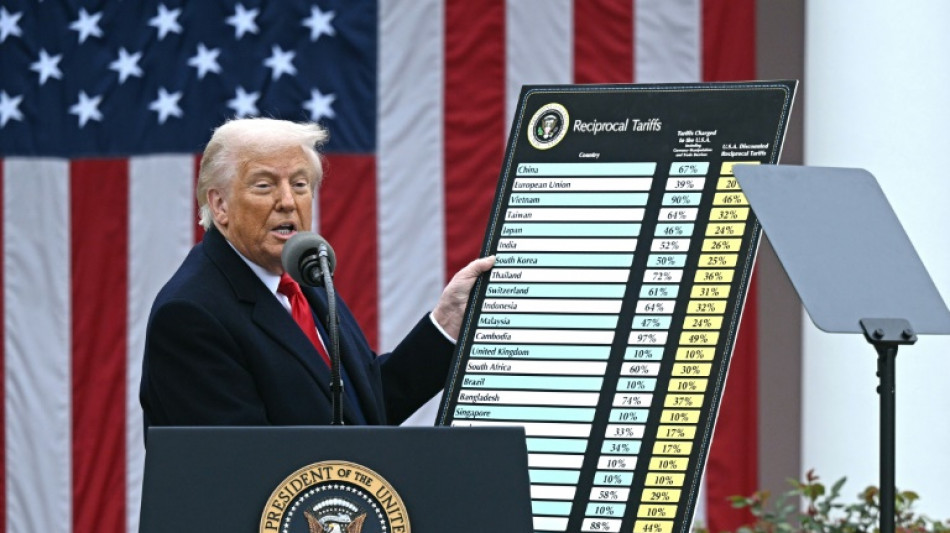
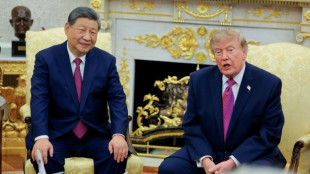
Where do trade talks stand in the rush to avert higher US tariffs? / Photo: Brendan SMIALOWSKI - AFP/File

 Trump's photo of Xi greeting carries signs of AI

 First US trial against TikTok to open Monday

 French literary prize removes novel from longlist after AI claims
 Trump accuser E. Jean Carroll finally has her damages
 Heavy fighting, internet disruption as Ethiopia conflict rages

 Asian markets mixed after oil gains

 UN approves resolution on dealing with rising sea levels

 Global stocks mostly fall as oil prices and bond yields rise

 Starbucks to close 250 more cafes in North America

 Stocks fall as oil prices rise and bonds back under pressure
 Top ECB official to resign to take up IMF role

 Eviction of pensioner puts Spain housing crisis in spotlight
 Average EU diesel price hits record 2.23 euros a litre: AFP analysis

 Whitetip Investments Marks 10 Years of Regulation, Transparency & Responsible Trading

 Stocks fall, oil prices rise as global bonds under pressure
 Hungary detects invasive spotted lanternfly for first time in EU

 Forex Expo Dubai 2026 Breaks Guinness World Record Again With 23,816 Attendees

 Asian markets fall on US-China jitters as leaders meet
 As Moscow steps up attacks, Kyiv residents brace for harsh winter

 Markets mixed as China's Xi arrives for US talks
 Archaeological 'breakthrough' could confirm origins of Paris

 Australian PM says OpenAI hacked government health website

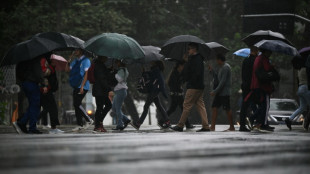 Rio breaks record for rainiest September amid powerful El Nino
 Mandela Digital Extends Early Access Programme to 11 February 2027 Following Strong Response

 McDonald's to boost franchisees as inflation weighs on consumers
As a Wednesday deadline approaches for steeper US tariffs to hit dozens of economies ranging from the EU to India, trade negotiations with President Donald Trump's administration are coming down to the wire.
The levies taking effect July 9 were announced in April, with the White House citing a lack of "reciprocity" in trade relations. But they were swiftly halted, allowing room for talks.
Days before their reimposition, where do things stand?
- EU: 'Ready' for deal -
The European Union said it is "ready for a deal" with Washington, with the bloc's trade chief meeting his US counterparts Thursday.
European Commission president Ursula von der Leyen said the EU was targeting an "agreement in principle" when it came to the July 9 cutoff.
With no deal, the US tariff on EU goods doubles from the "baseline" of 10 percent to 20 percent -- with Trump previously threatening a 50 percent level.
- Vietnam: A pact with uncertainties -
Washington and Hanoi unveiled a trade pact Wednesday with much fanfare and few details, but it allowed Vietnam to avoid Trump's initial 46 percent tariff.
Under the agreement, Vietnamese goods face a minimum 20 percent tariff while products made elsewhere face a 40 percent levy -- a clause to restrict "transshipping" by Chinese groups.
But there remain questions on how the higher levy would apply to products using foreign parts.
There is also a risk that Beijing will adopt retaliatory measures, analysts warned.
- Japan: Rice, autos at stake -
Despite being a close US ally and major source of foreign investment, Japan might not escape Trump's tariff hike.
Tokyo's trade envoy Ryosei Akazawa has made numerous trips to Washington through the end of June.
But Trump recently criticized what he described as Japan's reluctance to open up further to US rice and auto exports.
"I'm not sure we're going to make a deal," Trump said, adding that the country could pay a tariff of "30 percent, 35 percent, or whatever the number is that we determine."
- India: A good position -
Indian manufacturers and exporters want to believe they can avoid a 26 percent tariff.
Negotiations between both countries have been going well for weeks, and Trump himself suggested at the end of June that a "very big" agreement was imminent.
Ajay Sahai, director general of the Federation of Indian Export Organisations, said the feedback he received "suggests positive developments." But he maintained that the situation was fluid.
Finance Minister Nirmala Sitharaman has stressed that agriculture and dairy products remain "very big red lines."
- South Korea: Muted optimism -
Seoul, which is already reeling from US tariffs on steel and autos, wants to avert a sweeping 25 percent levy on its other exports.
Cooperation in shipbuilding could be a bargaining chip, but "at this stage, both sides still haven't clearly defined what exactly they want," said new President Lee Jae Myung on Thursday.
"I can't say with confidence that we'll be able to wrap everything up by July 8," he added.
- Indonesia, Thailand, Taiwan in the wings -
Other Asian economies including Indonesia, Thailand and Cambodia, which faces a 49 percent tariff, wait with bated breath.
Indonesia has indicated willingness to boost energy, agriculture and merchandise imports from the United States. Bangladesh meanwhile is proposing to buy Boeing planes and step up imports of US agriculture products.
Taiwan, for whom Washington is a vital security partner, faces a 32 percent duty without a pact.
Although both sides have faced bumps along the way, Taiwanese Vice President Hsiao Bi-khim said "negotiators from both sides are working diligently" to find a path forward.
- Switzerland: Hope for delay -
Switzerland's government said Washington has acknowledged it was acting in good faith, and assumes its tariff level will remain at 10 percent on July 9 while negotiations continue.
But without a decision by the president as of the end of June, Switzerland did not rule out that levies could still rise to a promised 31 percent.
burs-jug-bys/jgc
Y.Ibrahim--CPN