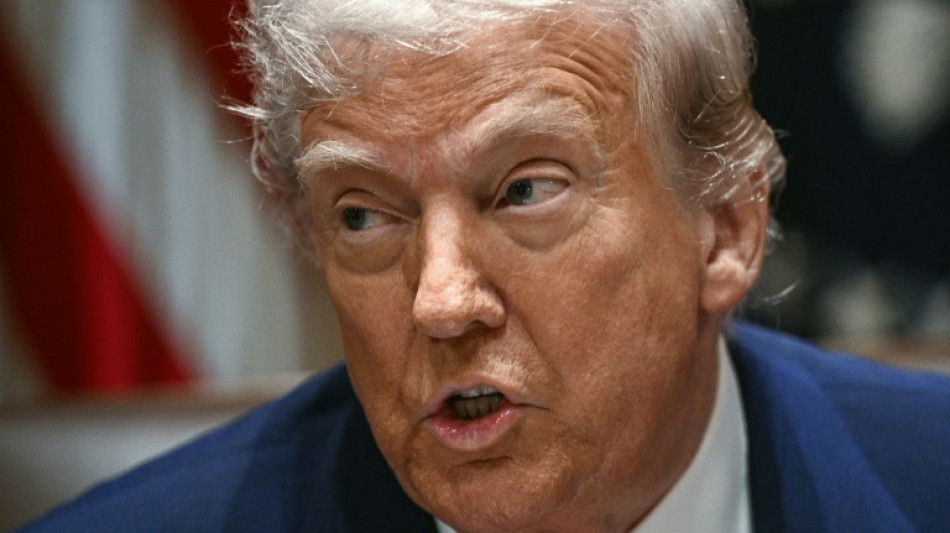
What is the state of play with Trump's tariffs? / Photo: Brendan SMIALOWSKI - AFP/File

 Trump's photo of Xi greeting carries signs of AI

 First US trial against TikTok to open Monday

 French literary prize removes novel from longlist after AI claims
 Trump accuser E. Jean Carroll finally has her damages
 Heavy fighting, internet disruption as Ethiopia conflict rages

 Asian markets mixed after oil gains

 UN approves resolution on dealing with rising sea levels

 Global stocks mostly fall as oil prices and bond yields rise
 Starbucks to close 250 more cafes in North America
 Stocks fall as oil prices rise and bonds back under pressure
 Top ECB official to resign to take up IMF role

 Eviction of pensioner puts Spain housing crisis in spotlight
 Average EU diesel price hits record 2.23 euros a litre: AFP analysis

 Whitetip Investments Marks 10 Years of Regulation, Transparency & Responsible Trading

 Stocks fall, oil prices rise as global bonds under pressure
 Hungary detects invasive spotted lanternfly for first time in EU

 Forex Expo Dubai 2026 Breaks Guinness World Record Again With 23,816 Attendees

 Asian markets fall on US-China jitters as leaders meet
 As Moscow steps up attacks, Kyiv residents brace for harsh winter
 Markets mixed as China's Xi arrives for US talks

 Archaeological 'breakthrough' could confirm origins of Paris
 Australian PM says OpenAI hacked government health website

 Rio breaks record for rainiest September amid powerful El Nino
 Mandela Digital Extends Early Access Programme to 11 February 2027 Following Strong Response

 McDonald's to boost franchisees as inflation weighs on consumers
With sweeping tariffs on friend and foe, US President Donald Trump has roiled financial markets and sparked a surge in economic uncertainty -- and tensions are mounting days before a fresh volley of higher duties are due to kick in.
Here is a rundown of what Trump has implemented in his second presidency, with levies on dozens of economies set to bounce from 10 percent to a range between 11 percent and 50 percent on Wednesday.
- Global tariffs -
While Trump imposed a 10 percent tariff on most US trading partners in April, the rate is set to rise for dozens of economies including the European Union and Japan come Wednesday.
To avoid higher levies, countries have been rushing to strike deals with Washington.
So far, the UK and Vietnam have struck pacts with the United States, while China has managed to temporarily lower tit-for-tat duties.
There are notable exceptions to the duty.
Immediate US neighbors Canada and Mexico, which were separately targeted over illegal immigration and fentanyl, are not affected by the 10 percent global tariff.
Also off the hook are copper, pharmaceuticals, semiconductors and lumber -- although these are sectors that Trump is mulling levies on. Gold and silver, as well as energy commodities, are excluded too.
- China focus -
China has borne the brunt of Trump's levies. The world's two biggest economies engaged in an escalating tariffs war this year before a temporary pullback.
Both sides imposed triple-digit tariffs on each other's goods at one point, a level effectively described as a trade embargo.
After high level talks, Washington agreed to lower its levies on Chinese goods to 30 percent and Beijing slashed its own to 10 percent.
The US level is higher as it includes a 20 percent tariff imposed over China's alleged role in the global fentanyl trade.
- Autos, metals -
Trump has also targeted individual business sectors in his second term.
In March, he imposed a 25 percent levy on steel and aluminum imports and last month doubled them to 50 percent.
He has also rolled out a 25 percent tariff on imported autos, although those imported under the US-Mexico-Canada Agreement (USMCA) can qualify for a lower levy.
Trump's auto tariffs impact vehicle parts too, while the president has issued rules to ensure automakers paying vehicle tariffs will not also be charged for certain other duties.
- Canada, Mexico -
Canadian and Mexican products were initially hard hit by 25 percent US tariffs, with a lower rate for Canadian energy.
Trump targeted both neighbors saying they did not do enough on illegal immigration and the flow of illicit drugs across borders.
But he eventually announced exemptions for goods entering his country under the USMCA, covering large swaths of products. Potash, used as fertilizer, got a lower rate as well.
- Other threats -
Beyond expansive tariffs on Chinese products, Trump ordered the closure of a duty-free exemption for low-value parcels from the country. This adds to the cost of importing items like clothing and small electronics.
Trump has also opened the door for 25 percent tariffs on goods from countries importing Venezuelan oil. He has threatened similar "secondary tariffs" involving Russian oil.
And he has ordered investigations into imports of copper, lumber, semiconductors, pharmaceuticals and critical minerals that could eventually bring new duties.
- Legal challenges -
Trump's sweeping tariffs on countries have faced legal challenges. The US Court of International Trade ruled in May that Trump had overstepped his authority with across-the-board global levies.
It blocked many of the duties from going into effect, prompting the Trump administration's challenge, and a US federal appeals court has since allowed the duties to remain while it considers the case.
L.Peeters--CPN