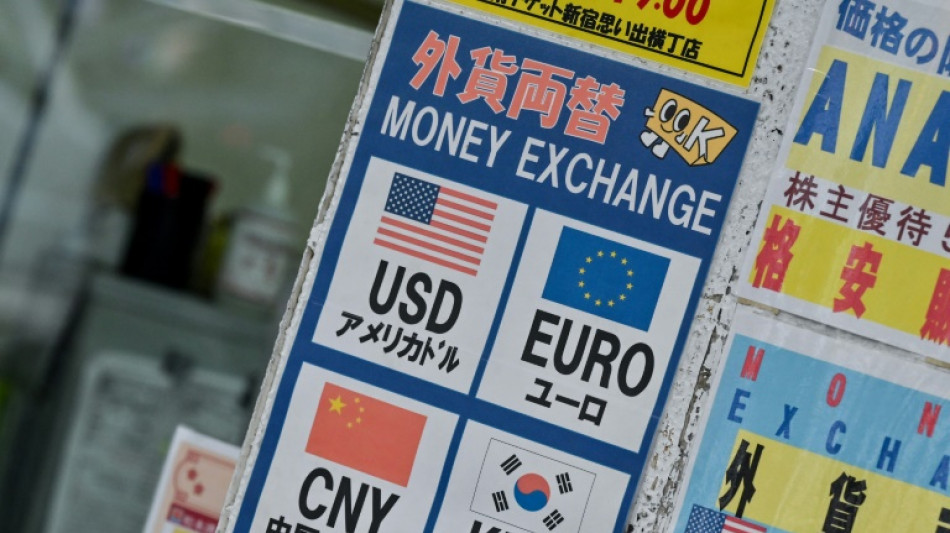
As US stocks hit records, experts see the dollar falling further / Photo: Richard A. Brooks - AFP/File

 Trump's photo of Xi greeting carries signs of AI

 First US trial against TikTok to open Monday

 French literary prize removes novel from longlist after AI claims
 Trump accuser E. Jean Carroll finally has her damages
 Heavy fighting, internet disruption as Ethiopia conflict rages

 Asian markets mixed after oil gains

 UN approves resolution on dealing with rising sea levels

 Global stocks mostly fall as oil prices and bond yields rise
 Starbucks to close 250 more cafes in North America

 Stocks fall as oil prices rise and bonds back under pressure

 Top ECB official to resign to take up IMF role

 Eviction of pensioner puts Spain housing crisis in spotlight
 Average EU diesel price hits record 2.23 euros a litre: AFP analysis

 Whitetip Investments Marks 10 Years of Regulation, Transparency & Responsible Trading

 Stocks fall, oil prices rise as global bonds under pressure
 Hungary detects invasive spotted lanternfly for first time in EU

 Forex Expo Dubai 2026 Breaks Guinness World Record Again With 23,816 Attendees

 Asian markets fall on US-China jitters as leaders meet

 As Moscow steps up attacks, Kyiv residents brace for harsh winter

 Markets mixed as China's Xi arrives for US talks

 Archaeological 'breakthrough' could confirm origins of Paris
 Australian PM says OpenAI hacked government health website

 Rio breaks record for rainiest September amid powerful El Nino
 Mandela Digital Extends Early Access Programme to 11 February 2027 Following Strong Response

 McDonald's to boost franchisees as inflation weighs on consumers
While the US stock market has fully recovered from a spring rout, the relentless drop in the dollar is prompting currency experts to warn of greater financial market turmoil ahead.
The American currency is down more than 10 percent so far in 2025, a historic retreat that has overlapped with occasional spikes in long-term US Treasury yields.
The anomalous dynamic suggests investors are rethinking US holdings, once considered safe havens, as they take stock of President Donald Trump's unpredictable policy shifts.
While the dollar's status as the global reserve currency appears unshakeable in the near future, many currency experts expect the greenback to continue to weaken in the coming years, given expectations for slower growth after a long run of US out-performance.
"It's US exceptionalism basically falling by the wayside and the rest of the world playing catch-up," said Erik Nelson, a macro strategist at Wells Fargo, who predicts the dollar will continue to depreciate.
In April, global markets were shaken by "Sell America" gyrations in the stock, foreign exchange and US treasury markets, and analysts expect similar sentiment in the future.
"I think the world is becoming a little bit less stable politically, which is generally kind of problematic for economic and financial market volatility," Nelson said.
"We are witnessing the end of a 14-year bull run of the US dollar," said Joseph Brusuelas, chief economist at RSM US, a consultancy, who expects a "multi-year unwinding of the dollar."
Harvard Economist Kenneth Rogoff, author of the 2025 book "Our Dollar Your Problem," said central banks in China and elsewhere were diversifying away from dollars even before 2025, but that Trump accelerated the trend.
"I think we'll see a period of a lot of financial volatility, largely centered around the chaos in the United States," Rogoff told AFP, pointing to factors that include uncertainty about US central bank independence and the rise of populism.
"We'll probably have a more volatile period in financial markets over the next 10 years than we have in the preceding."
- Onshoring benefit -
Both Nelson and Rogoff pointed out that the dollar at the start of 2025 was unusually lofty after surging in the weeks following Trump's November 2024 victory.
Economists have since rethought assumptions that the US would continue to outperform rival economies.
According to the ICE US Dollar Index, a basket of seven currencies, the dollar fell 10.7 percent through the end of June, the biggest drop in the first six months of a year since 1973.
On Thursday, the dollar index rose modestly after solid US jobs data dimmed odds for imminent Federal Reserve interest rate cuts.
With a gain of more than 13 percent against the dollar, the euro has been among the biggest winners following Germany's big fiscal investments in defense, even as the European Central Bank continued to cut interest rates.
Besides a weaker US economic outlook, the shift in the dollar reflects expectations for looser US monetary policy. Trump has taken relentless aim at Jerome Powell, referring to the Federal Reserve Chair as "a stupid person" while calling for interset rates "at least two to three points lower" -- a huge shift in monetary policy.
While Treasury Secretary Scott Bessent and other top officials have rejected suggestions they prefer a cheap dollar, a less expensive currency is beneficial to US exporters and consistent with the administration's stated goal of beefing up manufacturing.
"Lower interest rates and a weaker dollar would enable the US to strengthen its economic self-sufficiency and increase onshoring," said Jason Schenker of Prestige Economics, who argues that the moves align with a muscular national security posture towards China.
Market watchers have come to expect Trump to modulate his actions in response to big negative market swings.
On April 9, Trump backtracked on many of the most onerous tariffs from his "Liberation Day" announcement a week earlier after a spike in Treasury bond yields hammered stocks. Later that month, he said he has "no intention" of firing Powell after earlier comments set markets ablaze.
But equity markets so far appear unfazed by dollar weakness, with both the S&P 500 and Nasdaq ending Thursday's session at records.
"At some point it's going to get investors' attention," Cresset Capital Management's Jack Ablin said of the weak dollar.
"It signals foreign investors are less inclined to own US assets."
M.Anderson--CPN