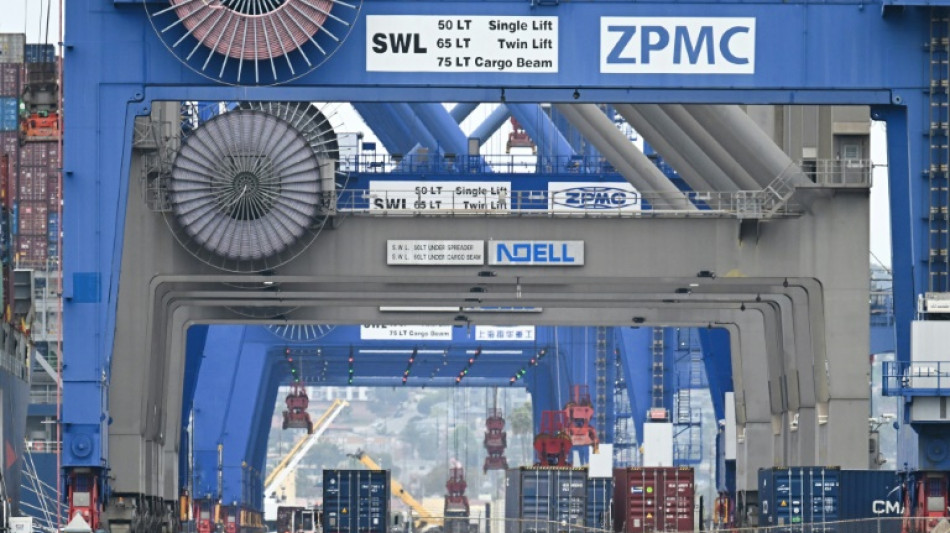
US trade deficit widens in May as Trump tariffs fuel uncertainty / Photo: Robyn Beck - AFP/File

 Trump's photo of Xi greeting carries signs of AI

 First US trial against TikTok to open Monday

 French literary prize removes novel from longlist after AI claims
 Trump accuser E. Jean Carroll finally has her damages
 Heavy fighting, internet disruption as Ethiopia conflict rages

 Asian markets mixed after oil gains

 UN approves resolution on dealing with rising sea levels

 Global stocks mostly fall as oil prices and bond yields rise

 Starbucks to close 250 more cafes in North America

 Stocks fall as oil prices rise and bonds back under pressure

 Top ECB official to resign to take up IMF role

 Eviction of pensioner puts Spain housing crisis in spotlight
 Average EU diesel price hits record 2.23 euros a litre: AFP analysis

 Whitetip Investments Marks 10 Years of Regulation, Transparency & Responsible Trading

 Stocks fall, oil prices rise as global bonds under pressure

 Hungary detects invasive spotted lanternfly for first time in EU

 Forex Expo Dubai 2026 Breaks Guinness World Record Again With 23,816 Attendees

 Asian markets fall on US-China jitters as leaders meet

 As Moscow steps up attacks, Kyiv residents brace for harsh winter

 Markets mixed as China's Xi arrives for US talks

 Archaeological 'breakthrough' could confirm origins of Paris

 Australian PM says OpenAI hacked government health website

 Rio breaks record for rainiest September amid powerful El Nino

 Mandela Digital Extends Early Access Programme to 11 February 2027 Following Strong Response

 McDonald's to boost franchisees as inflation weighs on consumers

The US trade deficit widened more than expected in May, with both imports and exports declining as US President Donald Trump's tariffs sent shock waves through the economy and snagged supply chains.
Trade data published Thursday showed the world's biggest economy logged an overall trade gap of $71.5 billion, in the month after Trump imposed a 10 percent duty on most trading partners before pausing steeper rates for dozens of these economies.
This was an expansion from the $60.3 billion deficit in April, according to the Commerce Department.
The figures, however, came as both imports and exports shrank in May.
US imports were down 0.1 percent to $350.5 billion, as incoming shipments of goods ticked down.
Imports of consumer goods dropped by $4.0 billion, with those of certain apparel and toys both sliding, although imports of autos and parts climbed.
US exports, meanwhile, dropped by 4.0 percent to $279.0 billion, with declines largely seen in industrial supplies and materials, the report showed.
US trade has been rocked by Trump's sweeping tariff announcements since the start of this year, as companies stocked up to get ahead of expected levies and halted shipments to wait for high duties to come down.
This was the case when Trump doubled down on tariffs impacting goods from China in April. Tit-for-tat tariffs on both sides surged to prohibitive levels before Washington and Beijing de-escalated tensions in mid-May.
Trade is "at risk of introducing more volatility in the data," said Bernard Yaros, lead US economist at Oxford Economics.
This is especially as the world heads towards a July 9 deadline when Trump's pause on higher duties for dozens of economies including the European Union, Japan and South Korea is due to expire.
"A worst-case tariff outcome this month would apply further downward pressure on imports," Yaros warned.
The path forward is unclear and he expects levels to land somewhere between their current position and the steep levels initially unveiled in April.
He cited a US deal with Vietnam announced Wednesday where the country averted the harsh tariff rate Trump first announced.
But Yaros maintains that "the true health of the economy will be better distilled by the consumer and business spending figures, which are showing signs of weakness."
Carl Weinberg, chief economist at High Frequency Economics, expects Federal Reserve policymakers to look past the fluctuations in inventories as they decide on further interest rate adjustments.
"There is not much in this report to alter the Fed's view that the economy remains strong," he said.
D.Avraham--CPN