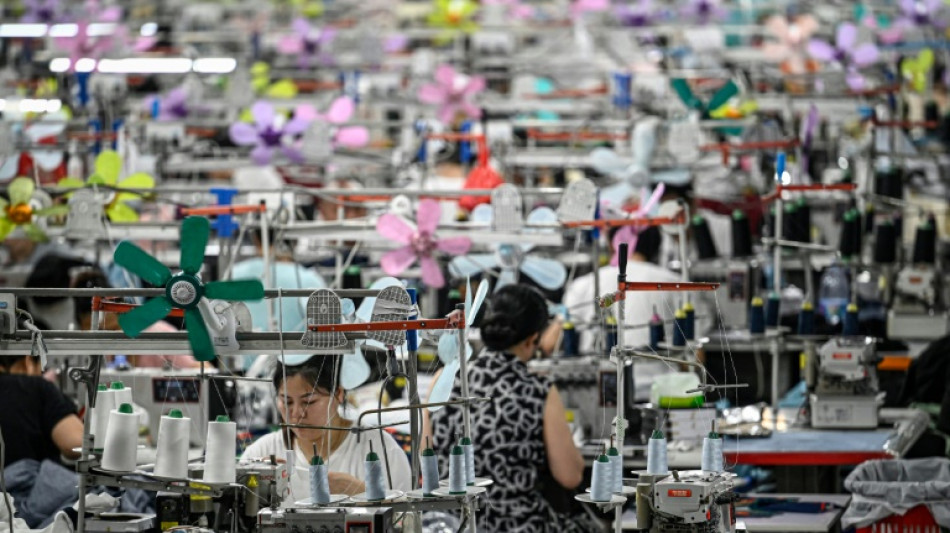
How Trump's 'liberation day' tariffs will impact China / Photo: Jade GAO - AFP

 Kenya's economy faces climate change risks: World Bank

 ArcelorMittal confirms long-stalled French steel plant revamp

 AstraZeneca profit jumps as cancer drug sales grow

 Trump tariffs hurt French wine and spirits exports

 Back to black: Philips posts first annual profit since 2021
 'Family and intimacy under pressure' at Berlin film festival
 Unions rip American Airlines CEO on performance

 Three missing employees of Canadian miner found dead in Mexico

 Epstein accomplice Maxwell seeks Trump clemency before testimony

 Emergency measures kick in as Cuban fuel supplies dwindle under US pressure
 AI chatbots give bad health advice, research finds
 Bank of France governor Francois Villeroy de Galhau to step down in June

 Japan restarts world's biggest nuclear plant again
 'Want to go home': Indonesian crew abandoned off Africa demand wages

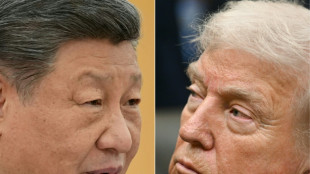 Trump says China's Xi to visit US 'toward the end of the year'

 US astronaut to take her 3-year-old's cuddly rabbit into space

 Storm-battered Portugal votes in presidential election run-off

 De Beers sale drags in diamond doldrums

 Pakistan's capital picks concrete over trees, angering residents
 Chile's climate summit chief to lead plastic pollution treaty talks

 Opinions of Zuckerberg hang over social media addiction trial jury selection
 Dow surges above 50,000 for first time as US stocks regain mojo

 EU nations back chemical recycling for plastic bottles
 Stocks rebound though tech stocks still suffer

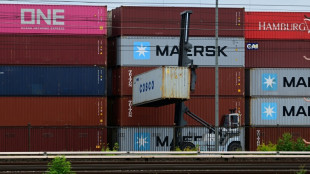 German exports to US plunge as tariffs exact heavy cost

US President Donald Trump has slapped punishing new tariffs on imports of Chinese goods, deepening a trade war between the world's two largest economies.
Beijing has vowed countermeasures in response and warned the new tariffs will cripple global supply chains -- and Washington's own interests.
AFP looks at how so-called "liberation day" tariffs -- which bring levies on Chinese goods to 54 percent -- will hit China:
- Why is China so vulnerable? -
China's export-driven economy is particularly sensitive to vicissitudes in international trade.
Trade between it and the United States, the world's two largest economies, is vast.
According to Beijing's customs data, sales of Chinese goods to the United States last year totalled more than $500 billion -- 16.4 percent of the country's exports.
US duties also threaten to harm China's fragile economic recovery as it struggles with a long-running debt crisis in the property sector and persistently low consumption -- a downturn Beijing had sought to slow with broad fiscal stimulus last year.
But an intensified trade war will likely mean China cannot peg its hopes for strong economic growth this year on its exports, which reached record highs in 2024.
"The US tariffs on Chinese imports announced so far this year could fully negate the lift from the fiscal stimulus measures announced so far," Frederic Neumann, Chief Asia Economist at HSBC, told AFP.
And while he said the impact on export competition may be slightly mitigated by the fact that all countries are hit by the levies, he stressed "the drag on Chinese growth is nevertheless significant".
- What impact will the new tariffs have? -
The new tariffs slap 10 percent levies on imports from around the world.
But China -- whose yawning trade deficit with the United States of $270.4 billion has long drawn Trump's ire -- faces much higher levies.
The latest salvo adds 34 percent to a 20 percent rate imposed last month, bringing the total additional tariffs on imports from the Asian economic powerhouse imposed by the Trump administration to 54 percent.
The tariffs come into effect in stages -- a ten percentage point bump on Thursday, followed by the full levy on April 9.
China is also under sector-specific tariffs on steel, aluminium and car imports.
Analysts expect the new levies to take a significant chunk out of the country's GDP, which Beijing's leadership hope will grow five percent this year.
Julian Evans-Pritchard, Head of China Economics at Capital Economics, said in a note he said he expected the economic hit to range from 0.5 percent to one percent of GDP.
Likely to be hit hardest are China's top exports to the United States -- the country is the dominant supplier of goods from electronics and electrical machinery to textiles and clothing, according to the Peterson Institute of International Economics.
But analysts also warn that because of the crucial role Chinese goods play in supplying US firms, the tariffs may also have major knock-on effects.
"US imports from China are dominated by capital goods and industrial materials instead of consumer goods," Gene Ma, Head of China Research at the Institute of International Finance, told AFP.
"The tariff will hurt US manufacturers as well as consumers."
"This trade war not only has a destructive impact on China but also on the global trade system," Chen Wenling, Chief Economist at the China Center for International Economic Exchanges in Beijing, said.
- How might Beijing respond? -
Beijing has yet to specify what exactly its "countermeasures" will involve.
But the retaliation could see Beijing hike pre-existing tariffs imposed in response to previous measures.
"China's countermeasures should be reasonable, beneficial and measured," Mei Xinyu, an economist at the state-affiliated Chinese Academy of International Trade and Economic Cooperation in Beijing, told AFP.
"They need to be strong and precise, while also avoiding turning the countermeasures into a decoupling of China and the United States," Mei added.
China last month slapped tariffs of 15 percent in imports of coal and liquefied natural gas from the United States. Crude oil, agricultural machinery, big-engined vehicles and pickup trucks also face 10 percent duties.
Analysts say those moves are designed to hit Trump's support base -- those in America's rural heartlands that voted him into office last year.
Beijing has called for dialogue to resolve the dispute, but any deal will take time.
"There are still chances for the two parties to resume talks in the following months," Betty Wang at Oxford Economics told AFP.
"But historical experience suggests that tariffs are typically quick to rise and slow to fall."
Y.Ponomarenko--CPN