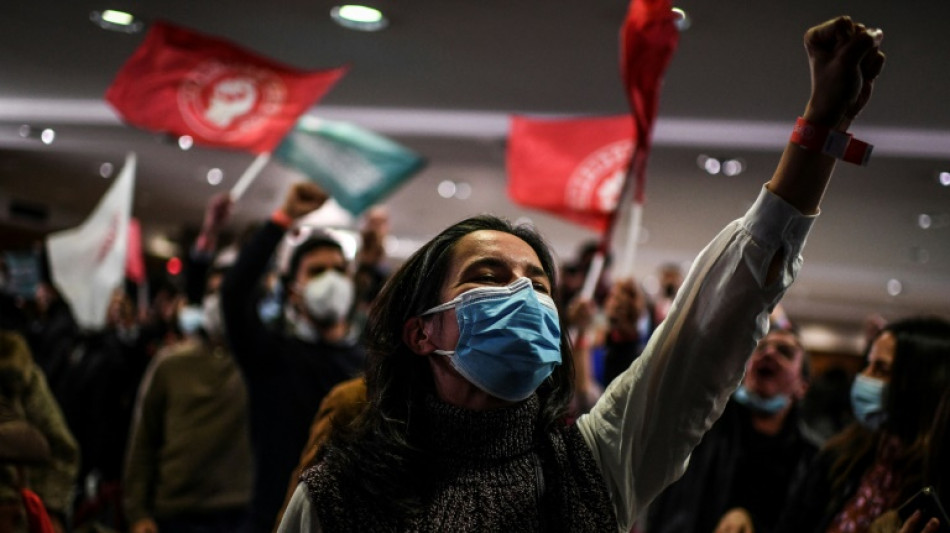
Portugal's Socialists win election marked by far right gains: exit polls

 Lights out in Laos as electricity exports surge

 Steven Strogatz weighs AI mathematics advances and their consequences for researchers

 Anthropic boss calls for AI slowdown, Altman and Musk agree

 French IT giant Capgemini sells subsidiary after row over ICE links

 Quebec Brokerage Qubit Insurance Announces New Data on Coverage Shortfalls as Rebuilding Costs Rise

 Lady Gaga welcomes first child with fiance: US media

 Bhutan business bets on hazelnuts for farming future

 'Widow's Bay' and 'The Pitt' are favorites for Emmys night

 Coastal erosion forces cancellation of California music festival

 Argentina's Dirty War rears its head in Venice film

 UK lawmakers throw out bill to legalise assisted dying

 US inflation steady in August, fueling Fed rate hike expectations

 New York marks 25th anniversary of 9/11 attacks

 Nepal flood reconstruction bill to be $4.78 bn: foreign ministry

 JUMO and Standard Bank launch Social Finance Framework to scale inclusive finance in Africa

 Doomsday tech: could AI really kill us all?

 French comedy show 'Call my agent' makes film comeback

 It's all coming back: Celine Dion fans gear up for Paris return

 Researchers eye AI revolution in natural disaster forecasts

 US braces for inflation report that may push Fed to hike rates

 Musk threatens legal action over documentary

 Latin America fact-check group asks Meta not to replace verification practice

 AI Risks to Enter 60–80% of Liability and Cyber Insurance Underwriting by 2028, ScienceSoft Predicts

 Tribal Launches Campfire, Letting Business and Technical Teams Build on Salesforce Together

 Stocks fall as fresh oil surge fans inflation fears

Portugal's ruling Socialists won Sunday's early election by a wide margin but may still fall short of an outright majority while the far right made huge gains, exit polls showed.
Prime Minister Antonio Costa's party received between 37 percent and 42.5 percent of the vote, compared to between 27 percent to 35 percent for the main opposition centre-right PSD, according to the polls for TV stations RTP, SIC and TVI.
That would give the Socialists 100 to 118 seats in the 230-seat parliament, up from 108 in the outgoing assembly.
A party needs at least 116 seats to have an absolute majority.
A significant development was the rise of upstart far-right party Chega, which won up to 8.5 percent of the vote, which could make it the third-biggest party in the assembly with six to 14 seats.
The party has from just one lawmaker in the outgoing assembly and its rise mirrors gains for other populist far-right formations elsewhere in Europe.
The early election came as the nation of around 10 million people tries to boost its tourism-dependent economy which has been badly hit by the pandemic.
A stable government is needed for Portugal to make the most of a 16.6 billion euros ($18.7 billion) package of European Union recovery funds it is due to receive by 2026.
Costa, 60, had said during the campaign that he planned to govern alone if the Socialists failed to secure a majority, negotiating support from other parties for laws on a case-by-case basis.
- Skills and experience -
Costa has relied on two far-left parties -- the left Bloc and the Communist Party -- to underpin two minority Socialist governments since 2015.
But the two formations turned against him in October and joined forces with the right to vote down his draft 2022 budget, prompting Sunday's early election.
The Socialists had a comfortable lead when the election was called but the PSD managed to close the gap as the polls neared.
But while there is a "certain disenchantment" with the Socialists, most voters feel Costa has "more skills and experience to govern" than PSD leader Rui Rio, said University of Lisbon political scientist Marina Costa Lobo.
Under Costa's watch, Portugal has rolled back austerity measures, maintained fiscal discipline and slashed unemployment to pre-pandemic levels.
The country also achieved the highest immunisation rate against Covid-19 in Europe, with over 90 percent of its population fully vaccinated.
But the PSD's Rio argues the economy -- which the Bank of Portugal projects grew by 4.8 percent last year -- should expand faster.
He had called for lower corporate taxes and privatisations to boost Portugal's competitiveness and spur growth.
Portugal's Socialist party is faring better than its peers in many other European nations such as Greece and France where they have been virtually wiped off the map in recent years.
P.Gonzales--CPN