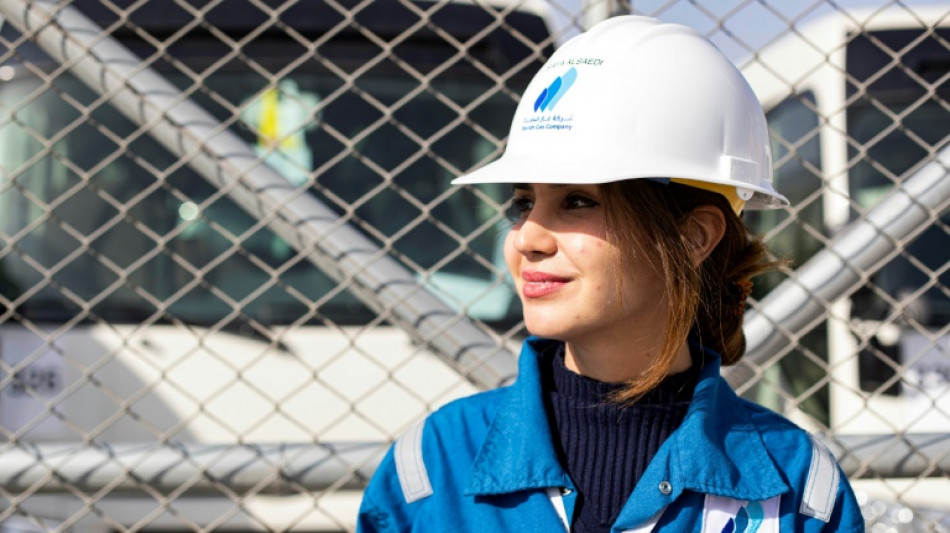
Bottom of gender rankings, Iraqi women defy critics to work

 Lights out in Laos as electricity exports surge

 Steven Strogatz weighs AI mathematics advances and their consequences for researchers

 Anthropic boss calls for AI slowdown, Altman and Musk agree

 French IT giant Capgemini sells subsidiary after row over ICE links

 Quebec Brokerage Qubit Insurance Announces New Data on Coverage Shortfalls as Rebuilding Costs Rise

 Lady Gaga welcomes first child with fiance: US media

 Bhutan business bets on hazelnuts for farming future

 'Widow's Bay' and 'The Pitt' are favorites for Emmys night

 Coastal erosion forces cancellation of California music festival

 Argentina's Dirty War rears its head in Venice film

 UK lawmakers throw out bill to legalise assisted dying

 US inflation steady in August, fueling Fed rate hike expectations

 New York marks 25th anniversary of 9/11 attacks

 Nepal flood reconstruction bill to be $4.78 bn: foreign ministry

 JUMO and Standard Bank launch Social Finance Framework to scale inclusive finance in Africa

 Doomsday tech: could AI really kill us all?

 French comedy show 'Call my agent' makes film comeback

 It's all coming back: Celine Dion fans gear up for Paris return

 Researchers eye AI revolution in natural disaster forecasts

 US braces for inflation report that may push Fed to hike rates

 Musk threatens legal action over documentary

 Latin America fact-check group asks Meta not to replace verification practice

 AI Risks to Enter 60–80% of Liability and Cyber Insurance Underwriting by 2028, ScienceSoft Predicts

 Tribal Launches Campfire, Letting Business and Technical Teams Build on Salesforce Together

 Stocks fall as fresh oil surge fans inflation fears

Each working morning, oil engineer Safa al-Saeedi dons a safety helmet and heads into a gas complex for another day challenging conservative prejudices by being a professional woman in Iraq.
"Society does not accept that a girl can live outside the family home," said 29-year-old Saeedi, who works in Iraq's southern oil and gas fields around Basra.
Saeedi, one of just 180 women among the 5,000 employees of the Basrah Gas Company, sees herself as a change maker and encourages other women to join the industry.
For many, a single woman working away from home in a male-dominated sector is frowned upon, and it is a hard task for women to break out of the role of wife and mother traditionally assigned to them.
"I often hear them say to me: 'You are almost 30, you will miss the boat! You will end up single,'" said Saeedi. "It makes me laugh, but I do not answer."
The female labour force participation rate in Iraq is "one of the lowest in the world" at 13 per cent, according to a joint report last year by UN Women, the agency working for gender equality, and the UN Economic and Social Commission for West Asia (ESCWA).
- 'Discriminatory' -
The 2021 UN report said surveys had found that "most Iraqis agree that university education is equally important for both sexes".
But it also reported that "attitudes toward equal rights in employment are discriminatory against women".
The World Economic Forum ranked Iraq bottom in women's economic participation and opportunity, and put it 152nd overall out of the 153 nations assessed in its 2020 Global Gender Gap Index.
Saeedi, who graduated in 2014 after studying engineering at university in Basra, was immediately employed by oil giant Shell -- a job that "required spending some nights away from home".
Her mother opposed the job because she was "afraid of what people will say, and that it will affect my reputation and my chances of getting married", Saeedi said. "It was a challenge," she added.
But Saeedi pressed on, rising through the ranks to become a team leader in the Basrah Gas Company, a joint venture majority-owned by the Iraqi government, with Shell and Mitsubishi.
- 'Powerful and brilliant women' -
Her job requires her to live on site for a month at a time, staying in company accommodation. After work, she plays sport, or jogs around the huge gas storage tanks.
On leave, she returns home to Basra -- if she is not indulging in her passion for travel, which has taken her so far to some 30 countries.
"I hope to reach a management position, because you rarely see women in these positions, even though Iraq has many powerful and brilliant women," Saeedi said.
It is a tough path to follow.
"I was initially overwhelmed with fear, because I was in a purely male environment," said chemical engineer Dalal Abdelamir. The 24-year-old works on the same site as Saeedi.
"At the beginning, I thought that I was inferior, that I would never have the required level. I was even worried to ask questions," she said.
"But this job and this position has taught me not to be afraid, not to hesitate and not to fear that I cannot do it, but to believe that I can."
Abdelamir joined the company via a graduate programme which hired 20 men and 10 women.
"We didn't go to Basra University saying we wanted to recruit women," said Malcolm Mayes, managing director of Basrah Gas Company.
"We went there saying we wanted the brightest students".
H.Müller--CPN