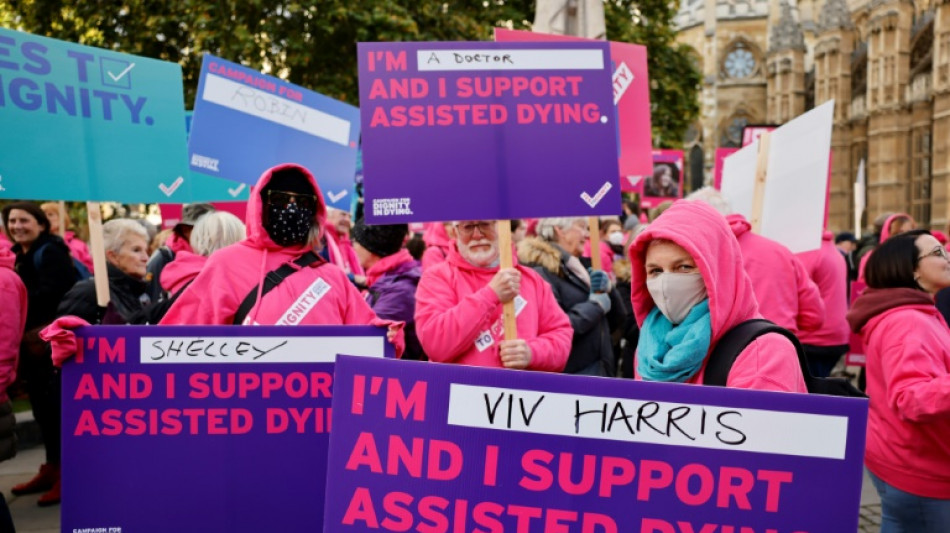
UK assisted dying bill hopes to end 'inhumane' suicides

 Lights out in Laos as electricity exports surge

 Steven Strogatz weighs AI mathematics advances and their consequences for researchers

 Anthropic boss calls for AI slowdown, Altman and Musk agree

 French IT giant Capgemini sells subsidiary after row over ICE links

 Quebec Brokerage Qubit Insurance Announces New Data on Coverage Shortfalls as Rebuilding Costs Rise

 Lady Gaga welcomes first child with fiance: US media

 Bhutan business bets on hazelnuts for farming future

 'Widow's Bay' and 'The Pitt' are favorites for Emmys night

 Coastal erosion forces cancellation of California music festival

 Argentina's Dirty War rears its head in Venice film

 UK lawmakers throw out bill to legalise assisted dying

 US inflation steady in August, fueling Fed rate hike expectations

 New York marks 25th anniversary of 9/11 attacks

 Nepal flood reconstruction bill to be $4.78 bn: foreign ministry

 JUMO and Standard Bank launch Social Finance Framework to scale inclusive finance in Africa

 Doomsday tech: could AI really kill us all?

 French comedy show 'Call my agent' makes film comeback

 It's all coming back: Celine Dion fans gear up for Paris return

 Researchers eye AI revolution in natural disaster forecasts

 US braces for inflation report that may push Fed to hike rates

 Musk threatens legal action over documentary

 Latin America fact-check group asks Meta not to replace verification practice

 AI Risks to Enter 60–80% of Liability and Cyber Insurance Underwriting by 2028, ScienceSoft Predicts

 Tribal Launches Campfire, Letting Business and Technical Teams Build on Salesforce Together

 Stocks fall as fresh oil surge fans inflation fears

Molly Meacher's voice quivers with emotion as she tells how her aunt took her own life after her liver cancer tumour grew to the size of a football.
"One night, she took a whole lot of pills and whisky, and her husband found her dead in the morning," said Meacher, a member of British parliament's upper House of Lords.
"It seemed to me terribly sad that somebody would end their life alone in the middle of the night without even their dear husband knowing that this was what they were doing," she told AFP.
Meacher, 81, has drafted a law to legalise assisted dying in England for the terminally ill with less than six months to live, an act currently punishable by up to 14 years in prison.
"It just was clear to me that this was just inhumane. You wouldn't treat a dog or a cat like that. But we treat our own people like that," said the former social worker.
The UK parliament examined the question of assisted dying in 2015 and decided against legalising it, but since then other countries have decided to approve what many see as an act of mercy.
"Things are moving in the right direction, there are a number of British Isles jurisdictions that are looking at changing the law," said Sarah Wootton, head of the Dignity in Dying campaign group.
- 'Discriminatory' -
Last September, the influential British Medical Association ended its opposition to "physician-assisted dying", taking the "historic step" of adopting a neutral position.
According to a poll by YouGov, 73 percent of Britons questioned in August said that doctors should be able to help terminally ill patients die.
By contrast, only 35 percent of MPs approved.
Campaigner Alex Pandolfo says the law "needs changing immediately (because) of the discriminatory practice that takes place in this country".
"It actually exists already for the privileged," says Pandolfo, in his 60s and terminally ill with Alzheimer's.
If you have £10,000 (about 12,000 euros, 13,500 dollars) for flights, hotels and food, you can go to a country such as Switzerland to die, he said.
Pandolfo has already booked his assisted death at a Swiss clinic and in recent years has accompanied around 100 Britons to die in Switzerland.
But he would rather die in England, to be near loved ones and allow them to have a more natural grieving process.
"I'm in no hurry," he jokes, saying he was given "a death sentence" in 2015.
"I am already dying of a condition that I've got no control over," he said.
"All I'm asking for is somebody to assist me with that death when it will be unbearable, to accelerate things. It's a rational act."
Sitting on his sofa in Lancaster, northwest England, the white-haired Pandolfo says his illness has already had a "massive impact" on his quality of life.
It affects his memory, movement, ability to speak and drive, and watch a football match.
As a result, he would never qualify for assisted dying under the terms of the draft law before parliament, which he says is "extremely restricted".
"By the time I've got six months to live, I won't have capacity to say that I want assisted dying," he said.
- 'Unacceptable pressure' -
Meacher said her bill's restrictions are "a political decision based on realities" in a "fairly conservative country", particularly where religious leaders and the faithful are involved.
"It's pretty hard to get a bill through parliament with these rather narrow limits," she said.
The Archbishop of Canterbury, Justin Welby, told parliament that euthanasia could expose the most vulnerable to unacceptable pressure to die from some "loved ones".
Welby, the most senior cleric in the worldwide Anglican communion, also told the BBC that "sadly people make mistakes in their diagnosis".
Meacher's bill "has done a great job at raising the issue," said Wootton.
While it will not necessarily become law a similar bill before the Scottish Parliament has much more chance of success "within a year-and-a-half", she said.
"It will be very difficult for medical regulators to have something lawful in one part of the country and not lawful in other parts of the country.
"I think that's an unsustainable situation in the long term."
Similar draft laws are being looked at in the self-governing Crown dependencies of Jersey and the Isle of Man.
Even strictly Roman Catholic neighbour Ireland is studying the possibility of euthanasia, giving people like Pandolfo a measure of hope.
Once he had his place booked in Switzerland, Pandolfo said: "I stopped worrying about dying and suffering and started focusing and concentrating on enjoying what life can."
M.Anderson--CPN