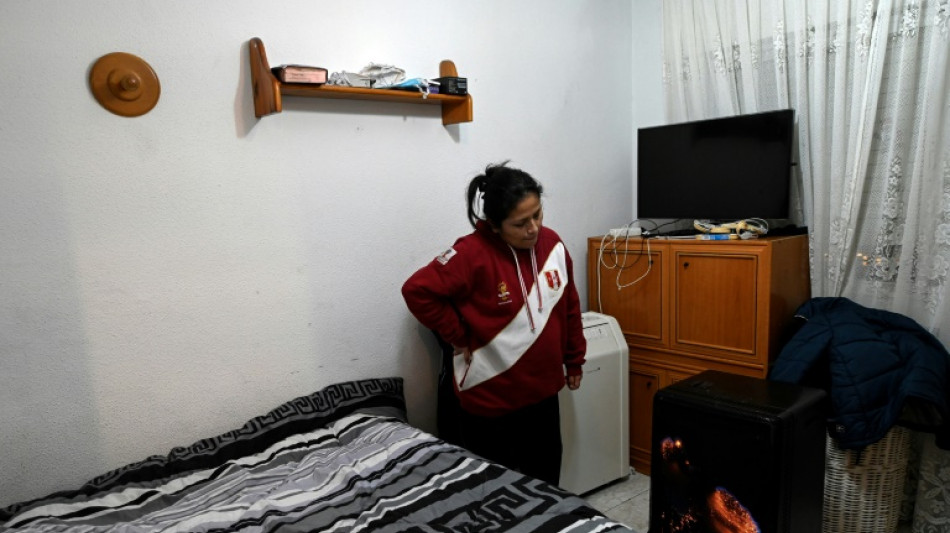
Left out in the cold by Spain's soaring energy prices

 Lights out in Laos as electricity exports surge

 Steven Strogatz weighs AI mathematics advances and their consequences for researchers

 Anthropic boss calls for AI slowdown, Altman and Musk agree

 French IT giant Capgemini sells subsidiary after row over ICE links

 Quebec Brokerage Qubit Insurance Announces New Data on Coverage Shortfalls as Rebuilding Costs Rise

 Lady Gaga welcomes first child with fiance: US media

 Bhutan business bets on hazelnuts for farming future

 'Widow's Bay' and 'The Pitt' are favorites for Emmys night

 Coastal erosion forces cancellation of California music festival

 Argentina's Dirty War rears its head in Venice film

 UK lawmakers throw out bill to legalise assisted dying

 US inflation steady in August, fueling Fed rate hike expectations

 New York marks 25th anniversary of 9/11 attacks

 Nepal flood reconstruction bill to be $4.78 bn: foreign ministry

 JUMO and Standard Bank launch Social Finance Framework to scale inclusive finance in Africa

 Doomsday tech: could AI really kill us all?

 French comedy show 'Call my agent' makes film comeback

 It's all coming back: Celine Dion fans gear up for Paris return

 Researchers eye AI revolution in natural disaster forecasts

 US braces for inflation report that may push Fed to hike rates

 Musk threatens legal action over documentary

 Latin America fact-check group asks Meta not to replace verification practice

 AI Risks to Enter 60–80% of Liability and Cyber Insurance Underwriting by 2028, ScienceSoft Predicts

 Tribal Launches Campfire, Letting Business and Technical Teams Build on Salesforce Together

 Stocks fall as fresh oil surge fans inflation fears

In her flat on the outskirts of Madrid, Pamela Ponce no longer turns on the heating despite the biting chill coming in through the windows.
"The prices have gone up a lot, I have no choice," sighs Ponce, a young Peruvian mother, her voice resigned.
On this bitterly cold January morning, the temperature outside is hovering around five degrees Celsius (41 degrees Fahrenheit). And inside, it's barely much warmer.
"It can also be very cold inside, above all when there's no sun," she says, walking through the three rooms where she lives with her mother and two children in Leganes.
This 32-year-old says she hasn't been able to pay her electricity bills for the past three months with prices in Spain soaring by a staggering 72 percent over the last year, one of the highest increases within the European Union.
The hike has been in part driven by Spain's excessive dependence on gas to produce electricity and the lack of a major power provider like in many other countries to help keep prices in check through reduced tariffs.
"Before I was paying between 35 and 60 euros a month but now, it's more than 100 euros, without even mentioning gas which has also gone up," explains Ponce, who hasn't worked since catching Covid which left her with severe after-effects, notably affecting her left hand.
"I just don't know what to do," says the former cleaning lady who admits she's reliant upon her ex-partner to pay the rent and buy food.
"I feel like I'm drowning," she whispers, her voice choked with emotion.
In an attempt to heat the flat, she has bought a heater that runs off a gas bottle which she moves from room to room depending on what they need.
"It's cheaper," she says. But everything else is strictly rationed.
"My kids only take a shower every other day (and) I generally cook for 2 or 3 days at a time so I don't have to turn the cooker on so much," she explains.
- More and more families affected -
And there are countless others like her.
"More and more families are struggling to pay their bills" and "have to chose between paying for food or light at the end of the month," says Sara Casas, head of environmental issues at the Spanish Red Cross.
Last year, Spain's left-wing government announced a series of tax cuts to try and bring down household bills but even this has not compensated for the huge rise in prices.
According to the UOC, Spain's largest consumer organisation, the average annual home electricity bill in Spain has risen from 675 euros in 2020 to 949 euros in 2021, a rise of 41 percent.
The previous record jump, in 2018, was 18 percent.
Vulnerable people, such as "single mums with children, older people with a low income and migrants" are particularly badly hit because many "struggle to get benefits because there's a lot of red tape and you have to bring in a lot of paperwork," says Casas.
- Layering up, homemade heaters -
According to an awareness campaign being run by Medicos del Mundo, some 6.8 million of Spain's 47 million residents are suffering to one degree or another from "energy poverty".
Such a situation brings with it "a higher risk of suffering from chronic bronchitis, depression and anxiety," the NGO says.
One of those struggling is Raul, a 55-year-old computer technician who lives with his wife, daughter and 82-year-old mother-in-law in the northwestern city of A Coruna.
"Whenever we turn something on, we have to think about how much the bill will go up," says Raul who hasn't worked since suffering a stroke in March 2021, with the family living off his wife's salary.
"My neurologist told me I should avoid stress but it's very difficult when you don't know if you're going to be able to pay next month's bills," he says, admitting they have barely switched on the heating this winter, despite the cold and the humidity.
"We bought a heated blanket for my mother-in-law" and "inside the house, I always wear lots of jumpers or coats," he says.
He has also been trying to cobble together a home-made heater.
"It's a temporary solution," shrugs Raul, who says he is keeping his fingers crossed "that the prices will eventually come down".
H.Müller--CPN