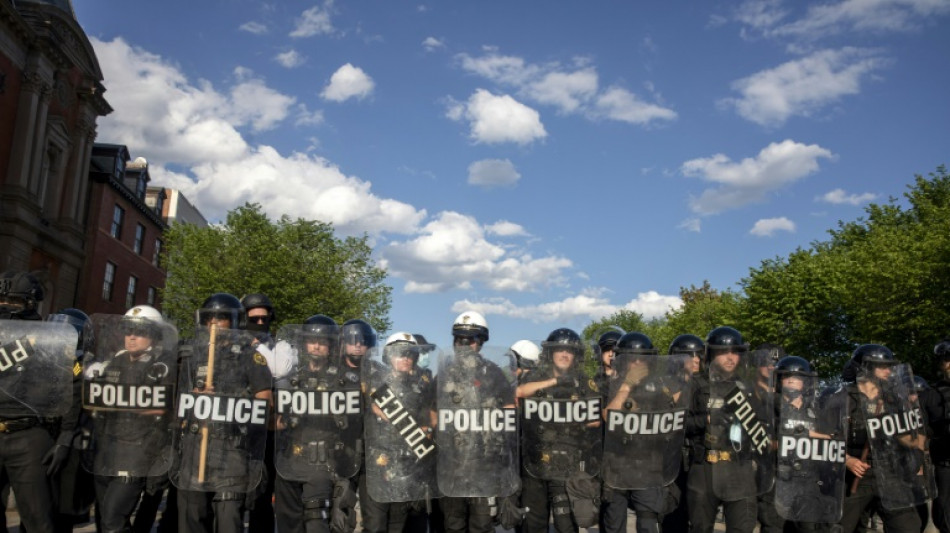
Standing up to violent colleagues a high-risk 'duty' for US police

 Kenya's economy faces climate change risks: World Bank

 Apple tops estimates in CEO Cook's final quarter, but shares fall

 Milei demands expulsion of foreigners expressing 'hate' against Argentina

 Italy's Po River valley on drought alert

 Prada profits pinched as growth hard to chase

 Stocks climb on earnings and rates, oil retreats

 US economic growth slows in second quarter, missing expectations

 Russia adds Telegram founder Durov to 'terrorist' blacklist

 Stocks diverge on earnings, as oil steadies

 Eurozone economy grows despite Middle East war

 Singapore group will develop 'most promising' Ebola vaccine

 Shell profit surges as Mideast war fuels oil prices
 Car maker Stellantis says back in profit in second quarter

 Samsung quarterly operating profit up 1,800% on AI boom

 South Korean stocks bounce after rout, oil holds gains on Mideast woes

 South Korea's women web sleuths fight AI deepfake porn

 Anything but programmable: New cost-efficient EC-power-supply-series for the DIN rail by CAMTEC PS

 Meta misses profit expectations, sticks to massive AI spending

 Campari - king of the spritz - hopes to conquer American heartland

 Air France-KLM and Lufthansa bid for Portugal's TAP airline

 Profits soar at Airbus as it delivers more planes

 Rheinmetall shares surge after armsmaker reports record profit

 FIFA hit by furious backlash over plans to sell stake in competitions

 MEXC Integrates World-Check to Fortify Institutional Grade Compliance Architecture

 Spain returns wildfire evacuees as France braces for worsening weather

US police officer Cariol Horne intervened when a colleague started choking a Black suspect during an arrest in 2006. "Fifteen years of hell" ensued for Horne, also African-American, as she was punished for stepping out of rank.
In the United States, police have a "duty to intervene" when another officer uses excessive force in their presence and can be prosecuted if they do not step in, according to half-century-old case law developed by the courts.
Three former Minneapolis police officers are currently on trial in such a case: the federal justice system accuses them of failing to act in May 2020 when George Floyd, a Black man, suffocated as another officer knelt on his neck for nearly 10 minutes.
In the video of the incident, which sparked anti-racism protests around America and the world, their passivity was almost as shocking as their colleague's actions.
In the face of public outrage, many municipalities changed their rules in order to codify their officers' duty to intervene and give the regulation more weight.
According to the Police Use of Force Project, 72 out of the 100 largest US police forces now have this clause, compared to 51 before Floyd's death.
But for De Lacy Davis, a former police officer who founded the organization Black Cops Against Police Brutality, these reforms are superficial.
He says they won't accomplish anything without a fundamental change in the culture of law enforcement, which he says currently has no intention of breaking the "blue wall of silence."
- 'Punched me in the face' -
That expression, which refers to the color of police uniforms, implies complete solidarity among officers -- even towards the black sheep of the force. And woe betide anyone who dares to break away.
Horne has lived through the bitter experience.
In 2006, working as an officer in Buffalo, New York, she says her colleague swung at a Black man in his 50s during an arrest and "tried to strangle him."
"I intervened and he punched me in the face," Horne told AFP.
A fight ensued, and paradoxically, "I became the one investigated. They came after me for having stopped him," she said.
After a long trial, Horne was dismissed in 2008, just before reaching 20 years' seniority that would have entitled her to a pension.
At the time, she was 40 and had five young children to support. Without her pension, she had to rely on federal assistance.
Disgusted by the injustice of her situation, "I went through a depression," said Horne, recalling "15 years of hell" as she fought to vindicate herself.
- No regrets -
In 2018, she got some indirect satisfaction when her former colleague was sentenced to prison for violence against four Black teenagers.
Floyd's murder shone new light on her own case, and in the fall of 2020, Buffalo City Hall adopted a new regulation dubbed the "Cariol Law" that would require police to step in when a fellow officer is overly abusive -- and would also protect those who intervene from repercussions.
Finally, in 2021, a judge overturned Horne's firing and restored her pension rights. "While the Eric Garners and the George Floyds of the world never had a chance for a 'do-over,' at least here the correction can be done," said Judge Dennis Ward.
Garner suffocated to death in 2014 when a New York officer put him in a choke hold. The African-American man pleaded, "I can't breathe," which has become a rallying cry at protests against police brutality and racism.
Today, Horne is still waiting for her pension payments, and is following the former Minneapolis officers' trial without high expectations.
Even if the court sends a message by convicting them, nothing will change "until the officers who try to intervene are... protected" from reprisal, she said.
"What we need are 'Cariol Laws' in the whole nation."
But even though she paid a high price, Horne remains convinced she made the right choice. "Never would I ever regret that a man lived because I intervened."
A.Levy--CPN