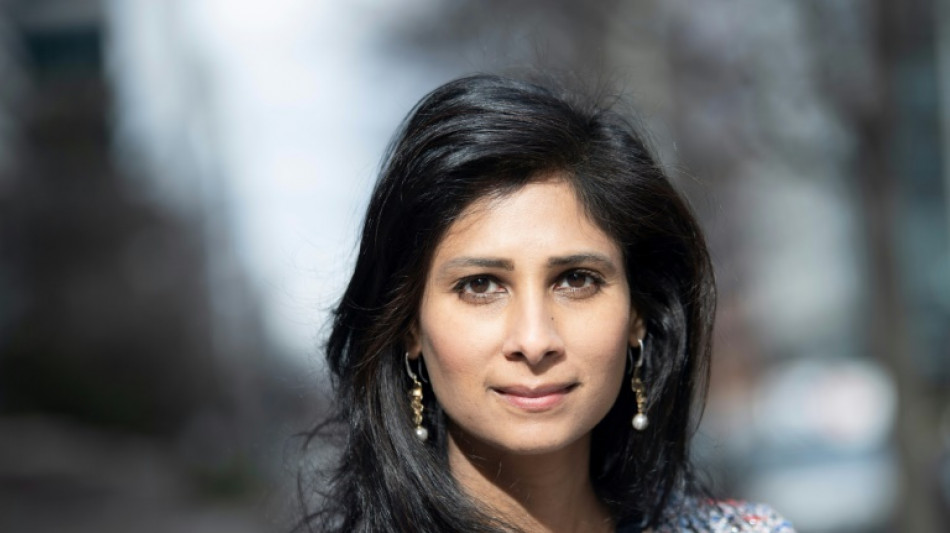
IMF's Gopinath says time to 'recalibrate' Covid restrictions

 Lights out in Laos as electricity exports surge

 Steven Strogatz weighs AI mathematics advances and their consequences for researchers

 Anthropic boss calls for AI slowdown, Altman and Musk agree

 French IT giant Capgemini sells subsidiary after row over ICE links

 Quebec Brokerage Qubit Insurance Announces New Data on Coverage Shortfalls as Rebuilding Costs Rise

 Lady Gaga welcomes first child with fiance: US media

 Bhutan business bets on hazelnuts for farming future

 'Widow's Bay' and 'The Pitt' are favorites for Emmys night

 Coastal erosion forces cancellation of California music festival

 Argentina's Dirty War rears its head in Venice film

 UK lawmakers throw out bill to legalise assisted dying

 US inflation steady in August, fueling Fed rate hike expectations

 New York marks 25th anniversary of 9/11 attacks

 Nepal flood reconstruction bill to be $4.78 bn: foreign ministry

 JUMO and Standard Bank launch Social Finance Framework to scale inclusive finance in Africa

 Doomsday tech: could AI really kill us all?

 French comedy show 'Call my agent' makes film comeback

 It's all coming back: Celine Dion fans gear up for Paris return

 Researchers eye AI revolution in natural disaster forecasts

 US braces for inflation report that may push Fed to hike rates

 Musk threatens legal action over documentary

 Latin America fact-check group asks Meta not to replace verification practice

 AI Risks to Enter 60–80% of Liability and Cyber Insurance Underwriting by 2028, ScienceSoft Predicts

 Tribal Launches Campfire, Letting Business and Technical Teams Build on Salesforce Together

 Stocks fall as fresh oil surge fans inflation fears

China should begin to "recalibrate" its aggressive anti-Covid policy as other countries are doing, to try to ease the negative impact the pandemic continues to have on global supply chains and economic growth, a senior IMF official said on Tuesday.
Speaking in an interview with AFP, Gita Gopinath, the newly-installed number two official at the global crisis lender, said with vaccines and treatments countries should be able to get back to more normal activity.
-Is it time for China time to ease its zero tolerance policy?
"Firstly, I would like to recognize that the zero COVID strategy for China has worked very well in 2020 and 2021. They've had very low cases, very few deaths, and the economy has been recovering. So it's a strategy that has worked well...
"Like all countries, they will indeed need to recalibrate because what we are seeing is with more frequent outbreaks, and therefore more lockdowns, even though they're very targeted, we're certainly seeing that having a negative impact on activity. And if that becomes much more serious, it will not just slow down growth even more but also have very important consequences for global supply chains.
"So we are moving I would say gradually to that recognition, that because of the vaccines that we have, the tests, the therapeutics, we can get back to much more normalcy."
-How do you view the inflation risk in the US economy?
"Inflation has become elevated pretty much across the globe. And especially if you look at headline inflation, that's been very high in many countries, because we've seen a big increase in energy prices and food prices.
"The US is an example of that, where inflation is quite a bit broad-based, and you're seeing it including in wages rising.
"Our projection is that inflation in most countries will decline through this year, especially in the second half of this year. And then into 2023 is when we will see it subsiding. But we should recognize for several countries, that inflation even though it's declining, it will be high. It will be above their targets.
"I would just recognize the high level of uncertainty around inflation projections. Because inflation this time round is not just a simple macro story, but has all very pandemic specific elements to it...
"From our perspective, the more likely scenario is that it will not be down to two percent (in the United States) by the end of this year, in fact, it will be quite a bit above it ... It will take going into 2023 for that to come down further."
-What is the risk of higher interest rates?
"This is going to be a challenge for central bankers this year to be able to communicate the transition to tighter monetary policy. And they should handle that with care. Because we are in a world with very high levels of debt (and) if interest rates really jump up in an unexpected way, then that can hit several countries quite negatively.
"We are concerned about the high debt levels, and importantly, the high levels of debt servicing costs many low income countries have to pay. We have 60 percent of low income countries that we assessed to be either already in debt distress or in high risk of being in debt distress.
"So these are very difficult times. And as global interest rates are going up, it's going to be a big fiscal cost of them."
H.Müller--CPN