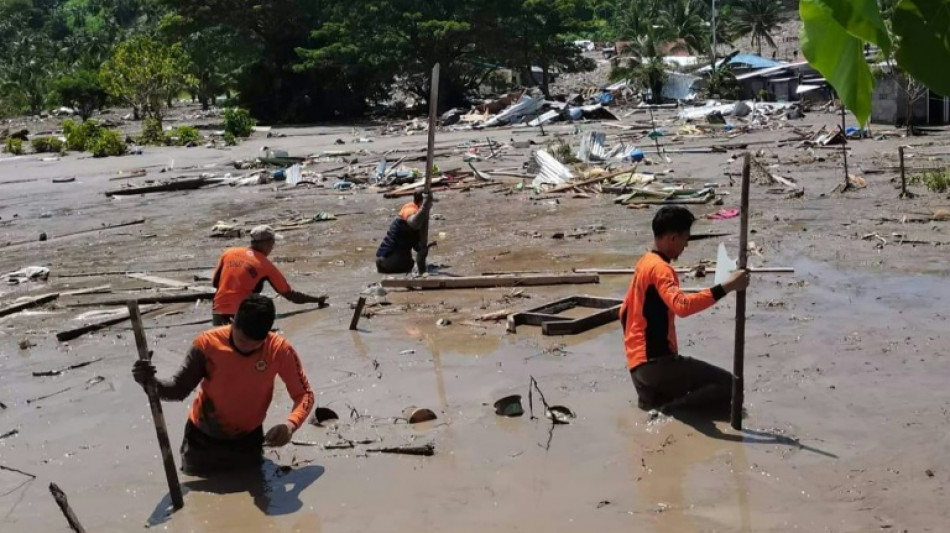
Rescuers search for bodies as Philippines storm death toll hits 101 / Photo: Handout - Philippines Coast Guard (PCG)/AFP

 Lights out in Laos as electricity exports surge

 Steven Strogatz weighs AI mathematics advances and their consequences for researchers

 Anthropic boss calls for AI slowdown, Altman and Musk agree

 French IT giant Capgemini sells subsidiary after row over ICE links

 Quebec Brokerage Qubit Insurance Announces New Data on Coverage Shortfalls as Rebuilding Costs Rise

 Lady Gaga welcomes first child with fiance: US media

 Bhutan business bets on hazelnuts for farming future

 'Widow's Bay' and 'The Pitt' are favorites for Emmys night

 Coastal erosion forces cancellation of California music festival

 Argentina's Dirty War rears its head in Venice film

 UK lawmakers throw out bill to legalise assisted dying

 US inflation steady in August, fueling Fed rate hike expectations

 New York marks 25th anniversary of 9/11 attacks

 Nepal flood reconstruction bill to be $4.78 bn: foreign ministry

 JUMO and Standard Bank launch Social Finance Framework to scale inclusive finance in Africa

 Doomsday tech: could AI really kill us all?

 French comedy show 'Call my agent' makes film comeback

 It's all coming back: Celine Dion fans gear up for Paris return

 Researchers eye AI revolution in natural disaster forecasts

 US braces for inflation report that may push Fed to hike rates

 Musk threatens legal action over documentary

 Latin America fact-check group asks Meta not to replace verification practice

 AI Risks to Enter 60–80% of Liability and Cyber Insurance Underwriting by 2028, ScienceSoft Predicts

 Tribal Launches Campfire, Letting Business and Technical Teams Build on Salesforce Together

 Stocks fall as fresh oil surge fans inflation fears

Philippine rescuers on Monday waded through thigh-deep mud using long pieces of wood to search for bodies buried by a landslide, as the death toll from a powerful storm rose to 101.
Just over half of the fatalities were from a series of flash floods and landslides unleashed by Tropical Storm Nalgae, which destroyed villages on the southern island of Mindanao on Friday.
Mindanao is rarely hit by the 20 or so typhoons that strike the Philippines each year, but storms that do reach the region tend to be deadlier than in Luzon and central parts of the country.
There is little hope of finding survivors in the worst-hit areas after the storm swept across the archipelago nation, inundating communities in and around the capital Manila over the weekend.
The national disaster agency has recorded 66 people still missing and scores of others injured.
Perfidia Seguendia, 71, and her family lost all their belongings except the clothes they were wearing when they fled to their neighbour's two-storey house in Noveleta municipality, south of Manila.
"Everything was flooded -- our fridge, washing machine, motorcycle, TV, everything," Seguendia told AFP.
"All we managed to do was to cry because we can't really do anything about it. We weren't able to save anything, just our lives."
The Philippine Coast Guard posted pictures on Facebook showing its personnel in devastated Kusiong village, in Maguindanao del Norte province of Mindanao, struggling through thick, thigh-deep mud and water as they searched for more bodies.
Kusiong was buried by a massive landslide, which created a huge mound of debris, just below several picturesque mountain peaks.
Rescuers poked long pieces of wood into the morass looking for five missing villagers, after recovering 20 bodies in recent days, the coast guard said.
Twelve of the dead, including seven from one family, were buried Monday in two mass graves dug by a backhoe.
Mourners, who survived the landslide, laid flowers and candles at the site.
"We have shifted our operation from search and rescue to retrieval because the chances of survival after two days are almost nil," said Naguib Sinarimbo, civil defence chief of the Bangsamoro region in Mindanao.
Meanwhile, survivors faced the heartbreaking task of cleaning up their sodden homes.
Residents shovelled mud from their houses and shops after piling their furniture and other belongings in the streets of Noveleta.
"In my entire life living here, it's the first time we experienced this kind of flooding," said Joselito Ilano, 55, whose house was flooded by waist-high water.
"I am used to flooding here but this is just the worst, I was caught by surprise."
- More rain on the way -
President Ferdinand Marcos began touring some of the hard-hit areas on Monday, including Noveleta, as aid agencies rushed food packs, drinking water and other relief to victims.
Marcos said preemptive evacuations in Noveleta had saved lives.
"While the calamity was huge, the number of casualties was not that high, although there's a lot of damage to infrastructure," he said.
Nalgae inundated villages, destroyed crops and knocked out power in many regions as it swept across the country.
It struck on an extended weekend for All Saints' Day, which is on Tuesday, when millions of Filipinos travel to visit the graves of loved ones.
Scientists have warned that deadly and destructive storms are becoming more powerful as the world gets warmer because of climate change.
The state weather forecaster warned that another tropical storm was heading towards the Philippines even as Nalgae moved across the South China Sea.
Starting Wednesday, the new weather system could bring more heavy rain and misery to southern and central regions badly affected by Nalgae.
Landslides and flash floods originating from largely deforested mountainsides have been among the deadliest hazards posed by storms in the Philippines in recent years.
A.Mykhailo--CPN