-
 Lights out in Laos as electricity exports surge
-
Anthropic details Claude misuse as US targets major illicit online marketplace

-
 Steven Strogatz weighs AI mathematics advances and their consequences for researchers
-
Venezuelans outside Caracas say capital not sharing blackout burden

-
 Anthropic boss calls for AI slowdown, Altman and Musk agree
-
Anthropic boss calls for slowing pace of AI development

-
 French IT giant Capgemini sells subsidiary after row over ICE links
-
BRICS nations urge 'maximum restraint' in Middle East war

-
 Quebec Brokerage Qubit Insurance Announces New Data on Coverage Shortfalls as Rebuilding Costs Rise
-
Europe eyes battle over 'pervert' AI glasses

-
 Lady Gaga welcomes first child with fiance: US media
-
Children in flood-hit Nepal grapple with loss, cling to hope

-
 Bhutan business bets on hazelnuts for farming future
-
Venice Film Festival: A look back on the highlights

-
 'Widow's Bay' and 'The Pitt' are favorites for Emmys night
-
DR Congo school fire stampede death toll rises to 26: UNICEF

-
 Coastal erosion forces cancellation of California music festival
-
Dance Fitness Tempe Announces Expansion of Accessible Digital Movement Programs

-
 Argentina's Dirty War rears its head in Venice film
-
Europe saw record summer air traffic despite Mideast war: Eurocontrol

-
 UK lawmakers throw out bill to legalise assisted dying
-
Relatives of 9/11 victims hit out at Saudi Arabia -- and US leaders

-
 US inflation steady in August, fueling Fed rate hike expectations
-
Relative of 9/11 victim unleashes searing attack on Saudi Arabia

-
 New York marks 25th anniversary of 9/11 attacks
-
Czech antitrust office lets Turkey's Pegasus Airlines buy Smartwings

-
 Nepal flood reconstruction bill to be $4.78 bn: foreign ministry
-
Investors on edge as energy costs, surging bond yields roil markets

-
 JUMO and Standard Bank launch Social Finance Framework to scale inclusive finance in Africa
-
UK lawmakers to vote again on failed assisted dying bill

-
 Doomsday tech: could AI really kill us all?
-
Yemen's Houthis complete takeover of Bab al-Mandab area: govt official to AFP

-
 French comedy show 'Call my agent' makes film comeback
-
Fast-pace dance takes I.Coast's working-class streets by storm

-
 It's all coming back: Celine Dion fans gear up for Paris return
-
Fans celebrate Celine Dion's Paris return with giant karaoke

-
 Researchers eye AI revolution in natural disaster forecasts
-
Appreciation, anger await as Trump heads to Irish golf resort

-
 US braces for inflation report that may push Fed to hike rates
-
Putin arrives in India for BRICS summit coloured by wars

-
 Musk threatens legal action over documentary
-
Carney says in touch with Trump, Canada ready for 'fair' trade deal

-
 Latin America fact-check group asks Meta not to replace verification practice
-
Tag Markets Names Craig Lund Chief Executive Officer

-
 AI Risks to Enter 60–80% of Liability and Cyber Insurance Underwriting by 2028, ScienceSoft Predicts
-
ECB lifts borrowing costs amid energy shock, opens door for more hikes

-
 Tribal Launches Campfire, Letting Business and Technical Teams Build on Salesforce Together
-
Global Tokenized Real Estate Market to Hit up to $3 Trillion by 2030, ScienceSoft Predicts

-
 Stocks fall as fresh oil surge fans inflation fears
-
US producer inflation tops expectations as diesel costs jump

'Dangerous' Typhoon Nanmadol slams into Japan
Typhoon Nanmadol made landfall in southwestern Japan on Sunday night, as authorities urged millions of people to take shelter from the powerful storm's high winds and torrential rain.
The storm officially made landfall around 7 pm local time (1000 GMT) as its eyewall arrived near Kagoshima city, the Japan Meteorological Agency (JMA) said.
It was packing gusts of up to 234 kilometres (146 miles) per hour and had already dumped up to 500 mm of rain in less than 24 hours on parts of southwestern Kyushu region.
At least 20,000 people were spending the night in shelters in Kyushu's Kagoshima and Miyazaki prefectures, where the JMA has issued a rare "special warning" -- an alert that is issued only when it forecasts conditions seen once in several decades.
National broadcaster NHK, which collates information from local authorities, said more than seven million people had been told to move to shelters or take refuge in sturdy buildings to ride out the storm.
The evacuation warnings are not mandatory, and authorities have at times struggled to convince people to move to shelters before extreme weather.
They sought to drive home their concerns about the weather system throughout the weekend.
"Please stay away from dangerous places, and please evacuate if you feel even the slightest hint of danger," Prime Minister Fumio Kishida tweeted after convening a government meeting on the storm.
"It will be dangerous to evacuate at night. Please move to safety while it's still light outside."
The JMA has warned the region could face "unprecedented" danger from high winds, storm surges and torrential rain and called the storm "very dangerous."
"Areas affected by the storm are seeing the sort of rain that has never been experienced before," Hiro Kato, the head of the Weather Monitoring and Warning Centre, told reporters Sunday.
"Especially in areas under landslide warnings, it is extremely probable that some kinds of landslides are already happening."
He urged "maximum caution even in areas where disasters do not usually happen."
By Sunday evening, utility companies said nearly 200,000 homes across the region were without power.
Trains, flights and ferry runs were cancelled until the passage of the storm, and even some convenience stores -- generally open all hours and considered a lifeline in disasters -- were shutting their doors.
- 'Highest caution possible' -
"The southern part of the Kyushu region may see the sort of violent wind, high waves and high tides that have never been experienced before," the JMA said Sunday, urging residents to exercise "the highest caution possible".
On the ground, an official in Kagoshima's Izumi city said conditions were deteriorating rapidly by Sunday afternoon.
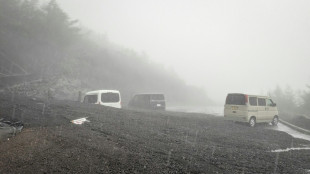
"The wind has become extremely strong. Rain is falling hard too," he told AFP. "It's a total white-out outside. Visibility is almost zero."
In Kyushu's Minamata city, fishing boats tied up for safety bobbed on the waves, as spray from the sea and bands of rain sluiced the boardwalk.
The storm, which has weakened slightly as it approached land, is expected to turn northeast and sweep up across Japan's main island through early Wednesday.
Japan is currently in typhoon season and faces around 20 such storms a year, routinely seeing heavy rains that cause landslides or flash floods.
In 2019, Typhoon Hagibis smashed into Japan as it hosted the Rugby World Cup, claiming the lives of more than 100 people.
A year earlier, Typhoon Jebi shut down Kansai Airport in Osaka, killing 14 people.
And in 2018, floods and landslides killed more than 200 people in western Japan during the country's annual rainy season.
Scientists say climate change is increasing the severity of storms and causing extreme weather such as heat waves, droughts and flash floods to become more frequent and intense.
L.K.Baumgartner--CPN