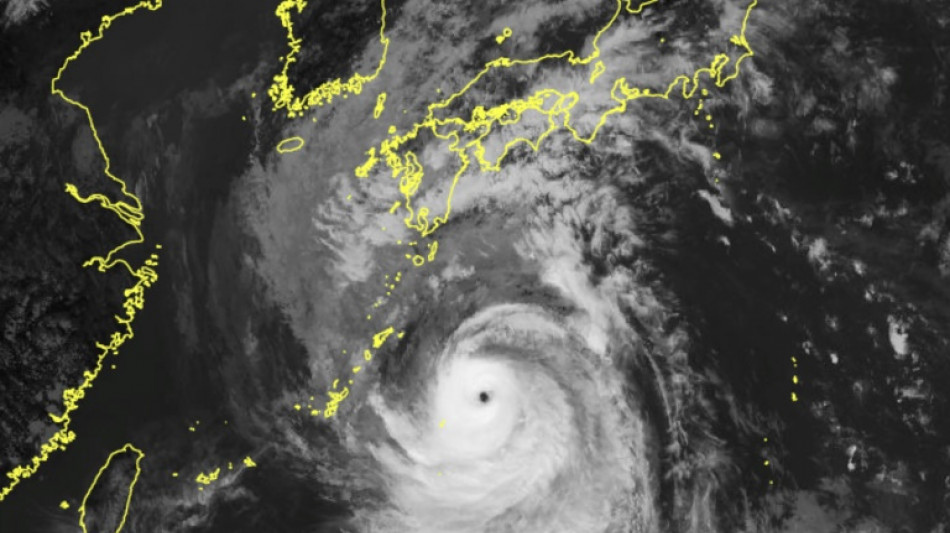
Japan braces for 'very dangerous' Typhoon Nanmadol / Photo: Handout - Japan Meteorological Agency/AFP

 Lights out in Laos as electricity exports surge

 Steven Strogatz weighs AI mathematics advances and their consequences for researchers

 Anthropic boss calls for AI slowdown, Altman and Musk agree

 French IT giant Capgemini sells subsidiary after row over ICE links

 Quebec Brokerage Qubit Insurance Announces New Data on Coverage Shortfalls as Rebuilding Costs Rise

 Lady Gaga welcomes first child with fiance: US media

 Bhutan business bets on hazelnuts for farming future

 'Widow's Bay' and 'The Pitt' are favorites for Emmys night

 Coastal erosion forces cancellation of California music festival

 Argentina's Dirty War rears its head in Venice film

 UK lawmakers throw out bill to legalise assisted dying

 US inflation steady in August, fueling Fed rate hike expectations

 New York marks 25th anniversary of 9/11 attacks

 Nepal flood reconstruction bill to be $4.78 bn: foreign ministry

 JUMO and Standard Bank launch Social Finance Framework to scale inclusive finance in Africa

 Doomsday tech: could AI really kill us all?

 French comedy show 'Call my agent' makes film comeback

 It's all coming back: Celine Dion fans gear up for Paris return

 Researchers eye AI revolution in natural disaster forecasts

 US braces for inflation report that may push Fed to hike rates

 Musk threatens legal action over documentary

 Latin America fact-check group asks Meta not to replace verification practice

 AI Risks to Enter 60–80% of Liability and Cyber Insurance Underwriting by 2028, ScienceSoft Predicts

 Tribal Launches Campfire, Letting Business and Technical Teams Build on Salesforce Together

 Stocks fall as fresh oil surge fans inflation fears

Japan's weather agency on Saturday warned of a "very dangerous" typhoon heading towards the country's southern Kyushu island, urging residents to evacuate before powerful wind hits the area.
Typhoon Nanmadol was carrying gusts up to 270 kilometres on Saturday near the remote Minami Daito island, 400 kilometres (250 miles) east of Okinawa island, the weather agency said.
The storm is expected to approach or make landfall on Sunday in the southern Kagoshima prefecture in Kyushu, then move north the following day before heading towards the main Japanese island.
"There are risks of unprecedented storms, high waves, storm surges, and record rainfall," Ryuta Kurora, the head of the Japan Meteorological Agency's forecast unit, told reporters.
"Maximum caution is required," he said, urging residents to evacuate early.
"It's a very dangerous typhoon."
Kurora said the weather agency was likely to issue the highest alert for Kagoshima later in the evening.
"The wind will be so fierce that some houses might collapse," he said, also warning of flooding and landslides.
Japan is currently in typhoon season and is hit by around 20 such storms a year, routinely seeing heavy rains that cause landslides or flash floods.
Scientists say climate change is increasing the severity of storms and causing extreme weather such as heat waves, droughts and flash floods to become more frequent and intense.
P.Gonzales--CPN