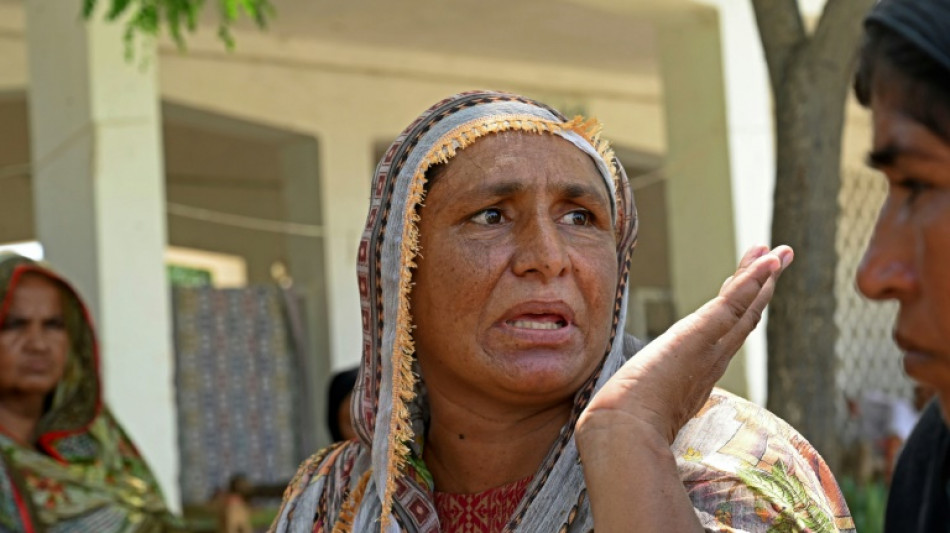
Shame, misery as Pakistan floods leave many without toilets / Photo: Arif ALI - AFP

 Lights out in Laos as electricity exports surge

 Steven Strogatz weighs AI mathematics advances and their consequences for researchers

 Anthropic boss calls for AI slowdown, Altman and Musk agree

 French IT giant Capgemini sells subsidiary after row over ICE links

 Quebec Brokerage Qubit Insurance Announces New Data on Coverage Shortfalls as Rebuilding Costs Rise

 Lady Gaga welcomes first child with fiance: US media

 Bhutan business bets on hazelnuts for farming future

 'Widow's Bay' and 'The Pitt' are favorites for Emmys night

 Coastal erosion forces cancellation of California music festival

 Argentina's Dirty War rears its head in Venice film

 UK lawmakers throw out bill to legalise assisted dying

 US inflation steady in August, fueling Fed rate hike expectations

 New York marks 25th anniversary of 9/11 attacks

 Nepal flood reconstruction bill to be $4.78 bn: foreign ministry

 JUMO and Standard Bank launch Social Finance Framework to scale inclusive finance in Africa

 Doomsday tech: could AI really kill us all?

 French comedy show 'Call my agent' makes film comeback

 It's all coming back: Celine Dion fans gear up for Paris return

 Researchers eye AI revolution in natural disaster forecasts

 US braces for inflation report that may push Fed to hike rates

 Musk threatens legal action over documentary

 Latin America fact-check group asks Meta not to replace verification practice

 AI Risks to Enter 60–80% of Liability and Cyber Insurance Underwriting by 2028, ScienceSoft Predicts

 Tribal Launches Campfire, Letting Business and Technical Teams Build on Salesforce Together

 Stocks fall as fresh oil surge fans inflation fears

The stench of decay hangs over a makeshift camp in Pakistan's south, where hundreds of locals have sought shelter from the devastating monsoon floods that have put nearly a third of the country under water.
In Punjab province, dozens of tents are perched in the area around a small rural railway station -- the only dry land on a horizon of water, reached only by a sliver of road.
The odour is a heady mix of rotting vegetation from drowned crops, leftover food scraps and garbage -- as well as the accumulated excrement of the hundreds of people and livestock gathered there.
"There is no place for showering or going to the bathroom," said Zebunnisa Bibi, forced to flee with her family two weeks ago when floodwater inundated her village.
Similar tent camps have mushroomed across the south and west of the country. The worst flooding in the country's history has covered an area the size of the United Kingdom and affected 33 million people -- one in seven Pakistanis.
A lack of functioning toilets at these camps is one of the biggest issues -- posing a health hazard for all, but misery in particular for women and girls.
Rural Pakistan is home to extremely conservative Muslim communities, and many displaced women are having to live in close proximity to men who aren't relatives for the first time in their lives.
"We used to live behind the veil, but God has removed that for us," said Zebunnisa, referring to the strict segregation between the genders that is practised in rural Pakistan.
- 'Deeply ashamed' -
She said she was "deeply ashamed" at having to relieve herself in the open -- especially after she caught a man watching her as she lowered her shalwar kameez behind a tree.
Shameen Bibi expressed similar sentiments.
"Where can I send my daughters alone? When we squat to relieve ourselves, we get scared that some man might come."
Swarms of flies and mosquitoes add to the misery, creating an environment ripe for a breakout of disease and infection.
Some women have stopped venturing into the floodwater to relieve themselves after many developed rashes.
Ehsan Ayaz, a volunteer doctor who arrived at the campsite in Fazilpur as AFP visited, said the lack of toilets was "the main reason" for the rise in cases of skin infections and stomach flu he treated.
Shameen and her daughters now drink as little water as possible during the day, preferring to spend hours in discomfort rather than be forced to relieve themselves where they can be seen.
When the sun sets and darkness descends on the camp, the women search for a secluded spot away from flickering campfires.
They take turns to keep watch and warn away any encroaching men.
"I don't know what we can even do if someone does decide to come and take advantage of us," said Shameen.
There is also another threat.
At night, said Shameen, "snakes and scorpions come out from the water".
D.Avraham--CPN