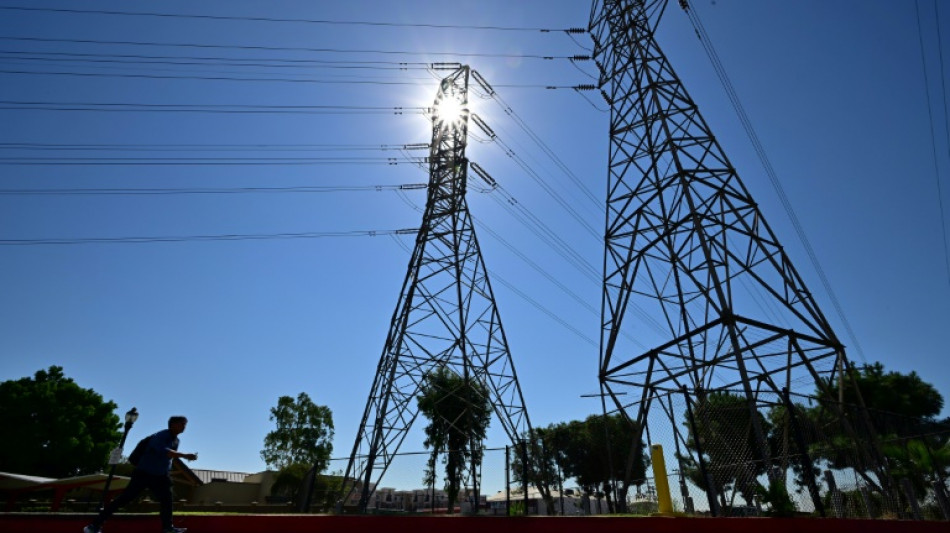
Californians told not to charge EVs as grid struggles in heat wave / Photo: Frederic J. BROWN - AFP

 Lights out in Laos as electricity exports surge

 Steven Strogatz weighs AI mathematics advances and their consequences for researchers

 Anthropic boss calls for AI slowdown, Altman and Musk agree

 French IT giant Capgemini sells subsidiary after row over ICE links

 Quebec Brokerage Qubit Insurance Announces New Data on Coverage Shortfalls as Rebuilding Costs Rise

 Lady Gaga welcomes first child with fiance: US media

 Bhutan business bets on hazelnuts for farming future

 'Widow's Bay' and 'The Pitt' are favorites for Emmys night

 Coastal erosion forces cancellation of California music festival

 Argentina's Dirty War rears its head in Venice film

 UK lawmakers throw out bill to legalise assisted dying

 US inflation steady in August, fueling Fed rate hike expectations

 New York marks 25th anniversary of 9/11 attacks

 Nepal flood reconstruction bill to be $4.78 bn: foreign ministry

 JUMO and Standard Bank launch Social Finance Framework to scale inclusive finance in Africa

 Doomsday tech: could AI really kill us all?

 French comedy show 'Call my agent' makes film comeback

 It's all coming back: Celine Dion fans gear up for Paris return

 Researchers eye AI revolution in natural disaster forecasts

 US braces for inflation report that may push Fed to hike rates

 Musk threatens legal action over documentary

 Latin America fact-check group asks Meta not to replace verification practice

 AI Risks to Enter 60–80% of Liability and Cyber Insurance Underwriting by 2028, ScienceSoft Predicts

 Tribal Launches Campfire, Letting Business and Technical Teams Build on Salesforce Together

 Stocks fall as fresh oil surge fans inflation fears

Californians were told Wednesday not to charge their electric vehicles, just days after the state said it would stop selling gas-powered cars, as the aging electricity grid struggles with a fearsome heatwave.
Temperatures as high as 112 degrees Fahrenheit (44 Celsius) were expected in some Los Angeles suburbs as a huge heat dome bakes a swathe of the western United States.
The sweltering weather is expected to put huge demands on the already-stretched power grid, especially when people crank up the air conditioners during the broiling hours after work and school.
"Consumers are urged to reduce energy use from 4 to 9pm when the system is most stressed because demand for electricity remains high and there is less solar energy available," said the American Public Power Association, a body that represents public utilities.
"The top three conservation actions are to set thermostats to 78 degrees or higher, avoid using large appliances and charging electric vehicles, and turn off unnecessary lights."
California's power companies routinely call for households to limit their usage during the so-called "shoulder hours," when rooftop solar panels stop producing electricity but demand remains high because of still-elevated temperatures.
The call to limit electric vehicle charging comes a week after state regulators banned the sale of new petrol- and diesel-powered vehicles from 2035.
All but a handful of SUVs, cars and light trucks will have to produce zero tailpipe emissions, with only highly efficient plug-in hybrids permitted to burn fossil fuels.
The move was hailed as a game-changer for the EV industry because of the size of California's auto market and the potential it has to set national, and even international, standards.
- 'Dangerously hot' -
Wednesday's call to conserve power was greeted with derision on Twitter, where some said it was proof the state had not thought through its green agenda.
"Perhaps we should figure out how to fix our electric grid before we outlaw gas cars...just a thought," tweeted @AerysGG
"So.........this is what they want. Walking? Hitchin' A Ride?? Moving to a more reasonable state??" tweeted @cinda_scheef
The National Weather Service has issued an "excessive heat warning" for most of California, as well as parts of Arizona and Nevada.
"Dangerously hot conditions expected... until Sunday evening," the NWS said.
"A prolonged period of excessive heat will significantly increase the potential for heat related illnesses, particularly for those working or participating in outdoor activities."
"Those without access to adequate or reliable cooling or hydration will be at most risk, but much of the population could be susceptible to impacts as well," the NWS warned.
Nighttime temperatures are not expected to offer much relief, with lows struggling to get below 80 degrees Fahrenheit in many places.
It is not unusual for southern California to experience heat waves in September, but temperatures above 100 degrees Fahrenheit are considered hot even for a place almost perpetually baked by sunshine.
The heat wave comes after swathes of the southwest were lashed with torrential rains over recent weeks.
Some areas, including the notoriously dusty Death Valley, suffered flooding, and one person died after being swept away in Zion National Park in Utah.
Scientists say global warming, which is being driven chiefly by humanity's use of fossil fuels, is making natural weather variations more extreme.
Heat waves are getting hotter and more intense, while storms are getting wetter and, in many cases, more dangerous.
C.Smith--CPN