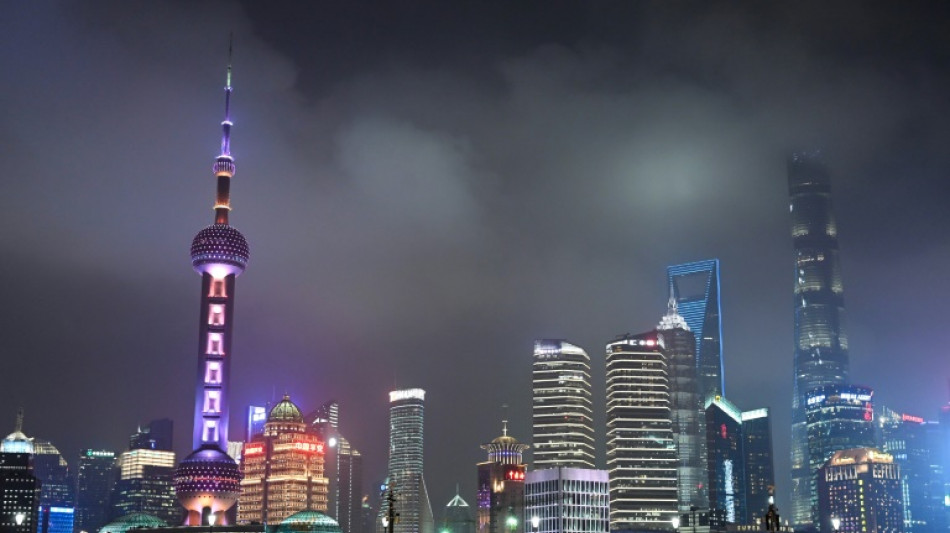
Shanghai's Bund to go dark as China heatwave prompts power cuts / Photo: HECTOR RETAMAL - AFP/File

 Lights out in Laos as electricity exports surge

 Steven Strogatz weighs AI mathematics advances and their consequences for researchers
 Anthropic boss calls for AI slowdown, Altman and Musk agree

 French IT giant Capgemini sells subsidiary after row over ICE links
 Quebec Brokerage Qubit Insurance Announces New Data on Coverage Shortfalls as Rebuilding Costs Rise

 Lady Gaga welcomes first child with fiance: US media

 Bhutan business bets on hazelnuts for farming future

 'Widow's Bay' and 'The Pitt' are favorites for Emmys night

 Coastal erosion forces cancellation of California music festival

 Argentina's Dirty War rears its head in Venice film

 UK lawmakers throw out bill to legalise assisted dying

 US inflation steady in August, fueling Fed rate hike expectations

 New York marks 25th anniversary of 9/11 attacks

 Nepal flood reconstruction bill to be $4.78 bn: foreign ministry

 JUMO and Standard Bank launch Social Finance Framework to scale inclusive finance in Africa

 Doomsday tech: could AI really kill us all?

 French comedy show 'Call my agent' makes film comeback

 It's all coming back: Celine Dion fans gear up for Paris return

 Researchers eye AI revolution in natural disaster forecasts

 US braces for inflation report that may push Fed to hike rates

 Musk threatens legal action over documentary

 Latin America fact-check group asks Meta not to replace verification practice

 AI Risks to Enter 60–80% of Liability and Cyber Insurance Underwriting by 2028, ScienceSoft Predicts

 Tribal Launches Campfire, Letting Business and Technical Teams Build on Salesforce Together

 Stocks fall as fresh oil surge fans inflation fears

Shanghai will switch off decorative lights along its famed Bund riverfront for two days from Monday as a nationwide heatwave sends power demands soaring, city authorities said.
Multiple provinces have announced power cuts to cope with a surge in demand, driven partly by people cranking up the air conditioning to cope with temperatures as high as 45 degrees Celsius (113 degrees Fahrenheit).
China has been hit by extreme weather this summer, including record temperatures, flash floods and droughts -- phenomena that scientists have warned are becoming more frequent and intense due to climate change.
To save power, Shanghai authorities said in a notice Sunday that they would switch off "landscape lighting" at the Bund, the city's most famous landmark.
Ornamental lights, billboards and video screens on both sides of the Huangpu River would be turned off on Monday and Tuesday, according to the notice.
The heat wave has reduced stretches of the Yangtze River, China's most vital inland waterway, to unprecedented drought levels, according to official data.
That has resulted in high pressure on hydroelectric plants that supply power to some of the country's key economic zones.
They include Sichuan, where authorities on Sunday extended industrial power cuts and activated their highest level of emergency response to deal with the heatwave.
"Since July this year, the province faces the most extreme high temperatures, the lowest rainfall in the corresponding period in history... (and) the highest power load in history," local authorities said.
Some of the world's biggest automakers -- including Japanese giant Toyota and Elon Musk's Tesla -- operate factories in Sichuan.
The province is also home to parts manufacturers that are crucial to global auto supply chains.
Many major factories were forced to halt work because of the Sichuan power cuts, which were supposed to end on Saturday but were extended to Thursday, Chinese news outlet Caixin reported.
Analysts have warned that Sichuan's power woes could have ripple effects on the wider Chinese economy and international supply chains.
Hydropower generated in the province supplies domestic consumers and factories, but also industrial powerhouse provinces Jiangsu and Zhejiang.
L.K.Baumgartner--CPN