UK breaks all-time temperature record as heatwave batters Europe / Photo: Philippe LOPEZ - POOL/AFP

 Lights out in Laos as electricity exports surge

 Steven Strogatz weighs AI mathematics advances and their consequences for researchers

 Anthropic boss calls for AI slowdown, Altman and Musk agree

 French IT giant Capgemini sells subsidiary after row over ICE links

 Quebec Brokerage Qubit Insurance Announces New Data on Coverage Shortfalls as Rebuilding Costs Rise

 Lady Gaga welcomes first child with fiance: US media

 Bhutan business bets on hazelnuts for farming future

 'Widow's Bay' and 'The Pitt' are favorites for Emmys night

 Coastal erosion forces cancellation of California music festival

 Argentina's Dirty War rears its head in Venice film

 UK lawmakers throw out bill to legalise assisted dying

 US inflation steady in August, fueling Fed rate hike expectations

 New York marks 25th anniversary of 9/11 attacks

 Nepal flood reconstruction bill to be $4.78 bn: foreign ministry

 JUMO and Standard Bank launch Social Finance Framework to scale inclusive finance in Africa

 Doomsday tech: could AI really kill us all?

 French comedy show 'Call my agent' makes film comeback

 It's all coming back: Celine Dion fans gear up for Paris return

 Researchers eye AI revolution in natural disaster forecasts

 US braces for inflation report that may push Fed to hike rates

 Musk threatens legal action over documentary

 Latin America fact-check group asks Meta not to replace verification practice

 AI Risks to Enter 60–80% of Liability and Cyber Insurance Underwriting by 2028, ScienceSoft Predicts

 Tribal Launches Campfire, Letting Business and Technical Teams Build on Salesforce Together

 Stocks fall as fresh oil surge fans inflation fears

A fierce heatwave left much of western Europe sweltering on Monday, fuelling ferocious wildfires and stretching emergency services, as it pushed north and took temperatures to record levels.
After Britain's warmest night on record, the country's Met Office said 39.1 Celsius (102.4 Fahrenheit) was provisionally recorded in Charlwood, near Gatwick Airport, south of London.
"If confirmed, this will be the highest temperature ever recorded in the UK," the Met Office meteorological agency said.
"Temperatures are likely to rise further through today," it added, with predictions that Britain would breach the 40C mark for the first time.
Experts blame climate change for the latest heatwave and note the more frequent extreme weather will only worsen in years to come.
The high temperatures have triggered an unprecedented red alert for extreme heat in much of England and Wales, where some rail lines were closed as a precaution and schools shuttered in some areas.
"A lot of our infrastructure is just not built for this temperature," Transport Secretary Grant Shapps told Sky News.
In France, various towns and cities in the country's west registered their highest-ever temperatures on Monday, the national weather office said.
- Wildfires -
The western region of Brittany -- normally cool and often wet in summer -- set new record highs above 40C.
As the heatwave moves northeast Tuesday, replaced by cooler air from the Atlantic offering some respite, weather authorities lifted their top red alert level in 15 departments.
But dozens of departments remained on orange alert, with temperatures still expected to top 40C in the east and south and violent thunderstorms forecast locally.
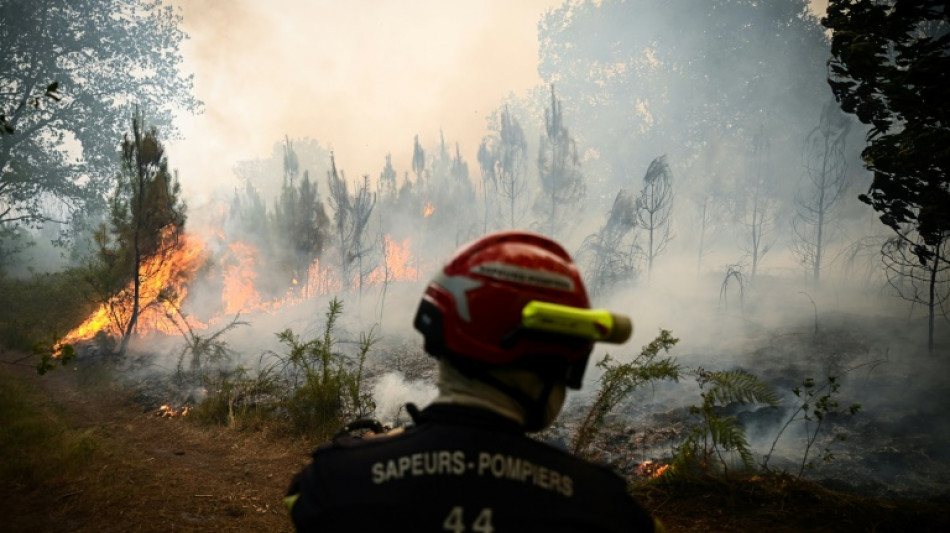
The heatwave -- the second to engulf parts of Europe in recent weeks -- has contributed to deadly wildfires in France, Greece, Portugal and Spain, destroying vast tracts of land.
Firefighters in France's southwest were still struggling to contain two massive fires that have caused widespread destruction and forced tens of thousands of people to leave their homes.
Nearly 1,700 firefighters from all over the country, supported by significant air resources, are battling the two blazes that have so far burned nearly 17,000 hectares (42,000 acres) of forest.
"It's heartbreaking," said Patrick Davet, mayor of La Teste-de-Buch, the site of one inferno which has prompted mass evacuations.
"Economically, it's going to be very difficult for them and very difficult for the town because we are a tourist town, and we need the (tourist) season."
In Brittany, a region not typically impacted by forest fires, hundreds of firefighters, specialised vehicles and waterbombing aircraft were tackling blazes in the Finistere region.
Several smaller fires were reported across the region.
- Deaths -
Prosecutors in the southwest city of Bordeaux said late Monday a man suspected of having started one of the fires had been taken into custody.
In Spain -- nearly 10 days into the latest heatwave -- more than a dozen fires continued to rage Tuesday, including in the northwest province of Zamora, which already experienced a huge fire last month.
Known as one of the largest wolf reserves in Europe, it saw nearly 30,000 hectares of land reduced to ashes during the June blaze.
Nearly 6,000 people had to be evacuated from there this week after flames destroyed several thousand hectares of meadows and forests, regional authorities said.
Train traffic between Madrid and Galicia, in the northwest of the country, remained suspended after fires on either side of the track.
Several people have died in recent days due to the blazes while separately, an office worker in his 50s died from heatstroke in Madrid.
In Portugal, more than 1,400 firefighters were fighting fires in the centre and north of the country, despite a clear drop in temperatures in recent days.
A couple in their 70s died Monday after they ran off the road while trying to escape the flames in their car.
Almost the entire country has been on high alert for wildfires despite a slight drop in temperatures, which last Thursday hit 47C -- a record for July.
The fires have already killed two other people, injured around 60 and destroyed between 12,000 and 15,000 hectares of land there.
- Heat -
Elsewhere, in northwest Europe, temperatures could locally exceed 40C in Belgium near the French border, prompting the Royal Meteorological Institute to issue its highest alert level.
Big state-run museums, primarily in Brussels, took the unusual step of offering free access Tuesday to over-65s to help them stay cool.
In Germany, temperatures were expected to reach up to 40C in the west of the country.
On Monday, two firefighters were injured while beating back a forest fire in a mountainous area in the state of Saxony.
The hot, dry summer so far has raised fears of drought, with the president of the German Farmers' Association warning of "major losses" in food production.
Henning Christ, who grows wheat and other crops in Brandenburg state, told AFP his farm was about 20 percent below its average yield for the year so far.
"We have become used to drought and dry periods to some extent, but this year has been very unusual."
On Monday, European Commission researchers said 46 percent of EU territory was exposed to warning-level drought. Eleven percent was at an alert level, and crops were already suffering from lack of water.
burs-jj/phz/jm
P.Schmidt--CPN