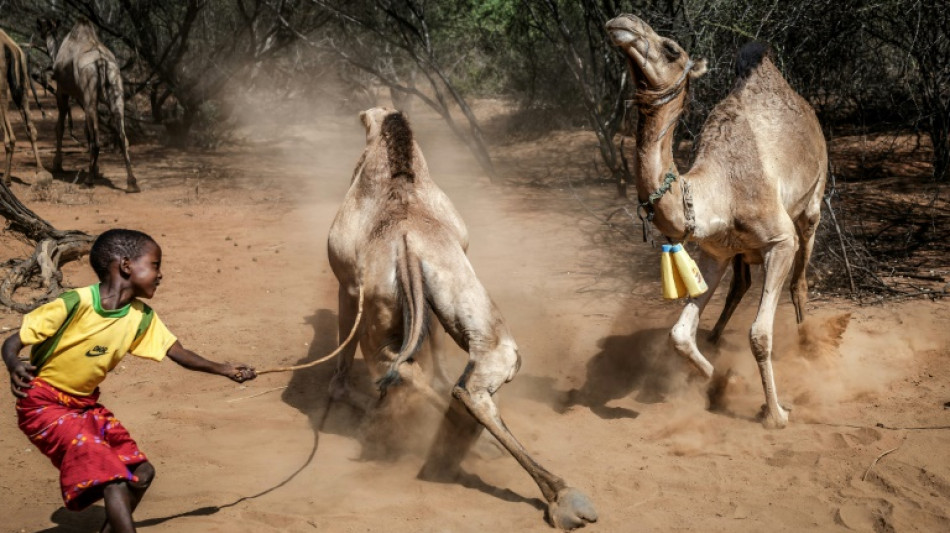
Camels replace cows as Kenya battles drought / Photo: Luis TATO - AFP

 COP31 host says AI's climate footprint to be a summit priority

 EU proposes energy rating for data centres

 TradersYard Shifts Focus to Futures Trading

 Indonesia doing 'everything' but struggling to curb fires

 France's Macron, Canada's Carney announce closer ties

 AI 'warning shots' focus Beijing on national security risks

 Philippine tribe in limbo over US-led tech hub

 Saudi-led coalition says Houthis fired ballistic missile at Riyadh
 Cuba works to restore power after another blackout
 Brigitte Bardot widower slams sale of star's belongings

 Indonesia accepts Malaysia's help to tackle wildfires

 Nvidia, OpenAI CEOs to attend Xi dinner at White House

 Cuba hit with seventh major blackout of the year

 Nigeria miners struggled to breathe in cell before 37 died: survivors

 Warren Buffett steps down as Berkshire Hathaway chairman

 Isolated Syrian-Druze city blames Damascus for shortages

 Kerry James Marshall: American 'blackness' painter celebrated in Europe

 Infantino 'must go', says German FA vice-president

 Japan's busiest rail station tests robot bins

 Backpackers fret over Australian visa crackdown

 Bank of Japan hikes rates to 31-year high to battle inflation

 AI doomsday warnings unlikely to slow IPOs but questions linger

 In Brazil's Amazon, the hunt for oil fuels hopes and fears

 Baby orangutans in India expose 'frightening' scale of trafficking

 Oversight Board blasts 'inadequate' Meta safeguards for AI deepfakes

"God, God, God, protect them," chanted two herders, their eyes following a dozen camels rushing toward acacia trees, oblivious to the dry riverbed in northern Kenya where it hasn't rained since April.
Sitting on the edge of a nearby well, Chapan Lolpusike recounted how his cows and oxen "all died" following the worst drought in four decades, caused by a succession of poor rainfall in 2021 and 2022.
After that, the herder made a sweeping change.
"We no longer have cattle at home. We only raise camels," said Lolpusike, a member of the semi-nomadic Samburu community.
Camels can graze on dry grasses, go more than a week without water, and produce up to six times more milk than cattle -- making them an increasingly necessary option in northern Kenya, an area particularly vulnerable to climate change.
Samburu county officials launched a camel programme in 2015 following several droughts that killed off at least 70 percent of the cattle in Kenya's arid and semi-arid regions.
The die-off had a devastating impact on malnutrition among local pastoralists.
Around 5,000 Somali camels -- a larger and more productive breed than the native herd -- have since been distributed, including 1,000 in the last year.
- Camels for every family -
Lolpusike, who previously knew nothing about camels, received some in 2023.
In his manyatta -- a hamlet of rectangular huts nestled in a shrubby savannah -- a dozen camels lay peacefully chewing dry grass.
The goal is for every family in the county to have their own, said village administrator James Lolpusike (no relation).
"If the drought persists, the cattle will not be anywhere anymore," he said.
Camel herds are at high risk of disease that could lead to losses.
But there are clear, positive changes as they become a regular sight in the region, including healthier children, said the village administrator.
They are certainly popular in the community, for the fact they can be milked up to five times a day.
"Cows are only milked when the grass is green," said Naimalu Lentaka, 40.
"Camels... during the dry season, they are still milked, and that's the whole difference."
Families now "depend on camels, on those who own them," she added.
- Racing stars -
Camel milk and human breast milk have similar nutritional and therapeutic properties, according to a 2022 study by Meru University in Kenya.
Camel milk contributes up to half the total nutrient intake during droughts among pastoral communities in the north.
The animal is already a star in the region, thanks to a famous endurance race.
At the Maralal International Camel Derby in late September, around 40 camels frolicked before a cheering crowd.
The winner covered 21 kilometres (13 miles), the equivalent of a half-marathon, in one hour and 22 minutes.
But organisers said the event -- whose theme was "peaceful cultural interactions" -- was primarily about bringing together communities that used to fight over resources, since, among their many virtues, camels are also a symbol of peace.
Moving cattle herds to more fertile areas during the dry season can spark conflict between herders that have claimed hundreds of lives over the years.
Camels are happy to stay where they are.
Even this hardy animal needs some water, however, so locals still pray for rain.
"We only pray the situation doesn't get worse," said James Lolpusike.
M.Mendoza--CPN